Reflection Conditions and Systematic Absences in Crystallography: A Practical Guide
1. What are reflection conditions?
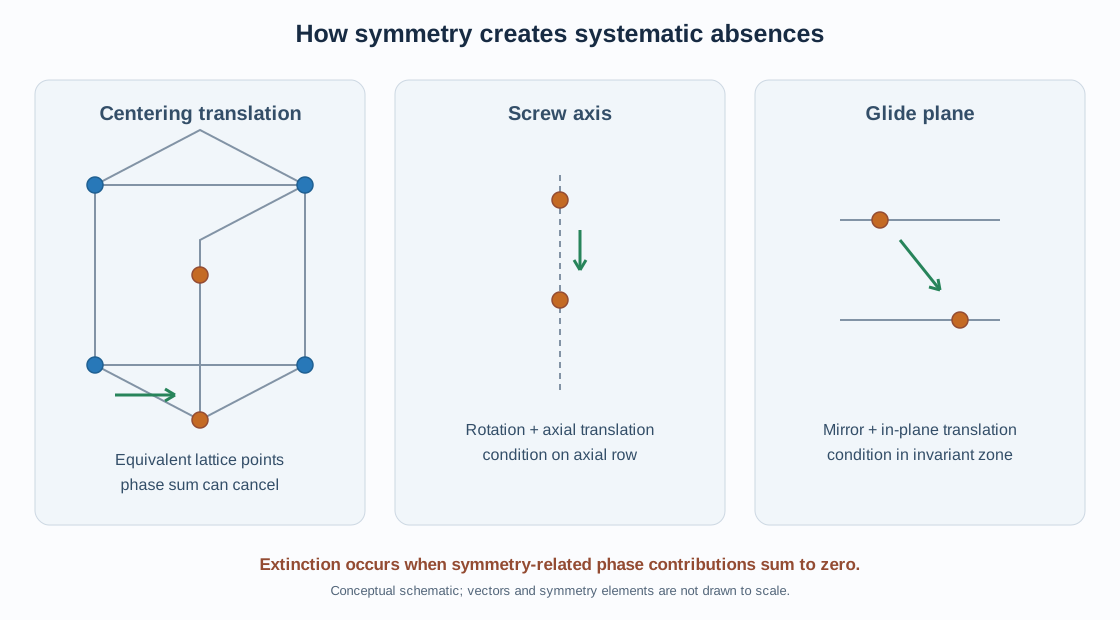
A crystal structure produces diffraction only when the scattering contributions from its periodic electron density satisfy the diffraction condition. Even when a reciprocal-lattice position is geometrically defined, its structure factor can be exactly zero because symmetry-related contributions cancel.
A systematic absence (also called a systematic extinction) is a symmetry-enforced absence of a reflection. The associated reflection condition states which Miller indices are allowed for a particular lattice or space group.
Reflection conditions are important because they provide experimental constraints on crystal symmetry. They can help distinguish primitive and centred lattices, identify possible screw axes or glide planes, and narrow down candidate space groups.
However, absence conditions do not usually determine a unique space group by themselves. They must be interpreted together with diffraction intensities, unit-cell metrics, chemistry, and structural refinement.
2. The structure-factor origin of an extinction
For atoms at fractional coordinates ((x_j,y_j,z_j)), the structure factor is
\[ F_{hkl}=\sum_j f_j \exp[2\pi i(hx_j+ky_j+lz_j)]. \]
The kinematic intensity is proportional to
\[ I_{hkl}\propto |F_{hkl}|^2. \]
A symmetry operation maps atoms to equivalent positions. If the phase contributions from these positions cancel for a particular index condition, then
\[ F_{hkl}=0. \]
This is fundamentally different from a weak reflection. A weak reflection has a small but non-zero structure factor or is reduced by experimental factors; a systematic absence is an exact cancellation required by the ideal symmetry model.
3. Lattice centering conditions
The translational symmetry of the conventional unit cell produces characteristic reflection conditions. They can be derived by summing the phase factors associated with the centering translations.
Primitive lattice (P)
A primitive cell has only the lattice point at the origin as its centering position. There is no additional centering extinction condition:
\[ P:\quad hkl\ \text{are not restricted by centering.} \]
Other space-group operations or the atomic basis may still cause absences.
Body-centred lattice (I)
The additional centering translation is
\[ \mathbf{t}=\left(\frac12,\frac12,\frac12\right). \]
The centering contribution is
\[ 1+\exp[\pi i(h+k+l)] =1+(-1)^{h+k+l}. \]
Therefore,
\[ \boxed{h+k+l=2n.} \]
Only reflections for which the sum is even satisfy the I-centering condition.
Face-centred lattice (F)
The centering translations are
\[ (0,0,0),\quad \left(0,\frac12,\frac12\right),\quad \left(\frac12,0,\frac12\right),\quad \left(\frac12,\frac12,0\right). \]
The centering factor is
\[ 1+(-1)^{k+l}+(-1)^{h+l}+(-1)^{h+k}. \]
It is non-zero when (h,k,l) are all even or all odd. Thus,
\[ \boxed{h,k,l\ \text{all even or all odd}.} \]
A-, B-, and C-centred lattices
The conditions depend on the centering translation:
| Lattice | Additional translation | Reflection condition |
|---|---|---|
| A | ((0,,)) | (k+l=2n) |
| B | ((,0,)) | (h+l=2n) |
| C | ((,,0)) | (h+k=2n) |
The letters identify the face on which the additional lattice points lie. Always confirm the unit-cell setting before applying a condition.
Rhombohedral lattice (R)
For an R-centred lattice expressed in the conventional hexagonal axes, the commonly used obverse setting has the condition
\[ \boxed{-h+k+l=3n.} \]
The exact index expression depends on the chosen rhombohedral setting (obverse or reverse) and axis convention. Do not transfer an R-centering condition between settings without transforming the indices.
4. Screw axes: rotation plus translation
A screw axis combines a rotation with a translation parallel to the rotation axis. The translational part creates phase differences and can produce absences along particular reciprocal-lattice rows.
For an (n_p) screw axis parallel to the crystallographic (c) direction, the operation rotates by (360^/n) and translates by (p/n) of (c). For the axial reflections (00l), the rotational part leaves the reflection direction unchanged. The relevant phase sum gives the condition
\[ \exp\left(2\pi i\frac{lp}{n}\right)=1, \]
or equivalently
\[ \boxed{lp=0\pmod n.} \]
Examples for an axis parallel to (c):
| Screw axis | Axial condition for (00l) |
|---|---|
| (2_1) | (l=2n) |
| (3_1), (3_2) | (l=3n) |
| (4_1), (4_3) | (l=4n) |
| (4_2) | (l=2n) |
| (6_1), (6_5) | (l=6n) |
| (6_2), (6_4) | (l=3n) |
| (6_3) | (l=2n) |
Here (n) on the right-hand side is an integer, not the screw-axis order. These are axial conditions for the specified axis direction; they are not general conditions for every reflection in the space group.
For a screw axis parallel to (b), the corresponding axial row is (0k0). For an axis parallel to (a), it is (h00).
5. Glide planes: reflection plus translation
A glide plane combines a mirror reflection with a translation parallel to the plane. The translational component creates phase differences for reflections in particular zones.
Common glide translations include:
- a-glide: translation by ();
- b-glide: translation by ();
- c-glide: translation by ();
- n-glide: translation by half of a face diagonal, such as ((,,0));
- d-glide: a quarter-diagonal translation, with the exact vector depending on the plane and setting;
- e-glide: a double glide with two distinct glide translations, as specified by the space-group symmetry.
The glide reflection leaves certain reciprocal-space zones invariant. Within such a zone, the pair of symmetry-related contributions includes a translation phase. For a translation (=(t_x,t_y,t_z)), the phase is
\[ \exp[2\pi i(ht_x+kt_y+lt_z)]. \]
For a simple pair of contributions, cancellation occurs when this phase is (-1). The corresponding condition is therefore
\[ ht_x+kt_y+lt_z=\frac12\pmod 1, \]
for the reflections in the invariant zone under consideration.
Examples:
- A c-glide plane perpendicular to (b) gives the zone condition (h0l: l=2n).
- An a-glide plane perpendicular to (c) gives the zone condition (hk0: h=2n).
- An n-glide plane perpendicular to (c), with translation ((,,0)), gives (hk0: h+k=2n).
These examples specify both the plane orientation and the relevant reciprocal-space zone. The glide symbol alone should not be applied as a condition to all reflections.
6. General method for deriving a reflection condition
A reliable derivation follows the symmetry operation rather than relying on memorized rules.
- Write the symmetry operation in fractional coordinates: [ ’=W+, ] where (W) is the rotational or reflection part and () is the fractional translation.
- Identify the reciprocal-space indices that remain invariant under the rotational part. These define the relevant row, zone, or set of reflections.
- Calculate the phase contribution from the translational part: [ . ]
- Combine the contributions from all symmetry-related positions.
- Set the symmetry sum to zero and solve for the integer conditions on (h,k,l).
For a general space group, multiple operations may impose independent conditions. The complete reflection conditions are the intersection of all applicable restrictions.
7. Worked example: P2₁/c in the unique-b setting
The monoclinic space group (P2_1/c) (No. 14) in the conventional unique-axis-b setting is a useful example. Its characteristic conditions include:
- The (2_1) screw axis parallel to (b) gives: [ 0k0:k=2n. ]
- The c-glide plane perpendicular to (b) gives: [ h0l:l=2n. ]
The first condition applies to the (0k0) row, and the second applies to the (h0l) zone. They should not be confused with a blanket requirement that all (k) or all (l) indices be even.
A practical check is to examine the two subsets independently in the measured diffraction data. A proposed space group should account for the absence pattern without requiring arbitrary removal of observed peaks.
8. Reflection conditions are not intensity predictions
A reflection condition tells us whether a reflection is allowed by a particular symmetry constraint. It does not predict how strong an allowed reflection will be.
The intensity also depends on
\[ I_{hkl}\propto |F_{hkl}|^2, \]
as well as multiplicity, Lorentz-polarization terms, absorption, preferred orientation, and other experimental factors.
An allowed reflection may be extremely weak because of the atomic arrangement. Conversely, a forbidden reflection may show apparent weak intensity in real measurements because of multiple diffraction, defects, symmetry lowering, contamination, or instrumental/background effects. Such observations require careful investigation.
9. Using systematic absences to constrain a space group
A practical workflow for powder or single-crystal diffraction is:
- Determine the lattice metric. Index the pattern and establish plausible unit-cell dimensions and symmetry.
- Identify the centering type. Test P, I, F, A, B, C, or R conditions using the correct setting.
- Inspect axial rows. Check (h00), (0k0), and (00l) for possible screw-axis conditions.
- Inspect reciprocal zones. Check (hk0), (h0l), and (0kl) for possible glide-plane conditions.
- Generate candidate space groups. Use the full observed absence pattern, not one missing reflection.
- Compare intensities and chemistry. Assess whether candidate structural models are plausible.
- Refine and validate. Check residuals, difference maps, occupancies, displacement parameters, and whether the symmetry is supported by the data.
In powder diffraction, overlapping peaks and limited sensitivity can make individual reflection conditions difficult to establish. Single-crystal diffraction often provides more direct access to zone-specific absences, although data completeness and multiple diffraction still matter.
10. Tools and crystallographic references
International Tables for Crystallography
The definitive source for space-group reflection conditions is International Tables for Crystallography, Volume A. It lists symmetry operations, settings, and reflection conditions for the 230 space groups. Use it when a specific space-group condition must be reported rigorously.
Bilbao Crystallographic Server
The Bilbao Crystallographic Server provides tools for exploring space-group symmetry, systematic absences, and group-subgroup relationships. Confirm the selected setting and origin choice before comparing calculated conditions with experimental indices.
GSAS-II
In GSAS-II, the selected phase space group determines the allowed reflection list and structural calculation. Compare the calculated reflection positions with the measured pattern, but remember that an absent calculated reflection and a weak calculated intensity are different issues.
VESTA
VESTA can display symmetry-generated structures and help inspect glide planes, screw axes, and unit-cell settings. A structural visualization is useful for understanding the operation, but the reflection condition should be verified from the space-group symmetry or a crystallographic reference.
11. Common mistakes
- Applying an I-centering condition to a primitive cell or to indices in a different setting.
- Using the hexagonal-axis R condition for rhombohedral axes without transforming the indices.
- Applying a screw-axis condition to all ((hkl)) instead of the relevant axial row.
- Applying a glide-plane condition outside the reciprocal-space zone left invariant by the reflection part.
- Treating every weak or unobserved peak as a systematic absence.
- Assuming that one extinction uniquely identifies a space group.
- Confusing allowed reflections with strong reflections.
- Ignoring setting and origin conventions when comparing databases and refinement software.
12. Key points
Systematic absences arise when symmetry-related scattering contributions cancel exactly. Lattice centering imposes general parity or congruence conditions; screw axes produce characteristic conditions along axial rows; glide planes produce conditions in specific reciprocal-space zones. Correct use of these rules requires the space-group setting and the orientation of each symmetry element to be known. Absence data constrain the possible space groups, but a reliable assignment requires the complete diffraction evidence and structural validation.
Further reading
- The Crystal Structure Factor: Atomic Scattering, Diffraction Intensities, and Systematic Absences
- Understanding Crystallographic Space Groups
- Inversion, Mirror, Glide, and Screw Symmetry
- Fractional Coordinates and Symmetry-Equivalent Atomic Positions
- The Reciprocal Lattice: Reciprocal Vectors, Crystal Planes, and X-ray Diffraction
- Bragg Reflections and Crystal Planes
References
- International Union of Crystallography, International Tables for Crystallography, Volume A: Space-Group Symmetry.
- A. J. C. Wilson, ed., International Tables for Crystallography, Volume C: Mathematical, Physical and Chemical Tables.
- B. D. Cullity and S. R. Stock, Elements of X-Ray Diffraction, 3rd ed., Prentice Hall, 2001.
- Bilbao Crystallographic Server, crystallographic symmetry and reflection-condition tools.