Thermoelectric Materials
Thermoelectric materials.
Thermoelectric materials convert a temperature gradient directly into electrical voltage. Their performance depends on a delicate balance between electronic transport and heat conduction.
Three properties. One coupled system.
The Seebeck coefficient, electrical conductivity and thermal conductivity should be interpreted together. A large thermopower is not sufficient if conductivity is too low; reducing thermal conductivity is useful only when electrical transport is preserved.
The central performance metric is the dimensionless figure of merit, ZT. Its interpretation requires careful measurement, consistent units and attention to the temperature dependence of each transport parameter.
Read the transport explainer ↗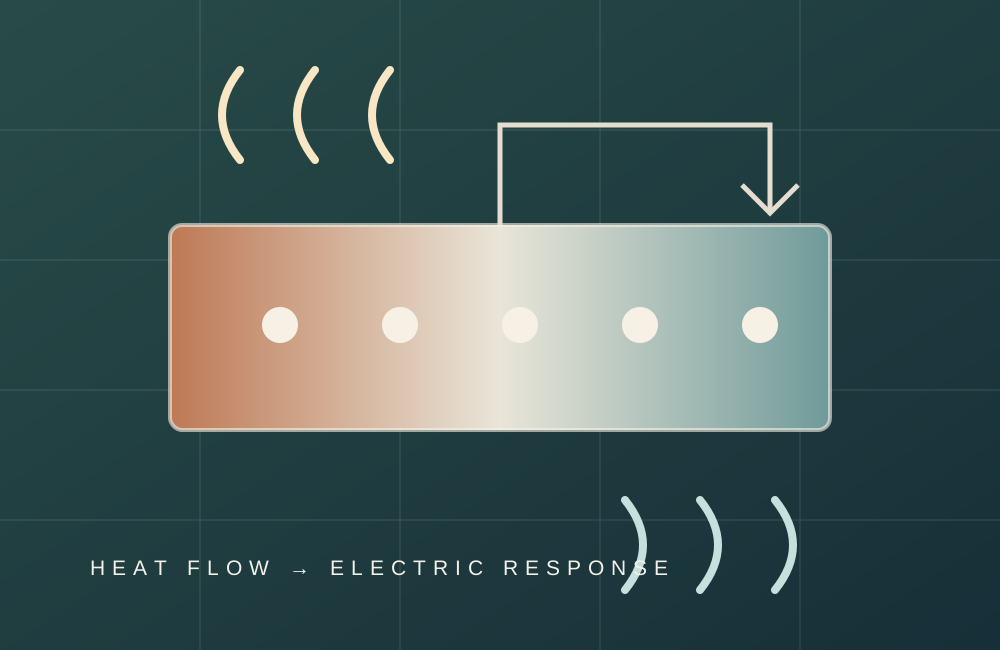
Why oxide thermoelectrics?
Oxide systems provide opportunities to explore chemical flexibility and high-temperature stability, while presenting important challenges in carrier mobility and lattice heat transport.
Transport measurements and interpretation
Temperature-dependent Seebeck coefficient, electrical conductivity and thermal conductivity are interpreted alongside structural characterization and carefully documented measurement conditions.
View measurement methods ↗Separate carrier effects from lattice effects.
Thermoelectric optimization is a coupled transport problem. Composition-dependent changes should be interpreted through the electronic and thermal terms that enter the figure of merit.
Magnéli-phase tungsten oxide
Published work includes W₁₈O₄₉ modified by vanadium substitution, with related proceedings on Cu- and Co-modified compositions.
Composition–transport relationships
How does substitution influence carrier concentration, electrical transport, thermopower and heat conduction? Which trends are consistent with structural evidence?
Structure and transport
Solid-state preparation and processing, powder X-ray diffraction, structural analysis, and temperature-dependent thermoelectric measurements.
Evidence-led optimization
Compare power factor and ZT with the underlying Seebeck, electrical conductivity and thermal conductivity data; report measurement range and uncertainty where available.