Hydrogen & Proton-Conducting Oxides
Hydrogen & proton-conducting oxides.
Ceramic oxides are promising materials for electrochemical hydrogen technologies. Their performance depends on defect chemistry, hydration, phase stability and the balance between ionic and electronic transport.
Transport through a ceramic is a materials problem.
Proton-conducting and mixed-conducting oxides can be considered for hydrogen pumping, separation and electrochemical energy conversion. Composition and atmosphere determine which defects form and which charge carriers dominate.
Understanding performance therefore requires controlled gas conditions, reliable electrical measurements and a clear separation of bulk, grain-boundary, electrode and interfacial contributions.
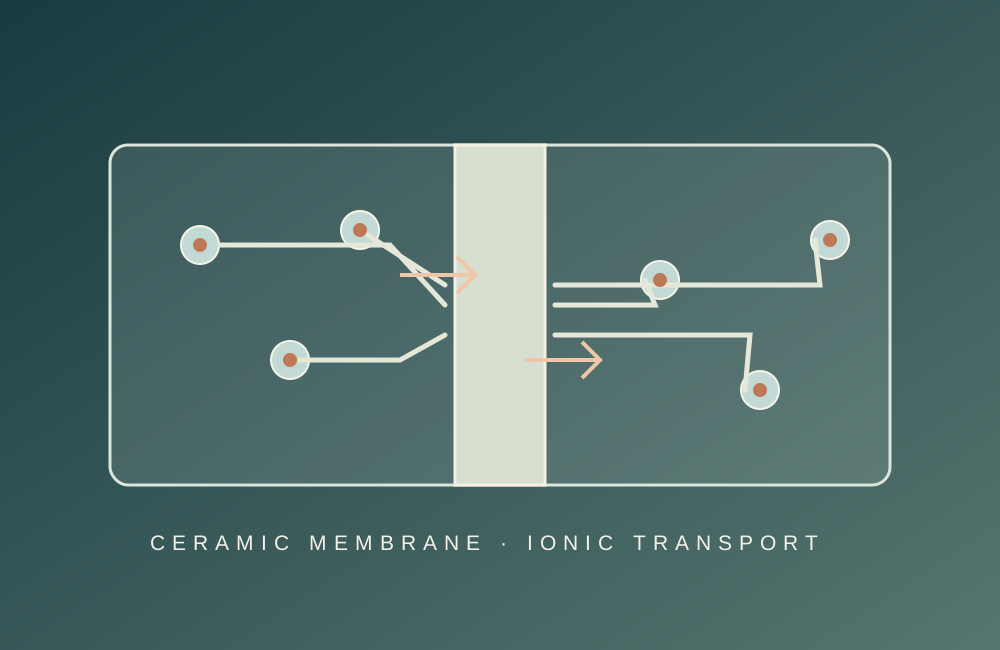
From composition to device response.
The research challenge is to connect defect populations and microstructure with measurable transport and stable electrochemical operation.
Electrochemical characterization
Impedance spectroscopy, controlled-atmosphere conductivity measurements and hydrogen-pumping or cell testing provide complementary views of transport behaviour.
Browse characterization methods ↗Identify the rate-limiting transport process.
Hydrogen-related ceramic research requires separating protonic, oxide-ion and electronic contributions while accounting for grain boundaries, electrodes and gas–solid interfaces.
Defect chemistry and hydration
Evaluate how acceptor/donor substitution, oxygen vacancies and hydration equilibria may influence mobile proton populations and phase stability.
Ionic and electronic contributions
Distinguish total conductivity from carrier-specific transport and consider how oxygen partial pressure, water vapour and temperature affect the response.
Impedance and controlled-atmosphere testing
Use impedance spectra, equivalent-circuit reasoning and controlled gas conditions to assess bulk, grain-boundary and electrode-related contributions.
Hydrogen pumping and electrochemical cells
Relate material conductivity and stability to cell-level current, voltage, Faradaic efficiency and operating conditions where these are measured.