Photocatalytic Materials
Photocatalytic materials.
Semiconductor photocatalysts use absorbed light to generate charge carriers that can drive surface redox reactions. Material composition, band alignment, interfaces and surface chemistry all influence the reaction pathway.
Photocatalysis is an interfacial process.
Optical absorption is only one part of photocatalytic performance. Photogenerated electrons and holes must be separated, transported and delivered to surface reaction sites before recombination occurs.
Understanding the mechanism requires linking optical response and band energetics with surface chemistry, reactive-species evidence and well-controlled reaction conditions.
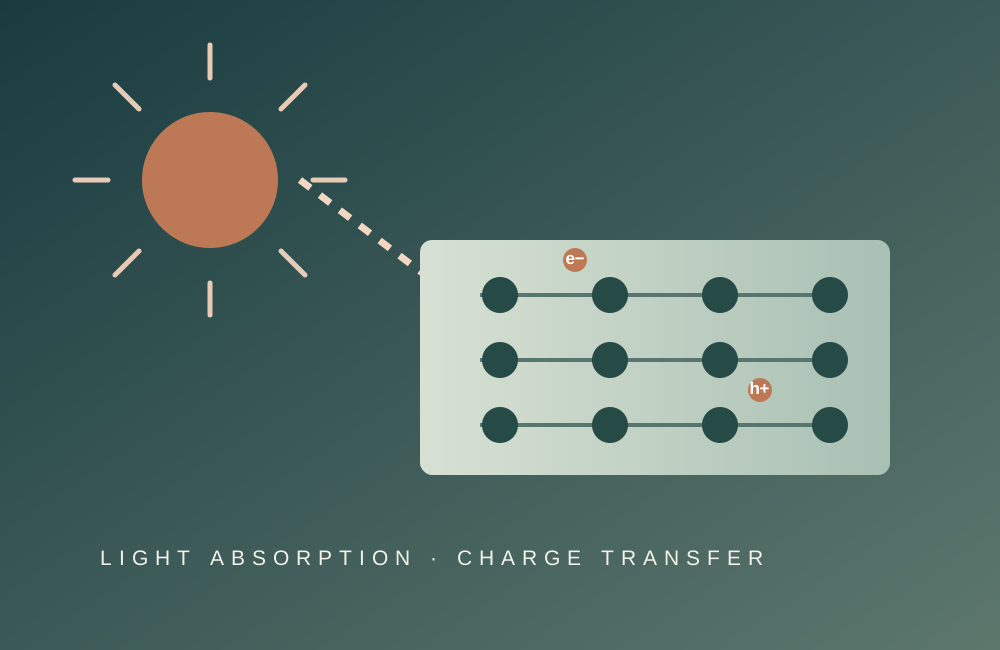
What happens after light absorption?
A convincing photocatalytic mechanism should be supported by multiple independent measurements and controls.
Optical and surface characterization
UV–Vis diffuse reflectance, spectroscopy, microscopy and carefully controlled photocatalytic tests are combined to evaluate structure–activity relationships.
Browse characterization methods ↗Build a mechanism from independent evidence.
A credible photocatalytic interpretation should connect optical excitation, charge separation, surface reaction pathways and product quantification. A band diagram alone is not proof of a reaction mechanism.
Semiconductor composition and interfaces
Assess how composition, particle size and heterointerfaces may alter optical response and interfacial charge transfer.
Absorption and band energetics
Use UV–Vis diffuse reflectance and clearly stated assumptions when estimating optical gaps or discussing band-edge positions.
Controls and quantification
Document irradiation wavelength and intensity, catalyst loading, solution volume, reaction time, aeration and analytical calibration.
Reactive species and charge transfer
Combine appropriate scavenger, atmosphere and control experiments with spectroscopy or other independent evidence before assigning a dominant pathway.