Fractional Coordinates and Symmetry-Equivalent Atomic Positions
1. Why fractional coordinates are used
Crystal structures are periodic. Instead of describing every atom in an extended solid using Cartesian distances, crystallography usually specifies atomic positions relative to the unit-cell vectors. These are fractional coordinates.
A fractional coordinate such as ((0.25, 0.50, 0.75)) means that the atom is located one-quarter of the way along the first cell vector, halfway along the second, and three-quarters along the third, measured from the chosen origin.
Fractional coordinates are especially useful because they:
- describe positions independently of the unit-cell dimensions;
- make lattice translations straightforward;
- allow symmetry operations to be written as compact algebraic transformations;
- provide the standard coordinate representation used in CIF files and most crystallographic software.
2. Fractional and Cartesian coordinates
Let the unit-cell basis vectors be (), (), and (). A position with fractional coordinates ((x,y,z)) has Cartesian position
\[ \mathbf{r}=x\mathbf{a}+y\mathbf{b}+z\mathbf{c}. \]
In matrix form,
\[ \mathbf{r}=A\mathbf{x}, \qquad A= \begin{bmatrix} a_x & b_x & c_x\\ a_y & b_y & c_y\\ a_z & b_z & c_z \end{bmatrix}, \qquad \mathbf{x}= \begin{bmatrix}x\\y\\z\end{bmatrix}. \]
The inverse transformation is
\[ \mathbf{x}=A^{-1}\mathbf{r}. \]
For an orthogonal cell with lengths (a,b,c), the Cartesian components are simply ((ax,by,cz)). For a non-orthogonal cell, the basis vectors are not mutually perpendicular, so multiplying each fractional coordinate by a cell length alone is insufficient.
Example. In a cubic cell with (a=4.00) Å, the fractional position ((1/4,1/2,3/4)) corresponds to ((1.00,2.00,3.00)) Å relative to the origin.
3. Periodicity and coordinates outside the unit cell
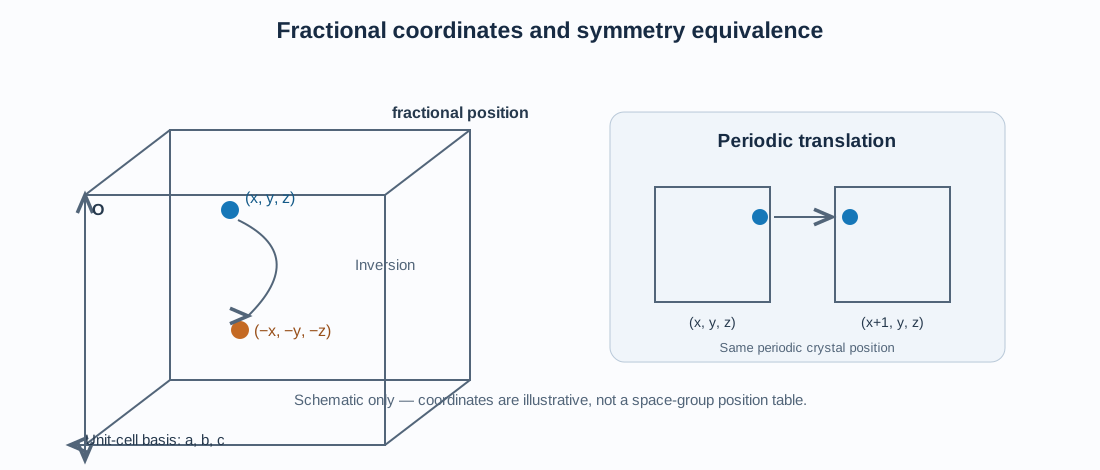
A crystal is invariant under integer lattice translations. Therefore,
\[ (x,y,z)\equiv(x+n_1,y+n_2,z+n_3), \]
where (n_1,n_2,n_3) are integers.
For example, ((1.20,-0.10,0.50)) and ((0.20,0.90,0.50)) represent the same periodic position. A common way to wrap a coordinate into the interval ([0,1)) is
\[ x_{\mathrm{wrapped}}=x-\lfloor x\rfloor, \]
with the same operation applied to (y) and (z).
Wrapping is a representation choice, not a physical displacement. Coordinates equal to 1 are equivalent to 0 along that direction. Numerical programs may use different boundary conventions, so compare positions modulo integer translations rather than by literal coordinate equality.
4. Symmetry operations in fractional coordinates
A space-group operation acts on a fractional coordinate vector as
\[ \mathbf{x}'=R\mathbf{x}+\mathbf{t}, \]
where (R) is a crystallographic rotation or roto-inversion matrix and () is a fractional translation. The transformed coordinate is then interpreted modulo lattice translations.
For a general position, applying all operations of the space group generates the full set of symmetry-equivalent positions. Some operations may generate the same point, particularly when the starting atom lies on a special Wyckoff position.
The symmetry operations are expressed in the coordinate basis and setting of the specified space group. Do not apply an operation list from a different setting or origin choice without transforming it consistently.
5. A simple worked example: inversion symmetry
Consider an inversion operation about the origin:
\[ \begin{bmatrix}x'\\y'\\z'\end{bmatrix} = \begin{bmatrix}-1&0&0\\0&-1&0\\0&0&-1\end{bmatrix} \begin{bmatrix}x\\y\\z\end{bmatrix}. \]
Thus,
\[ (x,y,z)\rightarrow(-x,-y,-z). \]
For an atom at ((0.20,0.30,0.40)), inversion gives ((-0.20,-0.30,-0.40)). Wrapping into ([0,1)) gives the equivalent representative
\[ (0.80,0.70,0.60). \]
The two positions form an inversion-related pair. If the atom were located exactly at an inversion centre, its transformed coordinate would be equivalent to the original position and would not create a second distinct site.
6. Example: generating positions in cubic Pm-3m
The primitive cubic space group (Pm{3}m) (No. 221) contains 48 symmetry operations. A generic point with coordinates ((x,y,z)), where the coordinates do not satisfy special symmetry constraints, generates 48 distinct positions in the conventional primitive cell.
By contrast, the ideal cubic perovskite (ABO_3) uses special positions:
| Species | Wyckoff position | Representative coordinate | Multiplicity |
|---|---|---|---|
| A | 1a | ((0,0,0)) | 1 |
| B | 1b | ((1/2,1/2,1/2)) | 1 |
| O | 3c | ((0,1/2,1/2)) | 3 |
The symmetry operations leave each site within its corresponding orbit. The three oxygen positions are generated from one representative oxygen coordinate by the space-group symmetry.
This illustrates an important distinction: a CIF may list one representative coordinate for a Wyckoff orbit, while a visualization program displays every symmetry-equivalent atom in the unit cell.
7. Symmetry-equivalent positions are not additional independent atoms
The asymmetric unit is the smallest region or set of independent atomic sites from which the full crystal structure can be generated by symmetry. It is not necessarily a geometrical wedge in the way a simple diagram might suggest; its exact description depends on the space group and chosen representation.
If a CIF lists an atom on a site of multiplicity 4, the full unit cell contains four symmetry-equivalent positions for that atom when its occupancy is one. These are not four independently refined atoms. They are generated from one crystallographic site and its symmetry operations.
For a site with multiplicity (m) and occupancy (g), its average contribution to the unit-cell population is
\[ N_{\mathrm{site}}=mg. \]
For a mixed site, the occupancies of the alternative species must be consistent with the physical occupancy model. Multiplicity and occupancy must not be confused.
8. Coordinate transformations between settings
The same physical crystal structure can be described using different unit-cell bases or origins. A change of basis can be written in a general affine form:
\[ \mathbf{x}_{\mathrm{new}}=P^{-1}(\mathbf{x}_{\mathrm{old}}-\mathbf{p}), \]
where (P) relates the old and new basis vectors and () describes the origin shift, subject to the convention used to define the transformation.
Because crystallographic software and references may use different settings, a coordinate triplet cannot be interpreted safely without its cell, space group, basis, and origin convention. A transformation of coordinates must be accompanied by the corresponding transformation of symmetry-operation matrices and translation vectors.
Common sources of mismatch include:
- comparing standard and non-standard settings of an orthorhombic space group;
- using a different origin choice;
- mixing primitive and conventional cells;
- comparing coordinates before and after a cell transformation.
9. Fractional coordinates in CIF files
The most common atom-site coordinate fields in a CIF are:
_atom_site_fract_x_atom_site_fract_y_atom_site_fract_z
They are normally accompanied by labels, element types, occupancies, and displacement parameters. Unit-cell dimensions and angles are recorded separately, and the space-group information identifies the symmetry framework.
A CIF may provide explicit symmetry-operation loops, a Hermann–Mauguin symbol, a Hall symbol, or a combination of these. Check whether the atom list contains only asymmetric-unit representatives or an already expanded list. Expanding a fully expanded list a second time can duplicate atoms.
10. Practical workflow in VESTA and GSAS-II
VESTA
- Open the CIF and inspect the reported unit cell and space group.
- Check whether the displayed structure is limited to the asymmetric unit or expanded by symmetry.
- Inspect the atom list and fractional coordinates.
- Toggle symmetry-equivalent atoms or unit-cell boundaries to understand how the displayed structure is generated.
- Confirm that periodic boundary atoms are not being mistaken for distinct independent sites.
GSAS-II
- Import the powder diffraction data and the structural CIF or phase model.
- Verify the space-group setting and lattice parameters.
- Inspect the atom-site list and the symmetry constraints on coordinates and displacement parameters.
- Confirm that the atom list represents the intended asymmetric unit.
- Refine only independent parameters allowed by the structural model.
- Check chemical composition, site multiplicities, occupancies, and generated geometry after refinement.
A low profile residual does not by itself validate the coordinate setting or the symmetry assignment. The structural model must also be crystallographically consistent.
11. Common errors and checks
- Treating fractional coordinates as Cartesian distances: multiply by the full cell basis, not just by one cell length in a non-orthogonal cell.
- Ignoring periodicity: compare coordinates modulo integer translations.
- Applying the wrong symmetry operations: confirm the space-group setting and origin.
- Counting generated positions as independent atoms: distinguish asymmetric-unit sites from the expanded unit cell.
- Expanding an already expanded CIF: check the atom list before generating symmetry equivalents.
- Ignoring special-position constraints: coordinates on special sites are not all independent.
- Confusing coordinate wrapping with a symmetry operation: wrapping adds lattice translations; it does not change the physical site.
12. Key points
Fractional coordinates describe atomic positions relative to the unit-cell basis. Space-group operations transform these coordinates to generate symmetry-equivalent sites, and integer translations express the periodicity of the lattice. The asymmetric unit stores independent crystallographic information; the full unit cell is reconstructed using symmetry and translations. Correct interpretation requires the cell, space-group setting, origin, Wyckoff constraints, and occupancy model to be considered together.
Further reading
- Symmetry Elements and Symmetry Operations in Crystals
- Understanding Crystallographic Space Groups
- Inversion, Mirror, Glide, and Screw Symmetry
- Understanding Wyckoff Positions in Crystallography
- Crystal Structures and the Seven Crystal Systems
- Reading and Interpreting XRD Patterns
- Rietveld Refinement with GSAS-II
References
- International Union of Crystallography, International Tables for Crystallography, Volume A: Space-Group Symmetry.
- Hall, S. R., Allen, F. H. and Brown, I. D., The Crystallographic Information File (CIF): a new standard archive file for crystallography, Acta Crystallographica Section A 47 (1991), 655–685.
- Bilbao Crystallographic Server, crystallographic symmetry and coordinate-transformation tools.
- G. M. Sheldrick, SHELXL and crystallographic refinement literature.