Understanding Wyckoff Positions in Crystallography
1. Why Wyckoff positions matter
A crystallographic structure is not defined only by its lattice parameters and chemical formula. It also requires the locations of atoms and the symmetry relationships between them. A space group describes the allowed symmetry operations, while Wyckoff positions provide a compact way to describe the distinct classes of crystallographically equivalent atomic sites.
A Wyckoff position tells you:
- how many symmetry-equivalent sites are generated in the conventional unit cell (multiplicity);
- the letter identifying that position within a particular space group;
- the symmetry that leaves an individual site unchanged (site symmetry);
- the coordinate constraints and free positional parameters.
This notation is essential when reading crystallographic tables, CIF files, structural prototypes, and Rietveld refinement models.
2. From a point to a Wyckoff orbit
A space-group operation transforms a fractional coordinate vector according to
\[ \mathbf{x}' = R\mathbf{x}+\mathbf{t}, \]
where (R) is the rotational part and () is the translational part. Coordinates are understood modulo integer lattice translations when points are compared within a unit cell.
Starting from one point, apply every operation of the space group and collect the distinct resulting positions. This set is the orbit of that point.
Two operations may produce the same position when the starting point lies on a symmetry element. The number of distinct positions is therefore not always equal to the total number of operations in the space group.
A Wyckoff position is an orbit type: all points related by the space-group symmetry and having the same site-symmetry type belong to the corresponding Wyckoff position.
3. How to read a Wyckoff label
A Wyckoff label combines a number and a letter, for example:
\[ \boxed{4c} \]
- 4 is the multiplicity: four equivalent positions occur in the conventional unit cell.
- c is the Wyckoff letter: the position’s identifier in that space group and setting.
The letter has no universal geometric meaning. Position c in one space group is not necessarily equivalent to position c in another. Wyckoff letters are assigned separately for each space group, convention, and setting. In the standard listings, letters are generally assigned in descending order of multiplicity, with the general position receiving the final letter.
A complete Wyckoff description should also include the space-group number or symbol, because a label such as 4c is not meaningful on its own.
4. General and special positions
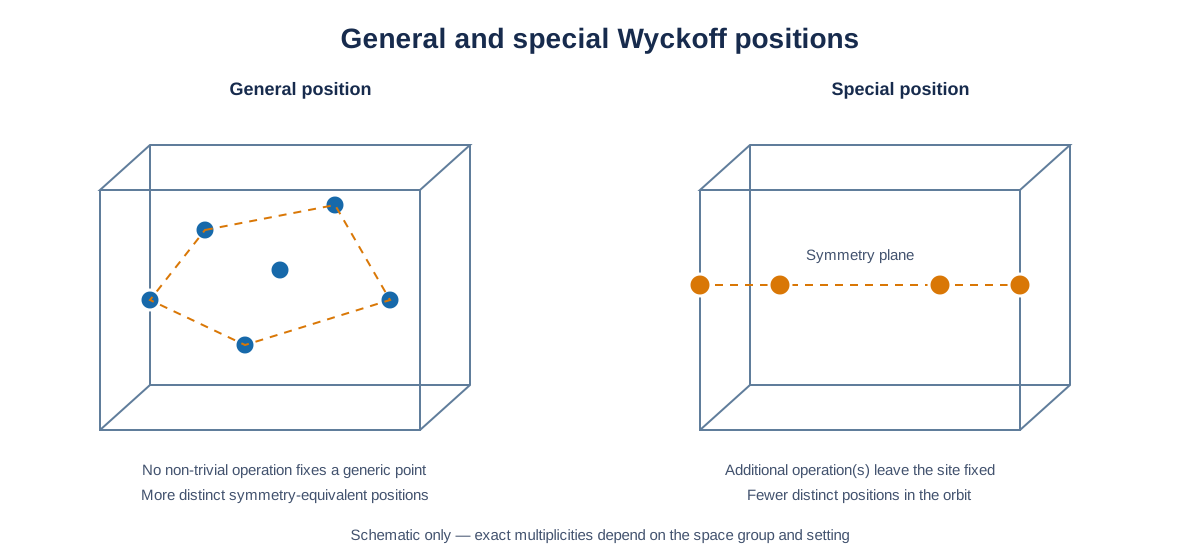
General positions
A general-position point has no site symmetry beyond the identity (site symmetry 1). Its coordinates are unconstrained independent parameters, conventionally written ((x,y,z)) in three dimensions.
For a given space group, the general position has the largest multiplicity. In a primitive lattice, its multiplicity equals the number of symmetry operations in the space group when operations are counted modulo lattice translations.
Special positions
A special-position point lies on a symmetry element or at a location where one or more non-identity operations leave it unchanged. Its site symmetry is higher than that of a general point, its coordinate parameters are constrained, and its multiplicity is lower.
For example, a point constrained to a mirror plane may have one fixed fractional coordinate, such as (y=1/4). The remaining coordinates can still vary.
5. Multiplicity and site symmetry
The site-symmetry group of a point consists of the space-group operations that leave that point fixed, allowing for lattice translations. In a conventional description, the multiplicity is related to the group order and the order of the site-symmetry group:
\[ m = \frac{|G|}{|G_{\mathbf{x}}|}, \]
where (|G|) is the number of symmetry operations in the space-group factor group for the chosen conventional cell, and (|G_{}|) is the number of operations that leave the site invariant. This is the orbit–stabilizer relation.
For a centered conventional cell, the centering translations are part of the conventional-cell operation count. Therefore, do not automatically equate the general multiplicity with the point-group order; account for the lattice centering and the chosen cell.
Site-symmetry symbols use crystallographic notation. For example:
- (1): identity only;
- ({1}): inversion symmetry;
- (m): a mirror plane;
- (2/m): a twofold axis together with a perpendicular mirror (or equivalent inversion-related description).
In orthorhombic and higher-symmetry groups, the position of symbols in the site-symmetry notation refers to the crystallographic directions defined by the chosen setting.
6. Worked example I: cubic (Pm{3}m) (No. 221)
The primitive cubic space group (Pm{3}m) has 48 symmetry operations. Its general position is 48n, with site symmetry 1. Some useful special positions are:
| Wyckoff position | Multiplicity | Representative coordinates | Site symmetry |
|---|---|---|---|
| 1a | 1 | ((0,0,0)) | (m{3}m) |
| 1b | 1 | ((1/2,1/2,1/2)) | (m{3}m) |
| 3c | 3 | ((0,1/2,1/2)) | (4/mmm) |
| 3d | 3 | ((1/2,0,0)) | (4/mmm) |
| 6e | 6 | ((x,0,0)) | (4mm) |
| 48n | 48 | ((x,y,z)) | (1) |
The table illustrates how a high-symmetry point can have multiplicity one, while a generic point generates 48 distinct positions. The 3c position represents the three face-centre coordinate representatives, while the 1a and 1b positions are the cube corner and body-centre sites, respectively.
Application to the ideal cubic perovskite
The ideal cubic perovskite structure (ABO_3), in space group (Pm{3}m), can be described as:
| Species | Wyckoff position | Representative coordinate | Atoms per conventional cell |
|---|---|---|---|
| A | 1a | ((0,0,0)) | 1 |
| B | 1b | ((1/2,1/2,1/2)) | 1 |
| O | 3c | ((0,1/2,1/2)) | 3 |
The multiplicities give (1+1+3=5) atoms per conventional cell, consistent with one formula unit of (ABO_3). This is a useful example of how Wyckoff positions encode stoichiometry as well as symmetry.
7. Worked example II: orthorhombic (Pnma) (No. 62)
The standard setting of (Pnma) is primitive orthorhombic and centrosymmetric. It has eight symmetry operations. Its Wyckoff positions include:
| Wyckoff position | Multiplicity | Representative coordinates | Site symmetry |
|---|---|---|---|
| 4a | 4 | ((0,0,0)) | ({1}) |
| 4b | 4 | ((0,0,1/2)) | ({1}) |
| 4c | 4 | ((x,1/4,z)) | (.m.) |
| 8d | 8 | ((x,y,z)) | (1) |
The general position 8d generates eight distinct positions. The special position 4c has one fixed coordinate, (y=1/4), and lies on a mirror plane perpendicular to the b direction. The 4a and 4b positions are inversion centres.
This example also demonstrates why the coordinate representative matters. A Wyckoff position is not merely a multiplicity: it includes the coordinate constraints and site symmetry.
8. Coordinate constraints, occupancy, and chemical interpretation
When an atom occupies a special position, its coordinates must obey the constraints of that position. Refining all three coordinates independently would violate the imposed site symmetry.
For a site with representative coordinates ((x,1/4,z)), only (x) and (z) are independent positional parameters. The fixed coordinate should remain fixed unless the structural model is changed to a lower-symmetry space group or a different structural description.
Occupancy is a separate parameter from multiplicity. If a site has multiplicity (m) and occupancy (g), its contribution to the unit-cell atom count is
\[ N_{\mathrm{site}} = m g. \]
For example, a fully occupied 4c site contributes four atoms per conventional cell; an occupancy of 0.75 contributes three atoms on average. For mixed occupancy, the sum of species occupancies on the same crystallographic site is normally constrained according to the chemical model and must not exceed the physically allowed total.
Special-position constraints can also affect displacement parameters. Anisotropic displacement parameters must respect the site symmetry; some tensor components become equal or are constrained to zero in the appropriate coordinate frame.
9. Wyckoff positions in CIF files
A CIF normally records the atom-site coordinates and the symmetry information needed to reconstruct the structure. Common atom-site fields include:
_atom_site_label: atom-site identifier;_atom_site_type_symbol: chemical species;_atom_site_fract_x,_atom_site_fract_y,_atom_site_fract_z: fractional coordinates;_atom_site_occupancy: site occupancy;_atom_site_adp_typeand displacement-parameter fields, when supplied.
Some CIFs also include _atom_site_Wyckoff_symbol, but this field is not guaranteed to be present in every file. A missing Wyckoff label does not mean that the structure lacks Wyckoff positions: software can determine the assignment from the space group, coordinates, and symmetry tolerance.
The space-group description may be supplied through Hermann–Mauguin and Hall symbols, symmetry-operation loops, or related CIF tags. Always check the setting and origin choice before comparing Wyckoff labels between two files.
10. Practical workflow: assigning Wyckoff positions
A reliable procedure is:
- Identify the space group. Record both its international number and Hermann–Mauguin symbol. Confirm the setting and origin choice.
- Read the fractional coordinates. Use the asymmetric-unit atom list, not a visually expanded unit cell, as the starting point.
- Consult the Wyckoff table. Find candidate positions with matching multiplicity and coordinate form.
- Apply symmetry operations. Generate equivalent positions and remove duplicates modulo lattice translations.
- Check site symmetry. Confirm that the representative coordinate is invariant under the operations associated with the proposed site.
- Check chemical content. Multiply multiplicity by occupancy and verify the resulting atom count and composition.
- Validate the model. Inspect the structure in a visualization program and verify that the CIF and refinement model use the same setting.
Useful resources and software include:
- International Tables for Crystallography for authoritative space-group and Wyckoff-position tables.
- Bilbao Crystallographic Server for symmetry operations, Wyckoff positions, and group–subgroup relations.
- VESTA for visual inspection of unit cells, symmetry-generated atoms, and coordination environments.
- GSAS-II for crystallographic refinement and inspection of the symmetry-constrained structural model.
A note on Rietveld refinement
In a Rietveld model, the space group determines which atomic coordinates are independent and which are generated by symmetry. A site assigned to 4c in (Pnma), for example, has fewer independent positional parameters than a general 8d site. Incorrectly assigning a general position, using an inconsistent setting, or refining coordinates that should be constrained can produce a structurally invalid model even if the fit residual appears acceptable.
A good refinement therefore checks both the diffraction fit and the crystallographic validity of the resulting atomic model.
11. Common mistakes
- Treating the Wyckoff letter as universal across different space groups.
- Confusing multiplicity with the number of atoms actually present when occupancy is below one.
- Assuming every atom listed in a CIF is a separate atom in the full conventional cell; the list often describes only the asymmetric unit.
- Comparing Wyckoff labels without checking the space-group setting and origin choice.
- Using a general-position coordinate set for an atom that lies on a special position.
- Assuming that a good Rietveld residual alone proves that the symmetry assignment is correct.
12. Key points
Wyckoff positions connect the abstract symmetry of a space group to the actual atomic arrangement. The multiplicity tells how many equivalent sites are generated, the letter identifies the orbit type within that group, and the site-symmetry symbol describes the symmetry retained at an individual site. Together with coordinate constraints and occupancy, these quantities provide a compact and rigorous description of crystallographic structures.
Further reading
References
- International Union of Crystallography, International Tables for Crystallography, Volume A: Space-Group Symmetry, space-group tables for Nos. 62 and 221.
- International Union of Crystallography, International Tables for Crystallography, Volume A1: Symmetry Relations between Space Groups, Wyckoff-position relations.
- Bilbao Crystallographic Server, crystallographic symmetry and Wyckoff-position tools.
- Hall, S. R., Allen, F. H. and Brown, I. D., The Crystallographic Information File (CIF): a new standard archive file for crystallography, Acta Crystallographica Section A 47 (1991), 655–685.