The 32 Crystallographic Point Groups: Crystal Classes, Symmetry, and Laue Groups
1. What is a crystallographic point group?
A crystallographic point group is the set of symmetry operations that leave at least one point fixed and are compatible with the periodicity of a three-dimensional crystal lattice. The operations include rotations, mirror reflections, inversion, and roto-inversions.
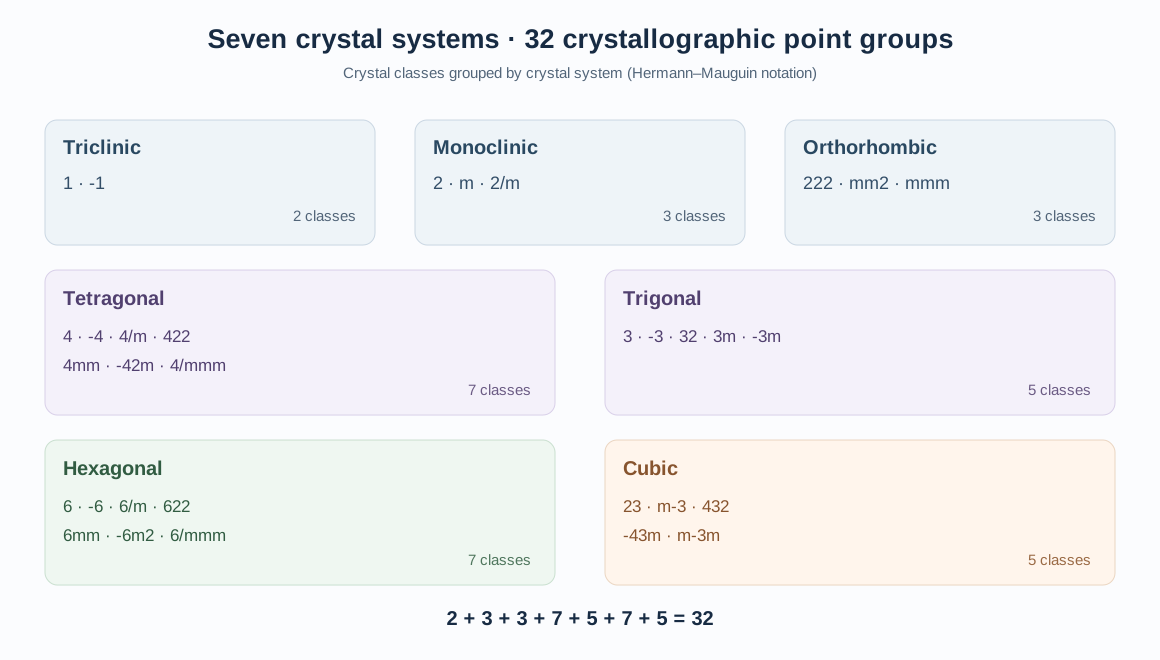
The crystallographic restriction theorem limits rotational symmetry compatible with a periodic three-dimensional lattice to orders 1, 2, 3, 4, and 6. The complete set contains 32 crystallographic point groups, also called the 32 crystal classes. They are distributed among the seven crystal systems.
A point group describes the point symmetry of a crystal. It does not specify translational symmetry. Lattice translations, screw axes, and glide planes belong to the full space-group description.
2. Crystal systems, point groups, and space groups
These concepts are related but not interchangeable.
- Crystal system: classifies crystal symmetry and lattice geometry into seven systems.
- Point group: describes symmetry operations that leave at least one point fixed.
- Space group: combines point symmetry with translational symmetry, including lattice translations, screw axes, and glide planes.
There are seven crystal systems, 32 crystallographic point groups, and 230 three-dimensional space groups. A space group can be reduced to its point group by removing the translational parts of its symmetry operations. This is the crystal class of that space group.
3. The 32 crystallographic point groups
Hermann–Mauguin (international) symbols are the standard notation. A bar over a number denotes a roto-inversion operation; in plain-text notation it is often written with a preceding minus sign.
| Crystal system | Crystal classes (Hermann–Mauguin) | Number |
|---|---|---|
| Triclinic | (1, {1}) | 2 |
| Monoclinic | (2, m, 2/m) | 3 |
| Orthorhombic | (222, mm2, mmm) | 3 |
| Tetragonal | (4, {4}, 4/m, 422, 4mm, {4}2m, 4/mmm) | 7 |
| Trigonal | (3, {3}, 32, 3m, {3}m) | 5 |
| Hexagonal | (6, {6}, 6/m, 622, 6mm, {6}m2, 6/mmm) | 7 |
| Cubic | (23, m{3}, 432, {4}3m, m{3}m) | 5 |
| Total | 32 |
The ordering of symbols conveys symmetry directions relative to the conventional crystallographic axes. The full group contains all products of its symmetry operations; the symbol is not merely a list of isolated operations.
4. Reading Hermann–Mauguin symbols
Common elements of point-group symbols include:
- (1): identity only.
- (2), (3), (4), (6): two-, three-, four-, and sixfold rotation axes.
- (m): mirror plane.
- ({1}): inversion centre.
- ({3}), ({4}), ({6}): roto-inversion operations.
- Combined symbols such as (4mm), (mmm), and (m{3}m): multiple symmetry directions and planes.
For example, (4mm) is a tetragonal point group with a fourfold principal axis and mirror symmetry in the conventional vertical directions. The orthorhombic class (mmm) contains three mutually perpendicular mirror planes; products of these operations also generate twofold axes and inversion.
5. Centrosymmetric and non-centrosymmetric classes
A point group is centrosymmetric if it contains an inversion centre. Inversion transforms a position according to
\[ (x,y,z)\rightarrow(-x,-y,-z). \]
The 11 centrosymmetric crystallographic point groups are
\[ \bar{1},\ 2/m,\ mmm,\ 4/m,\ 4/mmm,\ \bar{3},\ \bar{3}m,\ 6/m,\ 6/mmm,\ m\bar{3},\ m\bar{3}m. \]
The remaining 21 point groups are non-centrosymmetric. This distinction is important for physical properties, but non-centrosymmetric does not automatically mean polar, piezoelectric, or ferroelectric.
6. The 11 Laue classes
A Laue class describes the symmetry of a diffraction pattern when Friedel’s law applies. For ordinary non-resonant X-ray diffraction, Friedel’s law states approximately that
\[ I(hkl)=I(\bar{h}\,\bar{k}\,\bar{l}). \]
This gives the diffraction pattern an apparent inversion symmetry, even if the crystal structure itself is non-centrosymmetric. The diffraction symmetry is therefore described by a centrosymmetric Laue group.
There are 11 Laue classes:
| Crystal system | Laue class |
|---|---|
| Triclinic | ({1}) |
| Monoclinic | (2/m) |
| Orthorhombic | (mmm) |
| Tetragonal | (4/m), (4/mmm) |
| Trigonal | ({3}), ({3}m) |
| Hexagonal | (6/m), (6/mmm) |
| Cubic | (m{3}), (m{3}m) |
The Laue class is not necessarily the true crystal point group. Anomalous (resonant) scattering can make Friedel pairs measurably unequal; Bijvoet differences can then provide information about non-centrosymmetric structures and absolute structure. Multiple or dynamical diffraction can also complicate the simple Friedel-law picture.
7. Polar point groups, piezoelectricity, and ferroelectricity
A polar point group permits a unique polar direction, so a macroscopic polar vector is symmetry-allowed. The ten polar crystallographic point groups are
\[ 1,\ 2,\ m,\ mm2,\ 4,\ 4mm,\ 3,\ 3m,\ 6,\ 6mm. \]
A polar structure may support spontaneous polarization along its permitted direction. However, point-group symmetry alone does not prove that polarization is switchable. Ferroelectricity requires experimental evidence of reversible polarization switching and appropriate domain behaviour.
Piezoelectricity is forbidden in centrosymmetric point groups. Of the 21 non-centrosymmetric classes, 20 are piezoelectric; the cubic class (432) is non-centrosymmetric but non-piezoelectric. Symmetry determines which tensor components may be non-zero, not their magnitude.
8. Optical response and second-harmonic generation
Crystal symmetry constrains optical response tensors. In the electric-dipole approximation, bulk second-harmonic generation (SHG) is generally allowed in non-centrosymmetric crystals and forbidden in centrosymmetric crystals.
Surface and interface contributions, electric-quadrupole or magnetic-dipole terms, and local electric fields that break inversion symmetry can produce SHG signals even when the bulk crystal is centrosymmetric. An SHG signal must therefore be interpreted with the sample geometry and possible surface contributions in mind.
Optical activity, birefringence, and electro-optic effects also have symmetry-dependent selection rules. Non-centrosymmetry alone does not predict the magnitude of any particular optical response.
9. Worked example: a tetragonal material
Suppose diffraction indexing and lattice refinement indicate a tetragonal metric with a fourfold axis parallel to (c). The metric alone does not determine the point group.
Additional structural evidence is required:
- A fourfold axis with the appropriate vertical mirror planes may be consistent with (4mm).
- A fourfold axis combined with inversion may be consistent with (4/m).
- A fourfold axis, perpendicular twofold axes, and the corresponding mirror/inversion symmetry may lead to (4/mmm).
The space group must then be determined by considering translational symmetry, including screw axes and glide planes. This is why lattice parameters, point-group symmetry, and space-group symmetry must be evaluated separately.
10. Practical workflow for a real material
- Establish the lattice system. Index the diffraction data and refine the unit-cell parameters. Remember that metric symmetry can be higher than the true structural symmetry.
- Determine possible Laue symmetry. Examine diffraction symmetry and intensity equivalences, considering Friedel’s law and anomalous scattering.
- Evaluate systematic absences. Use centering, screw-axis, and glide-plane conditions to constrain candidate space groups.
- Generate compatible space groups. Confirm that each candidate belongs to the inferred crystal system and Laue class.
- Refine the structural model. Compare fit quality, residual density, chemical plausibility, and parameter stability.
- Derive the point group. Remove translational parts of the selected space-group operations.
- Assess physical properties. Use the point group to identify symmetry-allowed tensor components and macroscopic properties.
A high-symmetry unit-cell metric is not sufficient proof of high-symmetry atomic arrangement. Distortions, ordering, and subtle symmetry breaking can lower the true structural symmetry.
11. Common misconceptions
- Seven crystal systems means seven point groups. There are seven systems but 32 crystallographic point groups.
- Every non-centrosymmetric material is ferroelectric. Non-centrosymmetry is not enough; polarity and switchable polarization must be established.
- Every non-centrosymmetric class is piezoelectric. The cubic class (432) is non-centrosymmetric but non-piezoelectric.
- Laue symmetry is always the true point group. Friedel’s law can make diffraction appear centrosymmetric when the structure is not.
- A tetragonal metric proves tetragonal structural symmetry. The lattice metric is not a substitute for evaluating atomic positions and symmetry.
- Point groups include screw axes and glide planes. These are space-group operations with translational components; point groups retain their point-symmetry parts.
12. Key points
The 32 crystallographic point groups describe the allowed point symmetries of periodic crystals and are distributed among seven crystal systems. The 11 Laue classes describe diffraction symmetry under the usual Friedel-law approximation and should not be confused with the true crystal point group. Centrosymmetry, polarity, and piezoelectricity are distinct classifications with direct consequences for physical properties. A reliable symmetry assignment combines diffraction symmetry, systematic absences, structural refinement, and correct crystallographic settings.
Further reading
References
- International Union of Crystallography, International Tables for Crystallography, Volume A: Space-Group Symmetry.
- International Union of Crystallography, Online Dictionary of Crystallography, entries on crystal classes, point groups, and Laue classes.
- J. F. Nye, Physical Properties of Crystals: Their Representation by Tensors and Matrices, Oxford University Press, 1985.
- C. Hammond, The Basics of Crystallography and Diffraction, 4th ed., Oxford University Press, 2015.