Conventional and Primitive Unit Cells: Lattice Vectors, Coordinate Transformations, and Volume
1. Why unit-cell choice matters
A crystal lattice is an infinite periodic set of equivalent points. A unit cell is a volume that, when translated by lattice vectors, reproduces the complete lattice. The same lattice can be described using different choices of unit cell.
Two descriptions are particularly important:
- A primitive unit cell contains exactly one lattice point.
- A conventional unit cell is chosen to display the symmetry and geometry of the lattice clearly. It may contain more than one lattice point.
The distinction is not merely graphical. Changing the cell changes the lattice-vector basis, cell volume, fractional coordinates, and sometimes the indexing convention used to describe diffraction data.
The underlying crystal does not change when the unit-cell description changes. Only its mathematical representation changes.
2. Lattice vectors and the unit-cell matrix
Let the direct-lattice basis vectors be (a), (b), and (c). A lattice translation is
\[ \mathbf R=n_1\mathbf a+n_2\mathbf b+n_3\mathbf c, \qquad n_1,n_2,n_3\in\mathbb Z. \]
Using Cartesian column vectors, define the direct-lattice matrix
\[ A=\begin{bmatrix} |&|&|\\ \mathbf a&\mathbf b&\mathbf c\\ |&|&| \end{bmatrix}. \]
Then a position expressed in fractional coordinates (f=(x,y,z)^T) is
\[ \mathbf r=A\mathbf f. \]
The components (x,y,z) are measured along the unit-cell vectors, not necessarily along Cartesian axes. They are dimensionless and are often given modulo integer translations.
For a general triclinic cell, the cell volume is
\[ V=|\det A| =abc\sqrt{1+2\cos\alpha\cos\beta\cos\gamma -\cos^2\alpha-\cos^2\beta-\cos^2\gamma}. \]
This expression applies to any valid three-dimensional unit cell with the usual crystallographic definitions of the lengths and angles.
3. Primitive versus conventional cells
A primitive cell contains one lattice point after accounting for shared boundary contributions. A conventional cell is selected to make symmetry easier to see and use.
| Feature | Primitive cell | Conventional cell |
|---|---|---|
| Lattice points per cell | Exactly 1 | May be greater than 1 |
| Volume | Primitive reference volume | Integer multiple of primitive volume |
| Shape | May be oblique or less visually intuitive | Often reflects crystal-system symmetry |
| Main purpose | Minimal translation cell | Clear symmetry description and standard settings |
| Diffraction indexing | Valid, but may use a less familiar basis | Often matches standard crystallographic settings |
The number of lattice points in a conventional cell, (N), gives
\[ V_{\mathrm{conv}}=N V_{\mathrm{prim}}. \]
For common conventional cells, (N=2) for I-centred and C-centred cells, and (N=4) for F-centred cells. An R lattice described in the conventional hexagonal setting has three lattice points per hexagonal cell. A primitive P cell has one.
Do not confuse lattice points with atoms. The number of atoms in a cell depends on the atomic basis, occupancies, and chemical ordering.
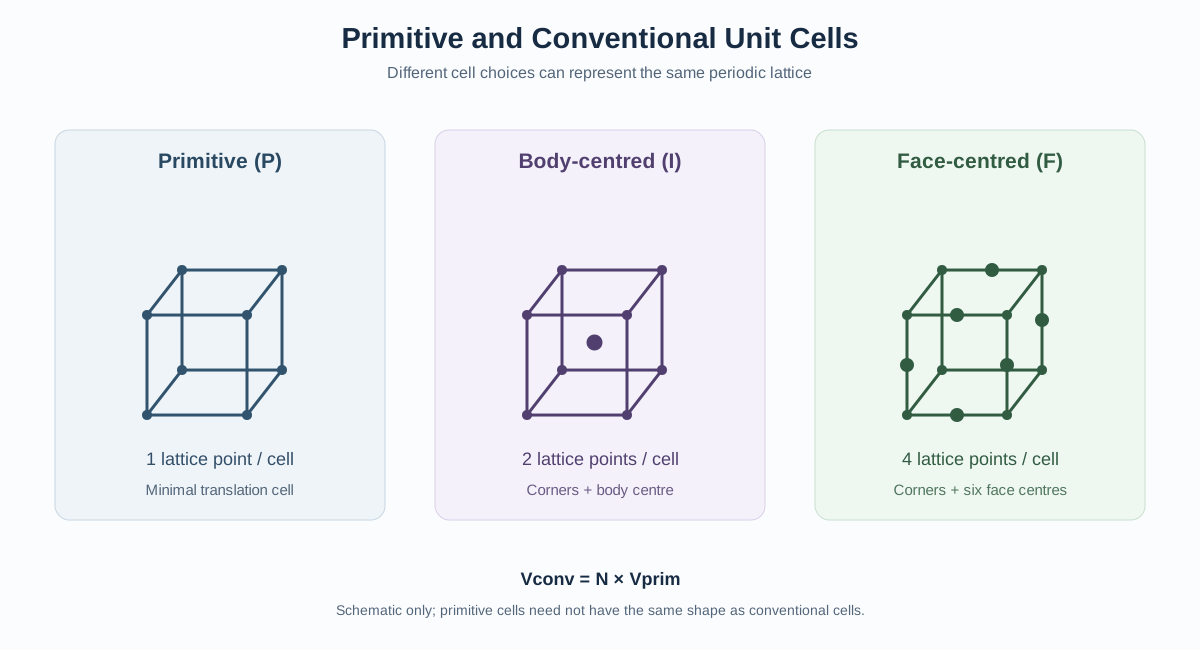
4. Example: simple cubic, body-centred cubic, and face-centred cubic
The cubic conventional cell makes the distinction particularly clear.
Simple cubic (P)
The conventional cubic cell is already primitive. Its eight corner points contribute
\[ 8\times\frac18=1 \]
lattice point per cell. Therefore,
\[ V_{\mathrm{prim}}=a^3. \]
Body-centred cubic (I)
The conventional cubic cell has eight corners and one body-centred point:
\[ N=8\times\frac18+1=2, \qquad V_{\mathrm{prim}}=\frac{a^3}{2}. \]
One possible primitive basis is
\[ \begin{aligned} \mathbf a'_1&=\frac a2(-1,1,1),\\ \mathbf a'_2&=\frac a2(1,-1,1),\\ \mathbf a'_3&=\frac a2(1,1,-1). \end{aligned} \]
The parallelepiped defined by these vectors has volume (a^3/2). It is not a cube, but it generates exactly the same BCC lattice.
Face-centred cubic (F)
The conventional cubic cell has eight corners and six face-centred points:
\[ N=8\times\frac18+6\times\frac12=4, \qquad V_{\mathrm{prim}}=\frac{a^3}{4}. \]
A possible primitive basis is
\[ \begin{aligned} \mathbf a'_1&=\frac a2(0,1,1),\\ \mathbf a'_2&=\frac a2(1,0,1),\\ \mathbf a'_3&=\frac a2(1,1,0). \end{aligned} \]
The primitive cell is a rhombohedron. The conventional cubic cell is usually preferred because it displays the cubic symmetry directly.
5. Changing the lattice basis with a transformation matrix
A new lattice basis can be formed by integer combinations of the old basis vectors. Let
\[ A'=AP, \]
where the columns of (P) specify the new basis vectors in terms of the old ones.
For example, if
\[ P=\begin{bmatrix} p_{11}&p_{12}&p_{13}\\ p_{21}&p_{22}&p_{23}\\ p_{31}&p_{32}&p_{33} \end{bmatrix}, \]
then the first new basis vector is
\[ \mathbf a'_1=p_{11}\mathbf a+p_{21}\mathbf b+p_{31}\mathbf c. \]
The new cell volume is
\[ V'=|\det A'| =|\det A|\,|\det P| =V|\det P|. \]
For a transformation between two primitive bases of the same lattice, (|P|=1). Such a matrix is unimodular (with integer entries and integer inverse). For a conventional-to-primitive transformation, the determinant magnitude is the ratio of primitive to conventional cell volumes. For example, it is (1/2) for the BCC basis above and (1/4) for the FCC basis above.
The determinant is therefore a useful check that a proposed transformation has the intended cell volume.
6. Transforming fractional coordinates
The Cartesian position of an atom must remain unchanged when the basis changes. If
\[ \mathbf r=A\mathbf f=A'\mathbf f' \]
and (A’=AP), then
\[ \boxed{\mathbf f'=P^{-1}\mathbf f}. \]
This is the coordinate transformation for the same origin and the stated column-vector convention.
If the new origin is displaced by a Cartesian vector (o), so that
\[ \mathbf r=\mathbf o+A'\mathbf f', \]
then
\[ \boxed{\mathbf f'=P^{-1}(\mathbf f-\mathbf f_o)}, \qquad \mathbf f_o=A^{-1}\mathbf o. \]
After transformation, coordinates may be wrapped into a chosen unit-cell interval, commonly ([0,1)), by adding or subtracting integer lattice translations. Wrapping changes the coordinate representative, not the physical atomic position.
Important: coordinate formulas depend on whether basis vectors are stored as columns or rows, and on the definition of the transformation matrix. Always state the convention and test the transformation by reconstructing the Cartesian position.
7. Worked coordinate example: a BCC basis
Use the BCC primitive vectors from Section 4, with the conventional cubic basis as the original basis. The transformation matrix is
\[ P=\frac12 \begin{bmatrix} -1&1&1\\ 1&-1&1\\ 1&1&-1 \end{bmatrix}. \]
Its determinant has magnitude (1/2), so the primitive cell volume is half the conventional cubic volume.
The conventional-cell body-centre position is
\[ \mathbf f=\begin{bmatrix}1/2\\1/2\\1/2\end{bmatrix}. \]
Applying (f’=P^{-1}f) gives a primitive-coordinate representation. Since the body-centre point is itself a BCC lattice point, it is equivalent to the primitive origin modulo an integer primitive-lattice translation. This is a useful consistency check: a lattice point must map to integer fractional coordinates in a primitive basis.
A coordinate outside the interval ([0,1)) is not an error. It can be reduced by integer translations to an equivalent coordinate inside the selected cell.
8. Reciprocal lattice and diffraction indexing
A change of direct-lattice basis also changes the reciprocal basis. With the crystallographic convention that includes (2), define
\[ B=2\pi A^{-T}. \]
If (A’=AP), then
\[ B'=2\pi(A')^{-T}=BP^{-T}. \]
A reciprocal vector is
\[ \mathbf G=B\mathbf h, \qquad \mathbf h=(h,k,l)^T. \]
To represent the same reciprocal vector in the new basis,
\[ B\mathbf h=B'\mathbf h' =BP^{-T}\mathbf h', \]
so
\[ \boxed{\mathbf h'=P^T\mathbf h}. \]
This relation is essential when changing indexing bases. Miller indices are basis-dependent labels: the physical reciprocal-lattice vector is unchanged, but its integer components can change.
Some crystallographic software defines reciprocal vectors without the factor (2). The transformation of indices is unchanged if one convention is used consistently.
9. Unit-cell transformations in CIF and crystallographic software
A CIF commonly records the unit-cell lengths and angles, space-group information, and fractional atomic coordinates. It may also contain explicit symmetry operations and setting information.
When converting between settings or primitive and conventional cells:
- Identify the original basis and origin.
- Obtain the exact basis-transformation matrix and any origin shift.
- Transform the cell vectors.
- Transform every atomic coordinate using the matching coordinate convention.
- Transform the reciprocal indices if diffraction data are being reindexed.
- Apply symmetry operations in the new setting and check equivalent positions.
- Confirm that the chemical composition, occupancies, and Cartesian atomic positions are preserved.
In VESTA, compare the transformed structure visually and inspect lattice parameters and atomic positions. In GSAS-II, make sure the selected space group, unit-cell setting, and reflection indexing correspond to the same convention as the input data. Do not assume that changing only the cell lengths and angles is a complete basis transformation.
10. Common errors
- Assuming a primitive cell must look like the conventional cell. A primitive cell can be an oblique parallelepiped even when the conventional cell is cubic.
- Confusing atoms with lattice points. Lattice-point counting is determined by the lattice and boundary sharing; atoms are determined by the basis.
- Using (P) instead of (P^{-1}) for direct fractional coordinates. With (A’=AP) and column coordinates, the correct relation is (f’=P^{-1}f).
- Forgetting the origin shift. A basis change and an origin change are separate operations.
- Changing the direct basis but not the Miller indices. Reciprocal indices must be transformed consistently.
- Rounding transformation matrices too early. Exact rational entries are preferable; premature rounding can break symmetry and create small coordinate inconsistencies.
- Comparing CIF coordinates without checking the setting. Two correct files can list different fractional coordinates because they use different origins or cell bases.
11. Key points
A primitive cell contains one lattice point, while a conventional cell is selected to display lattice symmetry and may contain several lattice points. The lattice-vector matrix provides a precise way to describe basis changes. For (A’=AP), fractional coordinates transform as (f’=P^{-1}f) when the origin is unchanged, while reciprocal indices transform as (h’=P^Th). Preserving the physical structure requires consistent treatment of basis vectors, coordinates, origin shifts, and diffraction indexing.
Further reading
References
- International Union of Crystallography, International Tables for Crystallography, Volume A: Space-Group Symmetry.
- C. Hammond, The Basics of Crystallography and Diffraction, 4th ed., Oxford University Press, 2015.
- B. D. Cullity and S. R. Stock, Elements of X-Ray Diffraction, 3rd ed., Prentice Hall, 2001.