The 14 Bravais Lattices: Centering, Unit Cells, and Crystal Geometry
1. What is a Bravais lattice?
A Bravais lattice is an infinite periodic arrangement of equivalent points in three-dimensional space. Every lattice point has an identical environment, and the complete arrangement can be generated by integer combinations of three independent translation vectors:
\[ \mathbf{R}=n_1\mathbf{a}+n_2\mathbf{b}+n_3\mathbf{c}, \qquad n_i\in\mathbb{Z}. \]
The vectors (), (), and () define the unit-cell edges. Their lengths are (a,b,c), while the interaxial angles are (), (), and ().
A Bravais lattice describes translational periodicity, not the full atomic structure. A crystal structure is obtained by associating an atomic motif (basis) with every lattice point.
\[ \text{Crystal structure} = \text{Bravais lattice} + \text{atomic basis}. \]
This distinction is fundamental when interpreting CIF files, building structural models, and indexing diffraction patterns.
2. The seven crystal-system families and 14 Bravais lattices
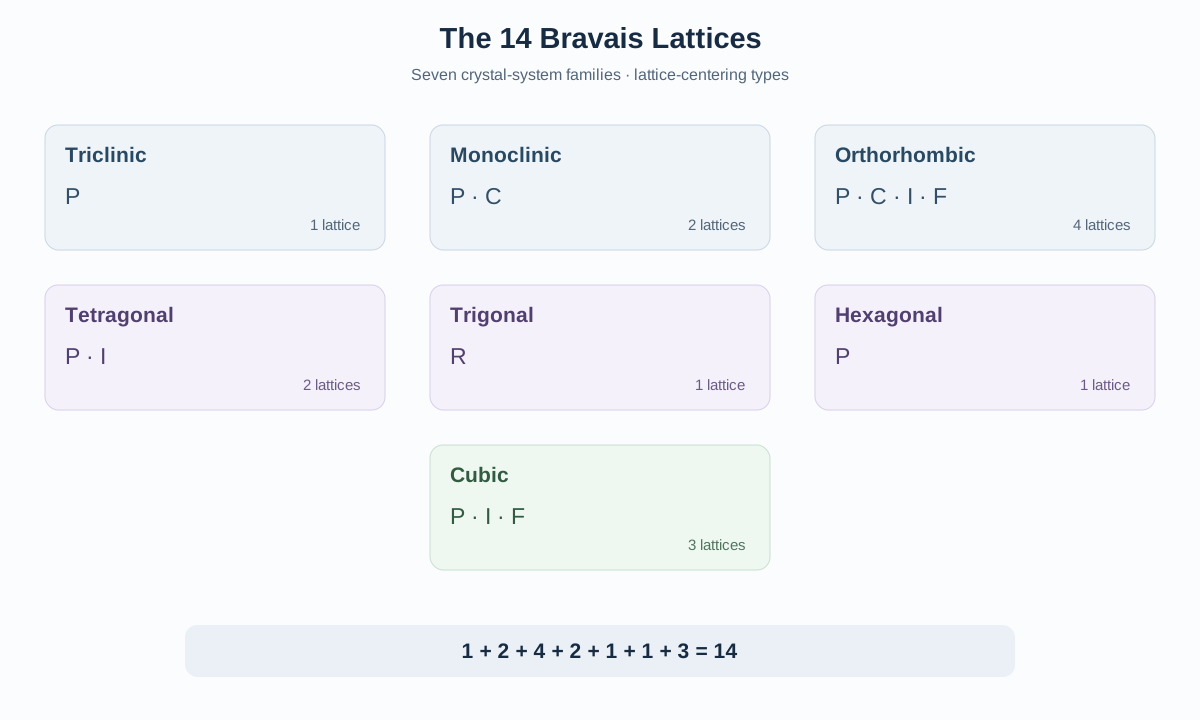
There are 14 distinct three-dimensional Bravais lattices. They are grouped into seven crystal-system families:
| Crystal-system family | Bravais lattices | Number |
|---|---|---|
| Triclinic | P | 1 |
| Monoclinic | P, C | 2 |
| Orthorhombic | P, C, I, F | 4 |
| Tetragonal | P, I | 2 |
| Trigonal (rhombohedral lattice) | R | 1 |
| Hexagonal | P | 1 |
| Cubic | P, I, F | 3 |
| Total | 14 |
Here, P, C, I, F, and R describe the centering of the conventional cell. The labels are not space-group symbols: each Bravais lattice can be compatible with multiple space groups.
3. What do P, I, F, C, and R mean?
The centering symbol identifies where equivalent lattice points occur within the conventional unit cell.
- P — Primitive: lattice points occur only at the eight corners. The corner contributions sum to one lattice point per cell.
- I — Body-centred: corner points plus one lattice point at the body centre; two lattice points per conventional cell.
- F — Face-centred: corner points plus one lattice point at the centre of each of the six faces; four lattice points per conventional cell.
- C — Base-centred: corner points plus lattice points at the centres of one pair of opposite faces, conventionally the C faces; two lattice points per conventional cell.
- R — Rhombohedral: a rhombohedral lattice. It may be described using primitive rhombohedral axes or a larger conventional hexagonal setting containing three lattice points.
The corner contribution is (8=1). Each face-centre contributes (), and the body-centre contributes one full point. Thus,
\[ N_{\mathrm{lattice}}= \begin{cases} 1 & P,\\ 2 & I\text{ or }C,\\ 4 & F. \end{cases} \]
For an R lattice in the conventional hexagonal setting, the conventional cell contains three lattice points. This is why the primitive rhombohedral cell and the conventional hexagonal description must not be confused.
4. Unit-cell geometry of the seven families
The unit-cell parameters constrain which lattice types are possible.
| Family | Axial lengths | Interaxial angles | Allowed Bravais types |
|---|---|---|---|
| Triclinic | (abc) | (), none fixed at 90° | P |
| Monoclinic | (abc) | Two angles 90°, one angle not 90° | P, C |
| Orthorhombic | (abc) | All 90° | P, C, I, F |
| Tetragonal | (a=bc) | All 90° | P, I |
| Trigonal / rhombohedral | (a=b=c) | (==^) | R |
| Hexagonal | (a=bc) | (=, ) | P |
| Cubic | (a=b=c) | All 90° | P, I, F |
These are conventional descriptions. The same lattice can sometimes be represented using a different cell choice, but that does not create a new Bravais lattice.
5. Why are there only 14?
A naive combination of every possible centering with every crystal system produces more candidates than are actually distinct. Some combinations are geometrically equivalent to another lattice when a different unit cell is selected.
For example, a base-centred tetragonal cell can be transformed into a primitive tetragonal description with a different choice of basis vectors. It is therefore not counted as an additional Bravais lattice.
The classification counts distinct three-dimensional translation lattices, not every possible drawing or conventional cell choice. The 14 types are the unique possibilities after equivalent descriptions are removed.
6. Primitive and conventional unit cells
A primitive cell contains exactly one lattice point, irrespective of its shape. Its translations generate the entire lattice without leaving out or duplicating lattice points.
A conventional cell is selected to make the lattice symmetry and geometry easier to recognize. It may contain more than one lattice point, as in I-, F-, C-, or R-centred conventional descriptions.
The primitive cell is not necessarily the smallest-looking or most visually symmetric cell. For an F-centred cubic lattice, for example, the conventional cubic cell is convenient for displaying cubic symmetry, while a primitive cell is a rhombohedron.
When comparing cell volumes, remember:
\[ V_{\mathrm{conventional}}= N_{\mathrm{lattice}}\,V_{\mathrm{primitive}}, \]
where (N_{}) is the number of lattice points in the conventional cell.
This relation concerns lattice points, not the number of atoms in the cell. The atomic count also depends on the basis and its occupancies.
7. Centering and systematic absences in X-ray diffraction
Lattice centering produces phase relationships between equivalent lattice points. For a reflection ((hkl)), the lattice contribution to the structure factor includes the sum over centering translations.
For a body-centred lattice, the additional translation is ((,,)). The centering factor is
\[ F_I=1+\exp[\pi i(h+k+l)]. \]
Therefore,
\[ h+k+l=2n \]
is required for an I-centred reflection to be present in the ideal kinematic description.
Common centering conditions include:
| Centering | Reflection condition |
|---|---|
| P | No additional centering condition |
| I | (h+k+l=2n) |
| F | (h,k,l) all even or all odd |
| C | (h+k=2n) |
| A | (k+l=2n) |
| B | (h+l=2n) |
| R (hexagonal axes, obverse setting) | (-h+k+l=3n) |
The C, A, and B conditions refer to the conventional choice of centred face. A different axis setting changes the corresponding index expression. The R condition shown is specifically for the stated hexagonal-axis obverse convention; verify the setting before applying it to a CIF or reflection list.
These are lattice-centering conditions. Screw axes and glide planes produce additional systematic absences. Atomic motifs can also cause accidental intensity cancellations, but those are not general Bravais-lattice conditions.
8. Worked example: identifying an I-centred cubic lattice
Consider a cubic cell with equal axes and right angles:
\[ a=b=c,\qquad \alpha=\beta=\gamma=90^\circ. \]
If the lattice has an additional lattice point at the body centre, its centering is I. The lattice is therefore body-centred cubic (BCC), one of the three cubic Bravais lattices.
For a reflection such as ((110)), the index sum is (1+1+0=2), so it satisfies the I-centering condition. For ((100)), the sum is odd, so the reflection is systematically absent due to body centering.
This extinction is a property of the translational lattice. It should not be confused with a weak peak, preferred orientation, or an overlap with another reflection.
9. Bravais lattice versus crystal structure: a materials example
A cubic Bravais lattice does not necessarily mean that the material is a monatomic cubic crystal. Different atomic bases can be associated with the same underlying lattice.
For example, a rock-salt-type structure can be described using an F-centred cubic Bravais lattice with a two-ion basis. A related structure type may retain the same Bravais lattice while changing the species, occupancies, or atomic coordinates in the basis.
Likewise, a body-centred arrangement of atoms is not automatically proof that the underlying Bravais lattice is I-centred: the complete translational symmetry of the full decorated structure must be considered. Chemical ordering can lower the translational symmetry and change the appropriate Bravais lattice.
10. Practical workflow for powder XRD and structural refinement
- Index the diffraction pattern. Obtain a candidate unit cell and assess whether the observed peak positions are consistent with its metric.
- Evaluate lattice centering. Check whether the observed reflection conditions are compatible with P, I, F, C, A, B, or R centering.
- Consider the crystal system. Use the refined metric and symmetry-related evidence; do not infer the full structure from lattice parameters alone.
- Check additional absences. Screw axes and glide planes may impose conditions beyond centering.
- Select candidate space groups. The Bravais lattice narrows the possibilities but does not uniquely determine a space group.
- Refine and validate the model. Examine fit statistics, residuals, chemical plausibility, atomic displacement parameters, occupancies, and parameter correlations.
- Report the setting. State the cell choice and axis setting, particularly for centred monoclinic cells and rhombohedral structures represented in hexagonal axes.
In GSAS-II, the space-group choice and unit-cell setting determine the symmetry operations and reflection conditions used in refinement. Confirm that the selected setting matches the CIF and the indexing convention.
11. Common mistakes
- Treating the 14 Bravais lattices as 14 space groups. A Bravais lattice describes translations; a space group includes point symmetry and translational symmetry.
- Confusing lattice points with atoms. A conventional cell may contain several lattice points, and each lattice point carries an atomic basis.
- Assuming every centred cell is a distinct Bravais type. Some apparent combinations are equivalent to another lattice under a change of cell.
- Using a centering condition without checking the setting. C, A, B, and R index conditions depend on the chosen axes and convention.
- Assigning a space group from the unit-cell metric alone. The metric does not establish atomic symmetry, screw axes, glide planes, or chemical ordering.
- Confusing systematic absences with weak intensities. A forbidden reflection is absent by symmetry in the ideal diffraction model; a weak observed feature requires careful assessment of overlap, multiple diffraction, impurity phases, and experimental effects.
12. Key points
The 14 Bravais lattices are the distinct three-dimensional translation lattices, grouped into seven crystal-system families. Centering symbols describe the lattice points in a conventional cell, while the atomic basis defines the chemical structure. Centering creates characteristic reflection conditions that help constrain diffraction indexing and space-group selection. A reliable structural assignment combines unit-cell geometry, reflection conditions, symmetry analysis, and refinement rather than relying on any one observation.
Further reading
References
- International Union of Crystallography, International Tables for Crystallography, Volume A: Space-Group Symmetry.
- C. Hammond, The Basics of Crystallography and Diffraction, 4th ed., Oxford University Press, 2015.
- B. D. Cullity and S. R. Stock, Elements of X-Ray Diffraction, 3rd ed., Prentice Hall, 2001.