Hydraulic Presses: Powder Compaction, Green Density and Defect Control
Hydraulic Presses
PROCESSING & THERMAL EQUIPMENT · TOPIC 03.03 · POWDER COMPACTION
A hydraulic press applies force through a ram and tooling to compact powder into a shaped green body. The press gauge, hydraulic pressure, ram force and pressure acting on the powder are related, but they are not identical quantities.
1. Hydraulic principle and load path
A hydraulic system uses fluid pressure to transmit force. In an ideal cylinder:
[ F=P_h A_{ram} ]
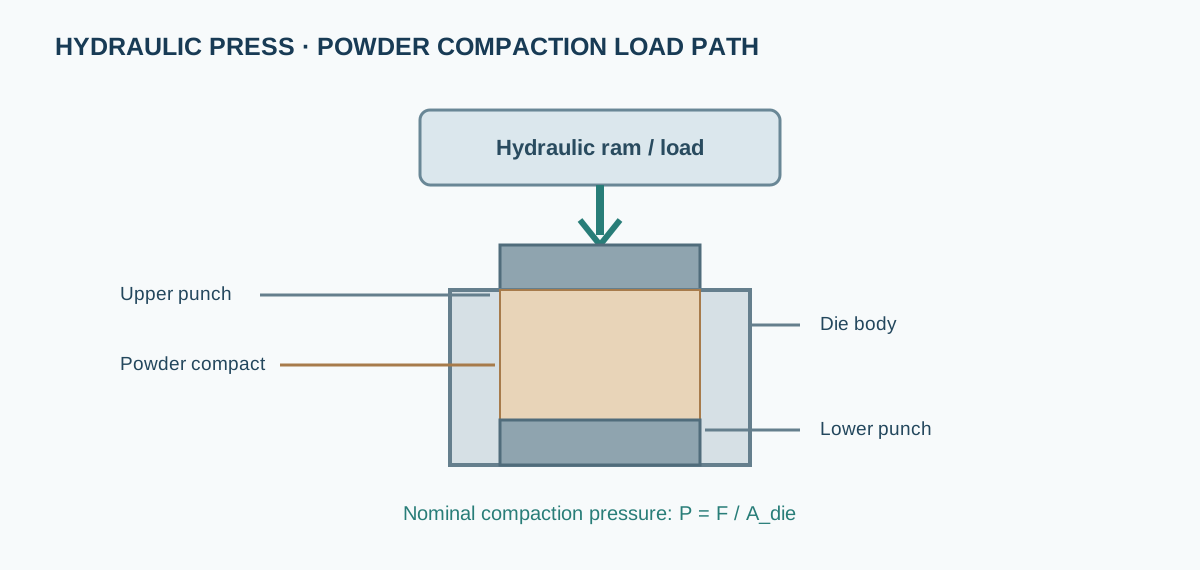
where (P_h) is hydraulic pressure and (A_{ram}) is the effective ram area. For a simple cylindrical die, nominal compaction pressure is:
[ P_c= ]
The correct die area depends on the tooling and specimen geometry. For a cylindrical compact, use the cross-sectional area of the powder column. Do not equate a hydraulic gauge reading directly with specimen pressure unless the cylinder area, mechanical arrangement and calibration are known.
2. Die and tooling
Tooling may include die body, upper and lower punches, spacers, ejector and alignment components. Die material, surface finish, clearance and lubrication influence friction, wear, contamination and compact release.
For ceramic powders, die-wall friction creates nonuniform stress and density. Double-action pressing or carefully designed tooling can reduce some gradients, but the result depends on geometry and powder flow.
3. Powder preparation and filling
Uniform filling is essential. Agglomerates, broad particle-size distributions, poor flow, moisture variation and segregation can produce density gradients before pressing begins.
Record powder mass, binder and lubricant content, granulation method, die dimensions, fill height and filling procedure. A die filled from one side may produce a different density profile from a carefully levelled, repeatable fill.
4. Compaction curve and green density
A compaction curve relates applied pressure to green density or compact height. Powder rearrangement, particle deformation and fracture contribute differently as pressure increases.
Green density is:
[ _g= ]
For a cylindrical pellet with measured diameter (d) and thickness (h):
[ V_g=()^2h ]
This bulk density includes pores. It should not be confused with theoretical density or final sintered density.
5. Practical pressing sequence
- Inspect die, punches and press alignment; confirm rated load.
- Clean tooling and verify there is no residual powder or damage.
- Weigh the powder charge and document any binder/lubricant.
- Fill the die uniformly and avoid segregation.
- Apply load gradually using the specified procedure.
- Hold only as required by the validated protocol.
- Release load in a controlled manner to reduce elastic recovery and cracking.
- Eject the compact without bending or impact.
- Inspect for lamination, capping, edge cracks and density nonuniformity.
- Measure mass and dimensions and calculate green density.
6. Defects and their causes
| Defect | Possible origin | Control |
|---|---|---|
| Lamination | Trapped air, rapid loading/unloading, density gradients | Improve granulation and controlled pressing |
| Capping | Elastic recovery, die friction, weak interparticle bonding | Adjust powder condition and unloading |
| Edge cracking | Ejection friction or nonuniform stress | Inspect die finish and ejection procedure |
| Density gradient | Die-wall friction and one-sided pressing | Optimize tooling and pressing strategy |
| Sticking | Tooling/powder compatibility or inadequate release | Validate lubricant and surface condition |
| Dimensional scatter | Variable fill mass, load or tooling wear | Standardize filling and verify force |
7. Pressure calibration and reporting
Verify load using a calibrated load cell or approved force measurement system. Record whether the displayed quantity is hydraulic pressure, ram force or calculated compaction pressure. Include cylinder/ram area, die dimensions, powder mass, dwell, loading/unloading rate and compact dimensions.
Do not compare nominal MPa values across laboratories unless the force conversion and die-area basis are equivalent.
8. Safety
Hydraulic presses store substantial mechanical energy. Keep hands clear of the die and ram, use guarding, inspect hoses and fittings, never exceed rated force, and follow the approved procedure for die installation and ejection. Do not attempt to correct a misaligned die under load.
9. Manufacturers and technical documentation
- Carver — laboratory hydraulic presses.
- Specac — laboratory pressing systems and accessories.
- Across International — laboratory hydraulic presses.
Use the exact press and tooling manual for rated load, alignment, guarding, pressure conversion and maintenance.