Ball Milling: Powder Mixing, Particle Refinement and Contamination Control
Ball Milling
PROCESSING & THERMAL EQUIPMENT · TOPIC 03.02 · POWDER PROCESSING
Ball milling is a mechanical powder-processing method in which moving grinding media transfer energy to particles through impact, shear and attrition. It is used for mixing, deagglomeration, particle-size reduction and, under suitable conditions, mechanochemical reactions.
The outcome is not determined by milling time alone. Jar geometry, media, speed, filling, powder loading, solvent, temperature and the mechanical properties of the powder all influence the process.
1. How particle refinement occurs
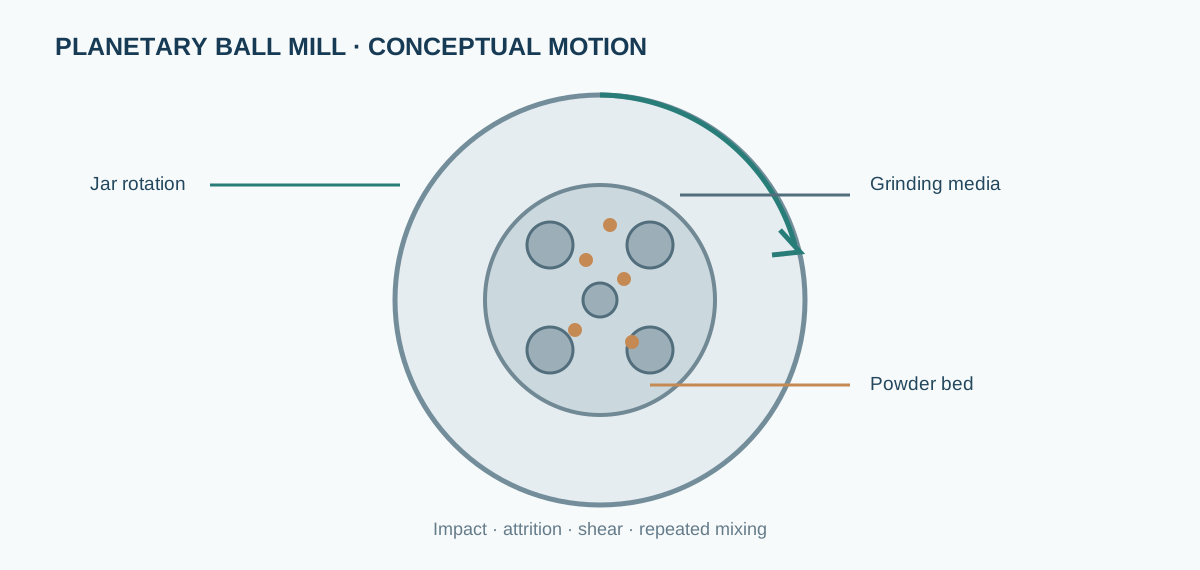
- Impact: media collide with powder and jar walls, applying high local stress.
- Attrition: particles are abraded through sliding and rolling contacts.
- Shear and mixing: repeated movement redistributes components and breaks soft agglomerates.
- Cold welding and fracture: ductile or brittle materials may undergo competing deformation and fracture mechanisms.
In ceramic oxide powders, milling can improve compositional homogeneity and disrupt agglomerates. It may also introduce media-derived impurities, amorphization, defect accumulation or unwanted reactions.
2. Ball-to-powder ratio
The ball-to-powder mass ratio is:
[ = ]
Always state whether the reported mass includes all balls and the dry powder only. BPR is not a complete measure of milling energy: two mills with the same BPR can have very different collision energies and trajectories.
3. Important process variables
| Variable | Why it matters |
|---|---|
| Mill type and speed | Determines motion regime and collision energy |
| Jar geometry and volume | Changes trajectories and filling fraction |
| Media size, density and material | Controls impact energy and contamination risk |
| BPR | Influences frequency and intensity of media–powder interactions |
| Milling duration and pauses | Controls cumulative exposure and heating |
| Wet/dry condition | Changes agglomeration, transport and energy dissipation |
| Solvent and solids loading | Affect viscosity, chemistry and drying |
| Atmosphere | Can limit oxidation or enable sensitive chemistry |
For planetary mills, excessive speed can cause media to remain pinned to the jar wall or create an undesirable motion regime. Use the manufacturer’s operating range rather than assuming higher rpm always means better milling.
4. Selecting jars and milling media
Choose jar and media materials based on hardness, density, chemical compatibility and contamination tolerance. Common choices include zirconia, alumina, agate, stainless steel and tungsten carbide, but none is universally inert.
A media choice that is mechanically effective may be chemically unacceptable. For functional oxides, trace Fe, Zr, Al, W or other contamination can influence phase formation, defect chemistry, sintering and electrical transport.
Run a media/jar blank when contamination could affect the research conclusion. Characterize the powder after milling rather than assuming the nominal jar composition is the only source of contamination.
5. Wet milling and drying
Wet milling can reduce dust, improve mixing and limit some agglomeration. Solvent selection must consider powder chemistry, hydrolysis sensitivity, flammability, toxicity, jar compatibility and downstream drying.
Drying can cause hard agglomerates or compositional segregation if suspension stability is poor. Record solvent identity, volume, solids loading, dispersant, drying temperature and method. Do not use a solvent solely because it is commonly used in another material system.
6. Practical workflow
- Define the objective: mixing, deagglomeration, particle-size reduction or mechanochemical processing.
- Check powder and solvent compatibility with the jar and media.
- Clean and dry the jar and media; document previous use.
- Weigh powder and media and calculate BPR.
- Load within the mill’s specified filling limits.
- Select speed, duration and pause cycles from a validated starting protocol.
- Monitor jar temperature and inspect for leakage or abnormal vibration.
- Recover powder using compatible tools and minimize contamination.
- Dry and sieve only where required by the process.
- Compare particle-size distribution, XRD, microscopy and chemical composition with the unmilled control.
7. Common artefacts and process risks
| Issue | Possible consequence | Control |
|---|---|---|
| Media wear | Foreign-element contamination | Blank milling and chemical analysis |
| Excessive energy | Amorphization, defects, unwanted phases | Time-series XRD and temperature monitoring |
| Overheating | Solvent loss or chemical change | Pause cycles and jar-temperature checks |
| Poor loading | Inconsistent energy transfer | Follow fill limits and standardize batch mass |
| Agglomeration after drying | Apparent particle-size increase | Optimize solvent/dispersant and drying |
| Cross-contamination | Uncontrolled chemistry between batches | Dedicated or validated cleaning procedure |
8. Verification and reporting
Report mill type/model, jar and media material, media size and mass, powder mass, BPR, speed, duration, pause schedule, atmosphere, solvent, solids loading, jar fill fraction and recovery/drying procedure. Characterize the powder before and after milling using methods appropriate to the question: particle-size analysis, microscopy, XRD, surface area or chemical analysis.
9. Manufacturers and documentation
- FRITSCH — planetary and laboratory mills.
- Retsch — laboratory milling and size reduction.
- Across International — planetary ball mills and laboratory equipment.
Confirm the exact jar, media, speed and loading limits from the manufacturer’s model-specific manual. Milling jars can store mechanical energy and may become hot or pressurized; follow the specified opening and handling procedure.
Interactive laboratory: ball-milling process window
How operating conditions change milling intensity
Explore the qualitative influence of rotational speed, duration, ball-to-powder ratio and media diameter.
A normalized teaching heuristic, not collision energy, particle-size prediction or a transferable milling law. Mill kinematics, jar geometry, filling, media density, critical speed, slurry rheology, temperature and material properties are not represented. Characterize actual samples.