Understanding Crystallographic Space Groups: Symbols, Numbers, Settings, and Practical Interpretation
Understanding Crystallographic Space Groups: Symbols, Numbers, Settings, and Practical Interpretation
A space group is the complete mathematical description of the symmetry of a periodic crystal. It specifies not only the rotational and reflection symmetry of the structure, but also the translational symmetry associated with the lattice, including screw axes and glide planes.
There are 230 distinct three-dimensional crystallographic space groups. This guide explains what those groups represent, how their symbols are read, and how to use space-group information in practical materials research.
1. What does a space group describe?
A crystal is periodic: its atomic arrangement repeats through space. A space group collects all symmetry operations that map the complete periodic structure onto an indistinguishable configuration.
A general space-group operation in fractional coordinates is written as
\[ \boxed{\mathbf{x}'=R\mathbf{x}+\mathbf{t}} \]
where (=(x,y,z)^T) is the original fractional-coordinate vector, (R) is a crystallographic rotation or reflection matrix, and (=(t_x,t_y,t_z)^T) is a translation component.
The translation component may be an integer lattice translation or a fractional translation associated with a screw axis or glide plane. Coordinates that differ by an integer translation describe equivalent positions in neighbouring unit cells.
A space group therefore describes more than the shape of a unit cell. Two structures can have the same lattice parameters and crystal system but belong to different space groups because their atomic arrangements obey different symmetry operations.
2. The building blocks: lattice, point group and space group
Three related concepts must be distinguished.
2.1 Bravais lattice
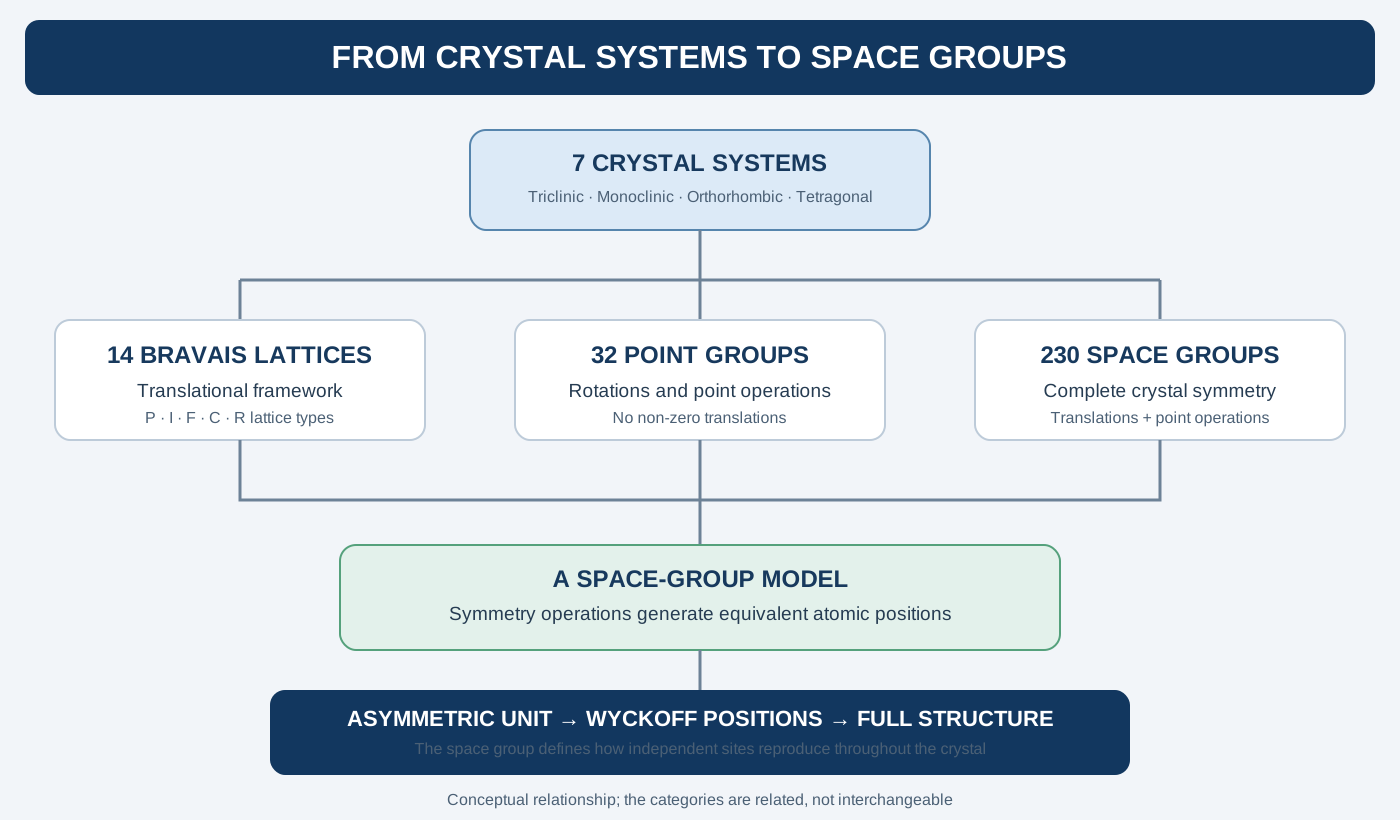
A Bravais lattice describes the periodic translational framework. In three dimensions there are 14 Bravais lattices distributed among the seven crystal systems.
| Symbol | Lattice type | Meaning |
|---|---|---|
| P | Primitive | Lattice points at the corners of the conventional cell |
| I | Body-centred | Additional lattice point at the cell centre |
| F | Face-centred | Additional lattice points at all face centres |
| C (or A/B) | Base-centred | Additional lattice points on one pair of opposite faces |
| R | Rhombohedral | Rhombohedral lattice in the appropriate setting |
The centering describes translational lattice points, not the number of atoms in the chemical formula or the number of independent atoms in the asymmetric unit.
2.2 Point group
A crystallographic point group contains symmetry operations that leave at least one point fixed. It includes rotations, mirrors, inversion and roto-inversion, but excludes non-zero translations.
There are 32 crystallographic point groups in three dimensions. Their allowed rotational symmetries are restricted by lattice periodicity.
2.3 Space group
A space group combines the point-symmetry operations with translational symmetry. It includes lattice translations, rotation axes, mirror planes, inversion centres, roto-inversion axes, screw axes and glide planes.
The point group can be obtained from the space group by removing the translational parts of its operations.
3. The 230 space groups and the seven crystal systems
The 230 space groups are classified into seven crystal systems. The number of groups in each system is:
| Crystal system | Number of space groups |
|---|---|
| Triclinic | 2 |
| Monoclinic | 13 |
| Orthorhombic | 59 |
| Tetragonal | 68 |
| Trigonal | 25 |
| Hexagonal | 27 |
| Cubic | 36 |
| Total | 230 |
These totals refer to the conventional three-dimensional crystallographic classification. The number of space groups in a system is not the number of point groups in that system.
4. Hermann–Mauguin notation: how to read a space-group symbol
Space groups are commonly identified using Hermann–Mauguin notation, also called international notation. A symbol communicates the lattice type and selected symmetry directions.
Consider the cubic space group
\[ \boxed{Pm\bar{3}m} \]
Its components can be interpreted as follows:
- P: primitive Bravais lattice.
- m: mirror symmetry in the first specified symmetry direction.
- ({3}): a threefold roto-inversion operation in the relevant direction.
- m: mirror symmetry in another specified direction.
The exact orientation of each symmetry element depends on the crystal system and conventional setting. A symbol should be interpreted using the relevant crystallographic convention rather than as a simple sequence of unrelated labels.
Common lattice symbols
The first letter indicates the lattice centering: P is primitive, I is body-centred, F is face-centred, C is base-centred, and R is rhombohedral in the appropriate setting.
For example, Pnma and Fm({3})m indicate different lattice types and different symmetry contents. The letter P or F alone does not determine the complete space group.
Common symmetry symbols
| Symbol | Meaning |
|---|---|
| 1 | Identity |
| 2, 3, 4, 6 | Rotation axes |
| m | Mirror plane |
| ({1}) | Inversion centre |
| ({3}), ({4}), ({6}) | Roto-inversion axes |
| (2_1), (4_1), etc. | Screw axes |
| a, b, c, n, d | Glide-plane types |
The notation is compact, but a full coordinate-operation list is preferable when generating atomic positions or implementing symmetry transformations computationally.
5. Space-group number, short symbol and full symbol
A space group can be identified in several ways:
- International space-group number: an integer from 1 to 230.
- Hermann–Mauguin symbol: the standard international symbol.
- Hall symbol: an alternative notation that explicitly encodes symmetry operations, including origin and setting information.
- Schoenflies symbol: a notation commonly used in molecular and group-theory contexts.
For routine crystallographic communication, the international number and Hermann–Mauguin symbol are widely used. The Hall symbol is particularly useful in computational crystallography because it distinguishes settings and origin choices more explicitly.
Do not assume that a short Hermann–Mauguin symbol, without its setting information, is always sufficient to reconstruct the exact coordinate operations used in a structural file.
6. Space-group settings and origin choices
A space group can be expressed using different conventional settings. The same physical crystal symmetry may therefore appear with different coordinate descriptions.
Important setting choices include choice of crystallographic axes, unique-axis choice in monoclinic systems, rhombohedral versus hexagonal axes for trigonal structures, origin choice, and transformations of the unit-cell axes.
A monoclinic space group may be described using a unique axis b in one setting, while another setting uses a different unique axis. The corresponding coordinate operations and reflection conditions must be interpreted consistently with that setting.
An origin shift changes the coordinate expressions of symmetry operations. It does not change the physical structure or its symmetry. Similarly, transforming the unit-cell basis changes the numerical fractional coordinates and operation matrices while preserving the underlying crystallographic description.
Practical rule: never compare fractional coordinates from two CIF files until you have checked whether their unit-cell settings and origin choices are compatible.
7. Centrosymmetric and non-centrosymmetric space groups
A space group is centrosymmetric if it contains an inversion operation. Otherwise, it is non-centrosymmetric.
This distinction is important for physical-property analysis, but it must be applied to the full space group rather than inferred from the crystal system alone.
- Centrosymmetric space groups contain an inversion centre as part of their symmetry.
- Non-centrosymmetric space groups lack inversion symmetry.
- Non-centrosymmetric does not automatically mean polar.
- Polar space groups allow a unique direction for a spontaneous polarization vector, subject to the physical state of the material.
- Ferroelectricity requires switchable spontaneous polarization; it cannot be concluded from a space-group symbol alone.
The 32 crystallographic point groups are commonly classified into centrosymmetric, non-centrosymmetric non-polar, and polar classes. Since the point group is derived from the space group, this classification is a useful bridge between crystallographic symmetry and macroscopic physical properties.
8. Space groups and systematic absences in XRD
A space group constrains which reciprocal-lattice reflections can have non-zero structure factors. Some reflections are systematically absent because contributions from symmetry-related atoms cancel.
These absences are called systematic absences or reflection conditions. They can arise from lattice centering, screw axes and glide planes.
For example, a body-centred lattice (I) produces the general condition
\[ h+k+l=2n \]
for allowed reflections in the conventional setting. Reflections for which (h+k+l) is odd are systematically absent due to the body-centering translation.
For a face-centred lattice (F), the general condition is that the indices are all odd or all even. These centering conditions are useful, but they are not sufficient to identify a unique space group: screw axes and glide planes can impose additional conditions.
The structure factor is
\[ F(hkl)=\sum_j f_j \exp\left[2\pi i(hx_j+ky_j+lz_j)\right] \]
where (f_j) is the atomic scattering factor and ((x_j,y_j,z_j)) is the fractional position of atom (j). A reflection is systematically absent when symmetry forces the structure factor to vanish, not merely because a peak is weak or overlaps another peak.
9. What is the asymmetric unit?
The asymmetric unit is the smallest region of space from which the complete structure can be generated using the symmetry operations of the space group.
It is not necessarily identical to the primitive unit cell or the conventional unit cell. A crystallographic model often reports only the independent atomic positions in the asymmetric unit. Applying all space-group operations and lattice translations generates the complete crystal structure.
The number of atoms in the asymmetric unit is therefore not generally equal to the number of atoms in the unit cell. The relationship depends on site symmetries, multiplicities and occupancies of the atomic positions.
This leads directly to the concept of Wyckoff positions, which organize symmetry-equivalent sites according to their multiplicity and site symmetry.
10. How to identify a space group in a CIF file
A CIF (Crystallographic Information File) normally stores space-group information in standardized data items. Common tags include:
| CIF data item | Information |
|---|---|
| _space_group_name_H-M_alt | Hermann–Mauguin symbol |
| _space_group_IT_number | International Tables space-group number |
| _space_group_name_Hall | Hall symbol |
| _space_group_symop_operation_xyz | Symmetry operations as coordinate expressions |
| _cell_length_a, _cell_length_b, _cell_length_c | Unit-cell lengths |
| _cell_angle_alpha, _cell_angle_beta, _cell_angle_gamma | Unit-cell angles |
Older CIFs may use legacy tags such as _symmetry_space_group_name_H-M or _symmetry_Int_Tables_number. These are encountered in published structural data and should not automatically be treated as errors.
A simplified example of symmetry-operation expressions might look like:
_space_group_symop_operation_xyz
'x,y,z'
'-x,-y,-z'
This example represents identity and inversion about the origin. It is illustrative only; it is not a complete CIF for a particular material.
When reading a CIF, verify that the declared space-group symbol, number, cell setting and symmetry-operation list are mutually consistent. A symbol copied into a header is not a substitute for checking the actual coordinate operations.
11. Practical workflow for materials researchers
When you receive a crystal structure from a database or publication, use the following workflow:
- Read the cell: record the lattice parameters and crystal system.
- Identify the space group: record the international number and Hermann–Mauguin symbol.
- Check the setting: note axis conventions and origin choice, especially for monoclinic and trigonal structures.
- Inspect the operations: read the symmetry-operation list in the CIF.
- Inspect the asymmetric unit: identify independent atomic sites and occupancies.
- Generate the full cell: apply the symmetry operations using crystallographic software.
- Check reflection conditions: compare allowed and absent reflections with the diffraction data.
- Validate the model: assess whether the structural model, chemical composition, bond geometry and refinement statistics are physically reasonable.
Useful resources include the Bilbao Crystallographic Server, International Union of Crystallography resources, and crystallographic software such as GSAS-II. Software can automate symmetry expansion and reflection-condition checks, but the researcher remains responsible for selecting the correct setting and evaluating the chemical plausibility of the model.
12. Common mistakes to avoid
- Confusing crystal system with space group: a crystal system contains multiple possible space groups.
- Treating the lattice symbol as the whole space group: P, I, F, C and R describe centering only.
- Ignoring origin choice: coordinate expressions can differ even when the physical symmetry is equivalent.
- Assuming all non-centrosymmetric structures are polar: non-centrosymmetry and polarity are different classifications.
- Equating the asymmetric unit with the unit cell: symmetry operations generate the complete cell from independent sites.
- Assigning a space group from one missing peak: systematic absences must be evaluated across suitable reflection classes and alongside intensity and structural evidence.
- Assuming a database label guarantees correctness: check the CIF operations, cell setting and chemical model.
Key takeaways
- A space group describes the complete symmetry of a periodic crystal, including point operations and translational components.
- There are 230 three-dimensional crystallographic space groups, classified into seven crystal systems.
- Hermann–Mauguin symbols encode lattice centering and characteristic symmetry operations.
- Space-group settings and origin choices affect coordinate expressions and must be checked when comparing structures.
- Systematic absences provide important constraints for space-group determination, but they are not the only evidence.
- The asymmetric unit and Wyckoff positions provide the framework for generating and describing all atomic sites in the crystal.
Further reading and crystallographic resources
- International Union of Crystallography, International Tables for Crystallography, Volume A: Space-Group Symmetry. https://it.iucr.org/A/.
- International Union of Crystallography, Online Dictionary of Crystallography. https://dictionary.iucr.org/.
- Bilbao Crystallographic Server. https://www.cryst.ehu.es/.
- B. K. Vainshtein, Fundamentals of Crystals: Symmetry, and Methods of Structural Crystallography, Springer.
- C. Giacovazzo et al., Fundamentals of Crystallography, 3rd edition, Oxford University Press.