How to Calculate Relative Density of Materials: Crystal Structures, Sample Geometry, and Practical Methods
Relative density is widely used to evaluate the densification of sintered ceramics, powder-compacted materials and other solids. The calculation is simple only after two quantities have been defined correctly: the theoretical density of the material and its measured bulk density. The crystal structure determines the theoretical density, whereas the specimen geometry and measurement method determine how the experimental density is obtained.
This guide explains both sides of the calculation, including all seven crystal systems, common pellet and specimen shapes, geometric measurements, and the Archimedes method.
Calculate. Explore. Understand.
Use the calculators below to estimate specimen densification and calculate crystallographic density from unit-cell parameters.
Relative density calculator
Calculate bulk density from Archimedes measurements or specimen dimensions, then compare it with theoretical density.
Calculated from the entered measurements.
*100 − relative density is an estimated total porosity only when the theoretical density and measured bulk volume represent the same solid phase assemblage and volume basis.
Crystal structure explorer
Select a crystal system, enter its lattice parameters and calculate unit-cell volume and theoretical density.
Cubic: V = a³
The value of Z must match the exact unit cell setting used for its volume. The crystal system alone does not determine Z.
1. What is relative density?
Relative density is the ratio of the measured bulk density of a specimen to its theoretical (crystallographic) density:
\[ \boxed{D_{\mathrm{rel}}(\%) = \frac{\rho_{\mathrm{bulk}}}{\rho_{\mathrm{theoretical}}}\times 100} \]
where:
- \(\rho_{\mathrm{bulk}}\) is the mass divided by the external bulk volume of the specimen, including its pore volume.
- \(\rho_{\mathrm{theoretical}}\) is the density calculated from the crystal structure and chemical composition, assuming a fully dense, pore-free crystal.
For a conventional sintered ceramic, a relative density of 95% means that the measured bulk density is 95% of the calculated theoretical density. The corresponding porosity estimate is approximately 5% only when the theoretical density represents the actual solid phase assemblage and the bulk-density measurement includes the relevant pore volume.
Important distinction: relative density is not the same as crystallographic occupancy, phase purity, or the percentage of a particular phase. A specimen can contain secondary phases and still have a high relative density.
2. Calculate theoretical density from the crystal structure
The crystallographic density is calculated from the mass contained in a unit cell divided by its unit-cell volume:
\[ \boxed{\rho_{\mathrm{theoretical}} = \frac{Z M}{N_{\mathrm A} V_{\mathrm{cell}}}} \]
For convenient laboratory units:
\[ \boxed{\rho_{\mathrm{theoretical}}\;(\mathrm{g\,cm^{-3}}) = \frac{1.660539\, Z M}{V_{\mathrm{cell}}\;(\mathrm{\AA^3})}} \]
Here:
- \(Z\) is the number of formula units per chosen unit cell (not the number of atoms in the cell).
- \(M\) is the molar mass of one chemical formula, in g mol\(^{-1}\).
- \(N_{\mathrm A}=6.02214076\times10^{23}\) mol\(^{-1}\) is Avogadro’s constant.
- \(V_{\mathrm{cell}}\) is the unit-cell volume in Å\(^3\).
- The factor 1.660539 incorporates Avogadro’s constant and the conversion from Å\(^3\) to cm\(^3\).
2.1 Unit-cell volume for the seven crystal systems
The volume is calculated from the lattice parameters \(a\), \(b\), \(c\) and angles \(\alpha\), \(\beta\), \(\gamma\). Use lattice parameters from a reliable refined structural model or CIF, with consistent units.
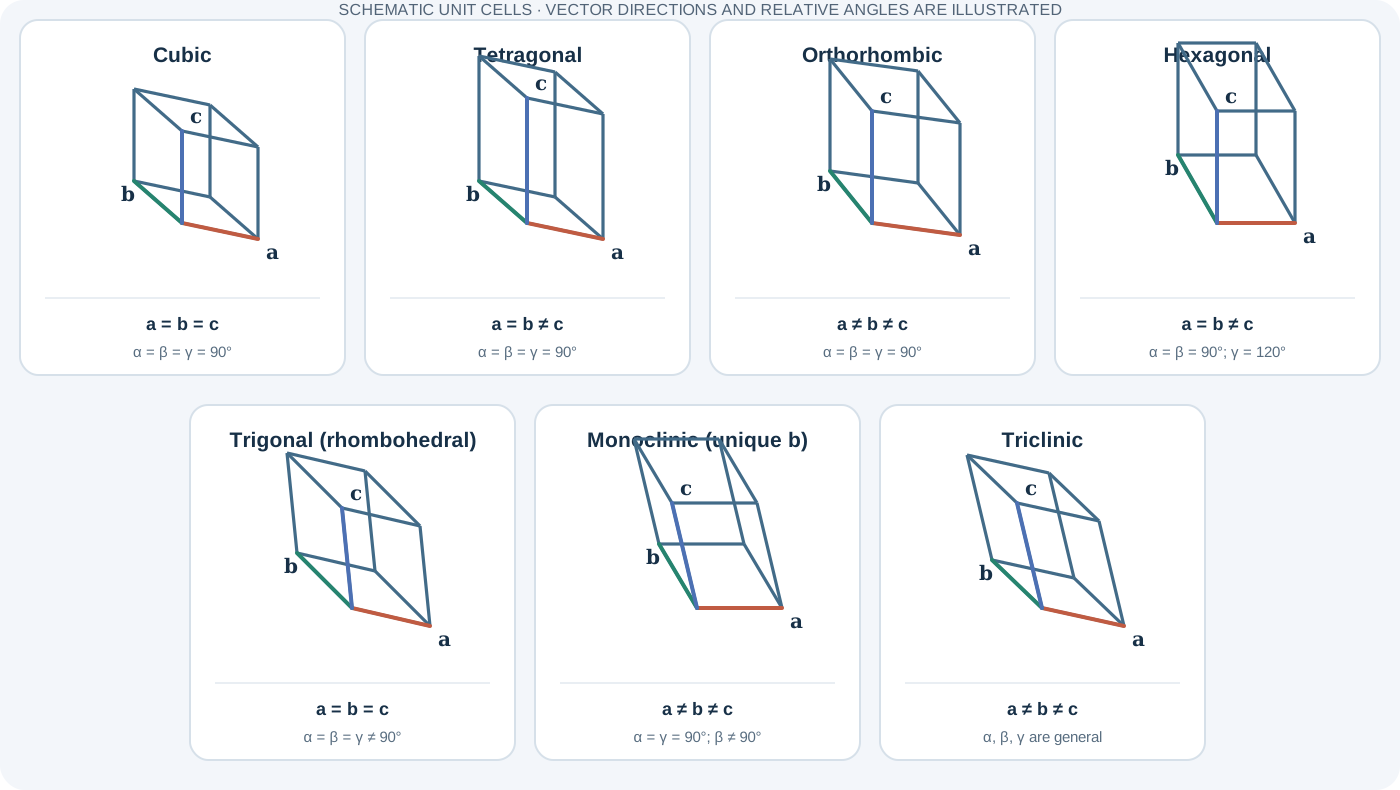
| Crystal system | Lattice constraints | Unit-cell volume |
|---|---|---|
| Cubic | \(a=b=c\); \(\alpha=\beta=\gamma=90^\circ\) | \(V=a^3\) |
| Tetragonal | \(a=b\ne c\); all angles 90° | \(V=a^2c\) |
| Orthorhombic | \(a\ne b\ne c\); all angles 90° | \(V=abc\) |
| Hexagonal | \(a=b\ne c\); \(\alpha=\beta=90^\circ,\;\gamma=120^\circ\) | \(V=\frac{\sqrt{3}}{2}a^2c\) |
| Trigonal (rhombohedral axes) | \(a=b=c\); \(\alpha=\beta=\gamma\ne90^\circ\) | \(V=a^3\sqrt{1-3\cos^2\alpha+2\cos^3\alpha}\) |
| Monoclinic (unique axis b) | \(a\ne b\ne c\); \(\alpha=\gamma=90^\circ\) | \(V=abc\sin\beta\) |
| Triclinic | General lengths and angles | \(V=abc\sqrt{1-\cos^2\alpha-\cos^2\beta-\cos^2\gamma+2\cos\alpha\cos\beta\cos\gamma}\) |
Trigonal setting note: trigonal structures may be described using either rhombohedral axes or a hexagonal conventional cell. Use the volume expression matching the lattice parameters and cell setting in the CIF. Do not combine a hexagonal-cell volume with a Z value belonging to the primitive rhombohedral cell, or vice versa.
Centered cells: primitive, body-centred, face-centred and base-centred cells have different contents. The value of \(Z\) must correspond to the exact cell whose volume is used. The crystal system alone does not determine \(Z\); the space group, Wyckoff positions and chemical contents do.
2.2 How to obtain Z and the formula mass
- Confirm the refined chemical formula, including dopants, vacancies and non-stoichiometry where known.
- Obtain the lattice parameters and unit-cell setting from the refined CIF or crystallographic model.
- Read the number of formula units per cell (often labelled \(Z\) in a CIF or crystallographic report).
- Calculate the molar mass of the actual formula using standard atomic weights.
- Calculate the cell volume using the matching crystal-system expression, or use the unit-cell volume reported by a validated crystallographic refinement.
- Substitute \(Z\), \(M\) and \(V_{\mathrm{cell}}\) into the density equation.
Do not confuse \(Z\) with the number of atoms in the unit cell or the number of symmetry-independent atoms in the asymmetric unit. For a doped solid solution, use the composition actually represented by the structural model. If site occupancies are fractional, calculate the average mass per unit cell from those occupancies.
2.3 Worked crystallographic example: cubic BaTiO₃
Consider an illustrative cubic BaTiO₃ unit cell with \(a=4.000\) Å and \(Z=1\).
The molar mass is:
\[ M=137.327+47.867+3(15.999)=233.191\;\mathrm{g\,mol^{-1}} \]
The cubic cell volume is:
\[ V=a^3=(4.000)^3=64.000\;\mathrm{\AA^3} \]
Therefore:
\[ \rho_{\mathrm{theoretical}} =\frac{1.660539\times1\times233.191}{64.000} \approx6.05\;\mathrm{g\,cm^{-3}} \]
This is an illustrative calculation based on the stated lattice parameter, not a universal density value for every BaTiO₃ specimen. Real BaTiO₃ may be tetragonal or have a different composition and lattice parameters depending on temperature, processing and substitution.
3. Measure the bulk density: choose the method for the specimen
The measured density is:
\[ \rho_{\mathrm{bulk}}=\frac{m}{V_{\mathrm{bulk}}} \]
The external bulk volume includes open and closed pores. The correct way to determine this volume depends on the specimen shape, surface condition and porosity.
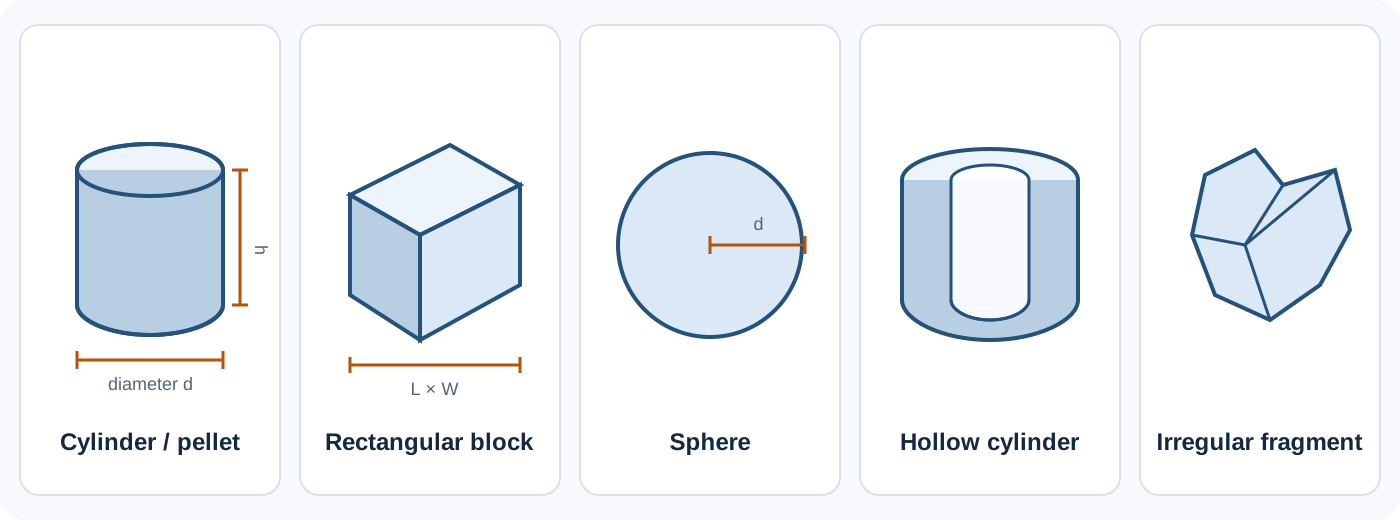
3.1 Cylindrical pellets and disks
Many ceramic pellets produced by uniaxial pressing or cold isostatic pressing are approximately cylindrical. Measure the diameter at several positions and the thickness at several positions; use representative averages.
\[ V_{\mathrm{cylinder}}=\pi r^2h =\frac{\pi d^2h}{4} \]
\[ \rho_{\mathrm{bulk}}= \frac{4m}{\pi d^2h} \]
Use consistent units. For example, if mass is in grams and dimensions are in centimetres, density is in g cm\(^{-3}\). A diameter measured in millimetres must be divided by 10 before using this expression with centimetres.
For a disk with chamfered edges, rounded edges, cracks or significant warping, the ideal cylinder formula may overestimate or underestimate the true external volume. Consider Archimedes’ method if the specimen is suitable for liquid displacement.
3.2 Rectangular or cuboid specimens
For a rectangular bar or block:
\[ V_{\mathrm{block}}=LWT \]
\[ \rho_{\mathrm{bulk}}=\frac{m}{LWT} \]
Measure length, width and thickness at multiple locations when the surfaces are not perfectly parallel. Report how the dimensions were averaged.
3.3 Spherical specimens
For a sphere of diameter \(d\):
\[ V_{\mathrm{sphere}}=\frac{4}{3}\pi r^3 =\frac{\pi d^3}{6} \]
This method is appropriate only when the specimen is sufficiently spherical and its diameter can be measured accurately.
3.4 Hollow cylinders, rings and tubes
For a hollow cylindrical specimen:
\[ V_{\mathrm{ring}}=\pi h(R_o^2-R_i^2) \]
where \(R_o\) and \(R_i\) are the outer and inner radii. For thin-walled tubes, small errors in either radius can produce a large relative error in the calculated wall volume. Measure both diameters carefully.
3.5 Irregular fragments or specimens
A geometric formula is usually unsuitable for irregular pieces. Liquid displacement (Archimedes’ method) can determine bulk density if the liquid does not react with the material and the specimen can be properly saturated and weighed. For highly porous, cracked or liquid-sensitive specimens, select a method and protocol designed for those conditions.
4. Archimedes’ method for ceramic pellets
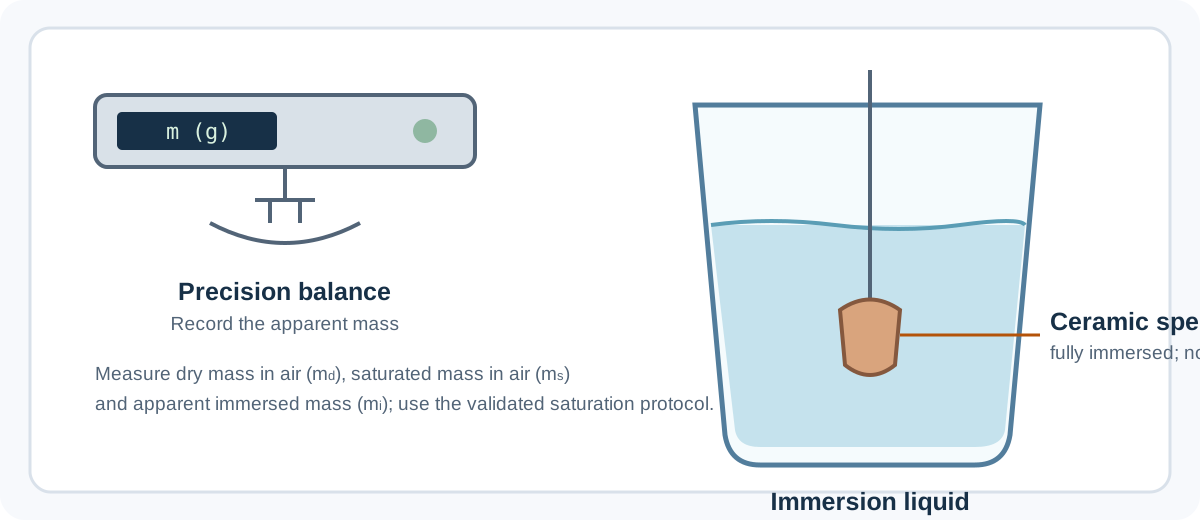
For many sintered ceramics, the Archimedes method is a practical way to determine bulk density. It uses buoyancy to determine the specimen’s external volume. A typical liquid-displacement procedure uses three masses:
- \(m_d\): dry mass in air.
- \(m_s\): saturated, surface-dry mass in air.
- \(m_i\): apparent mass while suspended and immersed in the liquid.
- \(\rho_l\): density of the immersion liquid at the measurement temperature.
The bulk density is:
\[ \boxed{\rho_{\mathrm{bulk}}= \frac{m_d}{m_s-m_i}\rho_l} \]
The expression assumes that the saturation procedure has filled accessible open pores and that surface liquid has been removed consistently. The liquid density and temperature must be recorded.
A common related quantity is apparent porosity:
\[ P_{\mathrm{open}}(\%)= \frac{m_s-m_d}{m_s-m_i}\times100 \]
This is an open-porosity measure under the method’s assumptions; it is not the total porosity when closed pores are present.
Practical measurement sequence
- Dry the specimen to constant mass using a temperature appropriate for the material, then cool it in a desiccator and record \(m_d\).
- Immerse the specimen in the selected liquid and apply the specified saturation procedure (for example, vacuum or boiling where permitted by the applicable method).
- Remove the specimen, remove surface droplets using a reproducible surface-drying procedure, and record \(m_s\).
- Suspend the saturated specimen in the liquid without allowing it to touch the vessel; remove attached bubbles and record \(m_i\).
- Measure or obtain the liquid density at the test temperature.
- Calculate bulk density and then relative density.
Do not use the three-mass equation blindly. The exact drying, saturation, wiping and weighing procedure must follow the applicable standard and be suitable for the material. Trapped bubbles, incomplete saturation, liquid absorption, dissolution or reaction with the liquid can bias the result.
ISO 18754:2020 describes liquid-displacement (Archimedes) and geometric methods for fine ceramics. It also cautions that the liquid-displacement method may be unsuitable for specimens with high apparent porosity, very low open porosity or large average pore sizes. Consult the standard for the full procedure and applicability limits.
5. Calculate relative density: a ceramic pellet example
Suppose a sintered ceramic pellet has:
- Dry mass: \(m_d=2.500\) g
- Saturated mass in air: \(m_s=2.530\) g
- Suspended mass in water: \(m_i=2.105\) g
- Water density at the measurement temperature: \(\rho_l=0.997\) g cm\(^{-3}\)
- Theoretical density from the crystallographic model: \(\rho_{\mathrm{theoretical}}=6.05\) g cm\(^{-3}\)
First, calculate the bulk density:
\[ \rho_{\mathrm{bulk}}= \frac{2.500}{2.530-2.105}\times0.997 =5.865\;\mathrm{g\,cm^{-3}} \]
Then calculate relative density:
\[ D_{\mathrm{rel}}= \frac{5.865}{6.05}\times100 \approx96.9\% \]
This illustrative example gives a plausible high densification result. The calculated open porosity from these masses is approximately 7.1%; the result still depends on complete saturation, careful surface drying and the suitability of the immersion liquid.
For a specimen with a measured bulk density of 5.75 g cm\(^{-3}\) and theoretical density of 6.05 g cm\(^{-3}\):
\[ D_{\mathrm{rel}}= \frac{5.75}{6.05}\times100 \approx95.0\% \]
The corresponding estimated total porosity is approximately 5.0% only if the theoretical density is appropriate for the actual solid phases and the bulk density includes the full external volume.
6. Which density method should you use?
| Specimen or objective | Suitable approach | Main limitation |
|---|---|---|
| Regular cylindrical pellet | Mass + diameter + thickness | Edge defects and dimensional uncertainty |
| Rectangular bar or block | Mass + length × width × thickness | Non-parallel or rough faces |
| Dense, non-reactive irregular pellet | Archimedes liquid displacement | Requires reliable wetting and saturation |
| Open-pore ceramic | Archimedes with a validated saturation protocol | Incomplete saturation biases the result |
| Powder or finely divided solid | Gas pycnometry for skeletal/true density | Not the same as the bulk density of a sintered body |
| Multiphase ceramic | Phase-aware theoretical density plus bulk-density measurement | A single-phase theoretical density can be misleading |
A gas pycnometer generally measures skeletal density: gas-accessible pores are excluded from the displaced volume, while closed pores may remain included. It should not be substituted for bulk density when the objective is to quantify the densification of a porous pellet.
7. Important sources of error
- Incorrect Z or cell setting: the wrong number of formula units per unit cell directly changes the calculated theoretical density.
- Wrong chemical composition: dopant concentration, oxygen non-stoichiometry, vacancies and secondary phases affect formula mass and/or phase density.
- Unit errors: mixing Å, nm, mm and cm is a frequent source of large mistakes.
- Dimensional uncertainty: the cylinder volume depends on diameter squared; a small diameter error can noticeably affect the calculated density.
- Open and closed porosity: the method must measure the intended volume. Open pores may fill with liquid during Archimedes measurements; closed pores do not.
- Surface liquid and trapped bubbles: inconsistent wiping or bubbles attached during immersion distort mass readings.
- Temperature: liquid density changes with temperature; use the value at the actual measurement temperature.
- Multiphase materials: compare the measured bulk density with a theoretical density that represents the actual phase assemblage, not automatically the density of the nominal starting composition.
8. Relative density of a composite or multiphase specimen
A sintered specimen is not always a single phase. During synthesis or heat treatment, the target material may coexist with one or more secondary phases. These phases may arise from incomplete reaction, chemical decomposition, contamination, or changes in composition during processing. If a secondary phase is detected by X-ray diffraction (XRD), the theoretical density used to calculate relative density should represent the actual solid phase assemblage, rather than automatically assuming that the entire specimen is the nominal target phase.
The measured bulk density still includes the specimen’s pore volume. What changes is the reference theoretical density: it must be the pore-free density of the target phase plus the secondary phase(s).
8.1 Determine the phase fractions
First, determine the amount of each phase in the specimen. Quantitative phase analysis by Rietveld refinement of the XRD pattern (for example, using GSAS-II) can provide phase weight fractions when the refinement model and data quality are suitable.
For a two-phase specimen, define:
- \(w_1\): weight fraction of the target phase.
- \(w_2\): weight fraction of the secondary phase.
- \(w_1+w_2=1\).
For example, a result of 90 wt% target phase and 10 wt% secondary phase corresponds to \(w_1=0.90\) and \(w_2=0.10\).
Check what the reported fractions represent. Rietveld quantitative phase fractions are commonly reported on a weight basis, but software outputs and post-processing may present different bases. Do not insert volume percentages into a weight-fraction equation. Also note that ordinary normalization of crystalline phases does not automatically quantify an amorphous or unmodelled fraction; an internal standard or another suitable method may be required if such material is present.
8.2 Calculate the theoretical density of the phase mixture
If the phase fractions are weight fractions, calculate the pore-free mixture density using the reciprocal rule:
\[ \boxed{ \rho_{\mathrm{solid,mix}}= \left( \frac{w_1}{\rho_1}+ \frac{w_2}{\rho_2}+\cdots+ \frac{w_n}{\rho_n} \right)^{-1} } \]
where \(\rho_i\) is the crystallographic density of phase \(i\), calculated from that phase’s own composition, unit-cell volume and number of formula units per cell. The weight fractions must be expressed as decimal fractions and sum to one.
This relation follows from additive phase volumes: for a total mass \(m\), phase \(i\) occupies volume \(m w_i/\rho_i\). The total volume is therefore \(m\sum_i(w_i/\rho_i)\), and density is total mass divided by total volume.
If the phase fractions are instead volume fractions \(\phi_i\), use the volume-weighted arithmetic relation:
\[ \boxed{ \rho_{\mathrm{solid,mix}}=\sum_{i=1}^{n}\phi_i\rho_i } \qquad\text{with}\qquad \sum_i\phi_i=1 \]
Do not use the arithmetic weight-fraction average \(\sum_i w_i\rho_i\); it is generally incorrect for weight fractions.
8.3 Worked example: target phase plus a secondary phase
Assume quantitative XRD analysis gives 90 wt% target phase and 10 wt% secondary phase. Suppose their crystallographic densities are 6.05 and 5.20 g cm\(^{-3}\), respectively. These values are illustrative; in an actual study, calculate or obtain each phase density from the appropriate crystallographic model.
\[ w_1=0.90,\qquad w_2=0.10 \]
\[ \rho_{\mathrm{solid,mix}}= \left( \frac{0.90}{6.05}+ \frac{0.10}{5.20} \right)^{-1} =5.953\;\mathrm{g\,cm^{-3}} \]
The mixture’s theoretical density is therefore approximately 5.953 g cm\(^{-3}\), not 6.05 g cm\(^{-3}\). The difference occurs because the secondary phase contributes both mass and solid volume.
8.4 Calculate relative density using the mixture density
Once the pore-free mixture density has been calculated, use it as the denominator in the relative-density equation:
\[ \boxed{ D_{\mathrm{rel,mix}}(\%)= \frac{\rho_{\mathrm{bulk,measured}}} {\rho_{\mathrm{solid,mix}}} \times100 } \]
For example, if the measured bulk density is 5.70 g cm\(^{-3}\):
\[ D_{\mathrm{rel,mix}}= \frac{5.70}{5.953}\times100 \approx95.8\% \]
Using the target-phase density alone would give a different result and could misrepresent the densification of the multiphase specimen.
8.5 Practical cautions
- Calculate each phase density separately. Use the correct composition, unit-cell parameters, cell setting and \(Z\) for each identified phase. Do not use the target phase’s density for the secondary phase.
- Use phase fractions on a consistent basis. Weight fractions require the reciprocal rule; volume fractions require the arithmetic volume-weighted rule.
- Account for amorphous material where relevant. Conventional crystalline-phase normalization can make the identified crystalline phases sum to 100% even when an amorphous fraction is present. Use a suitable internal-standard approach if that fraction must be quantified.
- Assess the refinement quality. Peak overlap, preferred orientation, microabsorption, an incomplete phase model and poor counting statistics can affect quantitative phase fractions. Report the refinement and measurement limitations.
- Do not confuse phase fraction with porosity. Rietveld phase fractions describe the relative amounts of modeled solid phases; they do not directly measure open or closed pores.
- State the assumptions. The mixture-density equations assume that the phase fractions and phase densities are representative and that phase volumes are additive. They do not correct for unmodelled phases, reaction layers or composition gradients.
For a specimen containing a target phase and a detectable secondary phase, this phase-aware calculation is generally a more appropriate reference for relative density than treating the specimen as a single-phase material.
9. A practical reporting checklist
When reporting relative density in a paper or laboratory report, include:
- Chemical composition and the structural model used for theoretical density.
- Crystal system, lattice parameters, unit-cell volume and the value of \(Z\).
- The calculated theoretical density and its units.
- Specimen geometry and dimensions, or the liquid-displacement protocol.
- Dry, saturated and immersed masses when using Archimedes’ method.
- Immersion-liquid identity and temperature.
- Number of specimens, repeat measurements and uncertainty or standard deviation.
- Whether the reported value is bulk, skeletal, apparent or geometric density.
References and further reading
- International Organization for Standardization, ISO 18754:2020, Fine ceramics (advanced ceramics, advanced technical ceramics) — Determination of density and apparent porosity. ISO standard page.
- P. F. Lindley, “Determination of the density of solids,” in International Tables for Crystallography, Volume C: Mathematical, Physical and Chemical Tables. Online chapter.
- For the crystallographic cell contents and unit-cell parameters, use the original structure report or a validated CIF for the specific composition and temperature under study.