Symmetry Elements and Symmetry Operations in Crystals: Rotation, Reflection, Inversion, and More
Symmetry Elements and Symmetry Operations in Crystals: Rotation, Reflection, Inversion, and More
Symmetry is one of the most useful concepts in crystallography. It describes the operations that leave a crystal structure indistinguishable from its original configuration. Symmetry is not simply a visual property of a unit-cell drawing: it is a precise mathematical description of how atomic positions, orientations and the periodic lattice are related.
Understanding symmetry operations is essential before assigning a space group, interpreting Wyckoff positions, reading a CIF file, or analysing systematic absences in an X-ray diffraction (XRD) pattern. This guide introduces the symmetry elements used in crystallography and distinguishes operations that are often confused, particularly inversion, mirror reflection and diffraction reflection.
1. What is a symmetry operation?
A symmetry operation is a transformation that maps an object onto an indistinguishable configuration. In a crystal, the transformation must be compatible with the periodic arrangement of the structure.
For a point with Cartesian position vector (r), a general symmetry operation can be represented as
\[ \boxed{\mathbf r'=R\mathbf r+\mathbf t} \]
where:
- (r) is the original position.
- (r’) is the transformed position.
- (R) is a matrix representing the rotational or reflection part.
- (t) is a translation vector.
In crystallography, coordinates are often expressed as fractional coordinates relative to the unit-cell vectors (a,b,c). In that setting, symmetry operations are commonly written in the form
\[ \begin{pmatrix}x'\\y'\\z'\end{pmatrix} = R \begin{pmatrix}x\\y\\z\end{pmatrix} + \begin{pmatrix}t_x\\t_y\\t_z\end{pmatrix} \]
The entries of (R) and the translation components are constrained by the lattice and the space group. Fractional coordinates may be equivalent modulo integer lattice translations; for example, (x’=x+1) represents the same periodic position as (x’=x) in a neighbouring unit cell.
Symmetry element versus symmetry operation
These terms are related but not identical:
- A symmetry operation is the mathematical transformation, such as inversion or a 90° rotation.
- A symmetry element is the geometrical entity associated with that operation, such as an inversion centre, rotation axis or mirror plane.
For a pure translation, the symmetry operation is a displacement by a lattice vector. For a mirror operation, the associated symmetry element is the mirror plane.
2. Identity operation (1)
The identity operation leaves every point unchanged:
\[ (x,y,z)\longrightarrow(x,y,z) \]
Its matrix is the identity matrix:
\[ I=\begin{pmatrix} 1&0&0\\0&1&0\\0&0&1 \end{pmatrix} \]
Every space group contains the identity operation. It is denoted by (1) in crystallographic symmetry notation.
3. Translation symmetry
A crystal is periodic. Translating the complete structure by an integer combination of its lattice vectors reproduces the same arrangement:
\[ \mathbf r'=\mathbf r+u\mathbf a+v\mathbf b+w\mathbf c \]
where (u,v,w) are integers for a lattice translation.
Translations are fundamental to crystals, but not every translation is a symmetry operation of the lattice. The translation must map the full periodic structure onto itself. Fractional translations can also occur when combined with a point operation, as in screw axes and glide planes.
4. Rotational symmetry axes
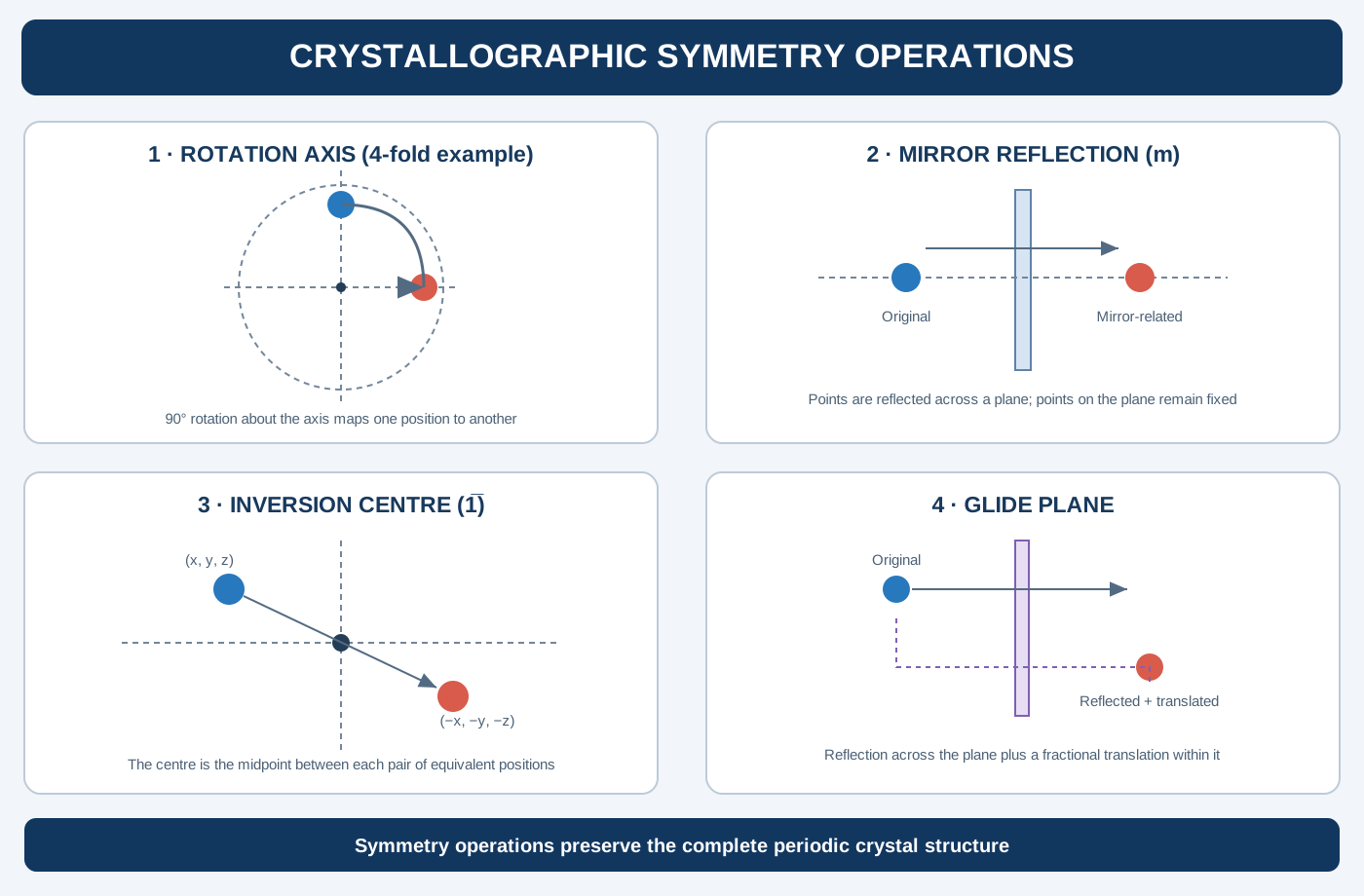
A rotation operation turns a structure through an angle about an axis. Crystallographic periodicity restricts the allowed proper rotation orders to:
\[ n=1,2,3,4,6 \]
The rotation angle is
\[ \boxed{\theta=\frac{360^\circ}{n}} \]
| Rotation symbol | Rotation angle | Meaning |
|---|---|---|
| 1 | 360° (identity) | No net change |
| 2 | 180° | Twofold axis |
| 3 | 120° | Threefold axis |
| 4 | 90° | Fourfold axis |
| 6 | 60° | Sixfold axis |
For example, a fourfold rotation about the (z)-axis maps
\[ (x,y,z)\longrightarrow(-y,x,z) \]
A second application gives
\[ (x,y,z)\longrightarrow(-x,-y,z) \]
and four applications return the original position.
Why are fivefold axes not allowed as ordinary crystallographic rotation axes? A fivefold rotation cannot generate a periodic two-dimensional lattice by itself. This is a consequence of the crystallographic restriction theorem. Quasicrystals can exhibit fivefold symmetry, but they are not periodic crystals in the conventional translational sense.
5. Mirror reflection (m)
A mirror operation reflects a point through a plane. For a mirror plane perpendicular to the (x)-axis and passing through the origin:
\[ \boxed{(x,y,z)\longrightarrow(-x,y,z)} \]
The plane (x=0) is unchanged by this operation. Points on the plane remain fixed, while points on opposite sides are mapped to corresponding positions.
Other mirror orientations produce different coordinate transformations. For example:
- Mirror perpendicular to (y): ((x,y,z)(x,-y,z)).
- Mirror perpendicular to (z): ((x,y,z)(x,y,-z)).
A mirror plane is denoted by (m). In Hermann–Mauguin notation, the orientation of the mirror relative to the crystallographic directions is important; the symbol alone does not specify every geometrical detail.
6. Inversion symmetry (({1}))
Inversion maps every point through a centre of inversion to the point on the opposite side at the same distance:
\[ \boxed{(x,y,z)\longrightarrow(-x,-y,-z)} \]
For an inversion centre at the origin, the position vector changes sign:
\[ \mathbf r'=-\mathbf r \]
A crystal has a centre of inversion if every atom at ((x,y,z)), with a particular chemical identity and occupancy, has an equivalent atom at ((-x,-y,-z)), modulo lattice translations.
The inversion operation is denoted by ({1}). The bar is essential: it distinguishes inversion from the identity operation (1).
How to test an inversion centre
For a proposed inversion centre at the origin:
- Select an atom with fractional coordinates ((x,y,z)).
- Apply inversion to obtain ((-x,-y,-z)).
- Reduce the resulting coordinates modulo integer translations to the unit-cell range used by the crystallographic software.
- Check whether an atom of the same species, occupancy and relevant structural description exists at the transformed position.
- Repeat for all independent atomic sites.
If the transformed position is not occupied by an equivalent atom, that proposed point is not an inversion centre of the complete structure.
Important: an inversion centre need not be located at the origin of the chosen unit cell. A change of origin changes the coordinate expression of the operation, not the physical symmetry. Also, checking only the shape of a polyhedron or the positions of one chemical species is insufficient; the complete decorated crystal structure must satisfy the operation.
Why inversion symmetry matters
Centrosymmetry has important consequences for physical properties. For example, in a bulk centrosymmetric crystal, electric-dipole second-harmonic generation is forbidden in the electric-dipole approximation under the usual assumptions. The piezoelectric tensor vanishes for a centrosymmetric point group. These statements concern bulk crystal symmetry; surfaces, interfaces, defects, applied fields and local symmetry breaking can change the response.
Not all non-centrosymmetric crystals are piezoelectric: the non-centrosymmetric point group 432 is a well-known exception. Pyroelectricity and ferroelectricity require additional symmetry conditions and physical behaviour; they should not be inferred merely from the absence of inversion.
7. Roto-inversion operations
A roto-inversion operation combines a rotation with inversion. It is written using a barred rotation symbol, such as
\[ \bar{1},\;\bar{2},\;\bar{3},\;\bar{4},\;\bar{6} \]
The operation consists of a rotation about an axis followed by inversion through a point on that axis. The order of applying these operations is part of the mathematical definition; in this context, the resulting crystallographic roto-inversion operation is represented by the corresponding barred symbol.
For example, ({2}) is equivalent to a mirror reflection perpendicular to the twofold axis. This is a useful relationship, but other roto-inversion operations should not be casually identified with a simple mirror plane.
A roto-inversion axis is different from a screw axis. Roto-inversion combines a point inversion with a rotation; a screw operation combines a rotation with a fractional translation parallel to the axis.
8. Glide planes
A glide plane combines reflection through a plane with a fractional translation parallel to that plane.
A simplified glide operation can be written as
\[ \mathbf r'=M\mathbf r+\mathbf t_{\parallel} \]
where (M) is the mirror-reflection matrix and (t_{}) is a fractional translation lying in the mirror plane.
Common glide types include:
- a-glide: translation by half a unit-cell vector along (a).
- b-glide: translation by half a unit-cell vector along (b).
- c-glide: translation by half a unit-cell vector along (c).
- n-glide: a half translation along a face diagonal, subject to the lattice setting.
- d-glide: a diamond glide, involving characteristic quarter translations in suitable lattice settings.
The exact coordinate operation depends on the orientation of the glide plane and the chosen crystallographic setting. Glide planes are important because their fractional translations can produce systematic absences in diffraction.
9. Screw axes
A screw axis combines rotation with a fractional translation parallel to the rotation axis. It is represented by symbols such as (2_1), (3_1), (3_2), (4_1), (4_2), (4_3), (6_1), and others.
For a (2_1) screw axis parallel to (c), one possible operation in fractional coordinates is
\[ (x,y,z)\longrightarrow(-x,-y,z+\tfrac12) \]
This is a 180° rotation about the axis followed by a translation of half the unit-cell repeat along that axis.
The subscript describes the translational fraction associated with the rotation. For an (n_m) screw axis, the rotation is (360^/n) and the translation is (m/n) of the lattice repeat along the axis, subject to the crystallographic setting and equivalence conventions.
Screw axes are not merely geometrical curiosities: they impose reflection conditions that help distinguish candidate space groups from diffraction data.
10. Quick comparison of symmetry operations
| Operation | Geometrical element | Main action |
|---|---|---|
| Identity | No element required | Leaves all coordinates unchanged |
| Translation | Lattice displacement | Moves by a lattice vector |
| Rotation | Axis | Rotates by an allowed angle |
| Mirror | Plane | Reflects through a plane |
| Inversion | Centre | Maps (r) to (-r) about the centre |
| Roto-inversion | Axis and centre | Rotation combined with inversion |
| Glide reflection | Plane | Reflection plus in-plane fractional translation |
| Screw rotation | Axis | Rotation plus axial fractional translation |
11. Do not confuse inversion, mirror reflection and X-ray reflection
The word reflection is used in two different contexts:
- Mirror reflection is a crystallographic symmetry operation that maps atomic coordinates through a mirror plane.
- X-ray diffraction reflection refers to a diffracted beam associated with a reciprocal-lattice vector or a set of lattice planes indexed by ((hkl)).
An XRD reflection is not a mirror plane and does not, by itself, demonstrate inversion symmetry. Similarly, an inversion centre is not an X-ray reflection.
A diffraction pattern contains information about the periodic electron density and symmetry constraints. Determining a space group requires analysis of reflection conditions, intensity information, candidate structural models and the limitations of the diffraction experiment. Some distinctions, especially between certain centrosymmetric and non-centrosymmetric structures, may not be resolved from routine powder XRD alone.
12. How symmetry operations build a space group
A point group describes the symmetry operations that leave at least one point fixed. A space group describes the full symmetry of a periodic crystal, including translations and operations such as screw axes and glide planes.
In three-dimensional crystallography, there are 32 crystallographic point groups and 230 space groups. The space-group symbol summarizes the symmetry, but the full list of coordinate operations is needed for practical structural work.
For example, a space group may contain:
- Identity and lattice translations.
- Rotational axes.
- Mirror planes or inversion centres.
- Screw axes and glide planes.
- Combinations of these operations.
The next step after understanding symmetry operations is learning how they generate symmetry-equivalent atomic positions and how those positions are organized into Wyckoff positions.
13. Practical checklist when reading a crystal structure
When examining a CIF or crystallographic information table:
- Identify the reported space-group number and Hermann–Mauguin symbol.
- Check the chosen unit-cell setting and origin choice.
- Read the symmetry-operation list rather than relying only on the symbol.
- Identify whether inversion, mirror, glide or screw operations are present.
- Check atomic coordinates and their symmetry-generated equivalents.
- Confirm that chemical species and occupancies are preserved by the proposed operations.
- Use the reflection conditions as a consistency check against diffraction data.
Key takeaways
- Symmetry operations are mathematical transformations that leave the complete periodic crystal structure indistinguishable.
- Rotation axes in periodic crystals have crystallographically allowed orders 1, 2, 3, 4 and 6.
- A mirror operation reflects through a plane; inversion maps (r) to (-r) through a centre.
- Roto-inversion combines rotation and inversion, while glide and screw operations include fractional translations.
- Inversion symmetry has important implications for tensor properties and optical responses, but non-centrosymmetry alone does not guarantee every such property.
- An XRD reflection is a diffraction event indexed by ((hkl)), not a mirror-reflection symmetry operation.
Further reading
- International Tables for Crystallography, Volume A: Space-Group Symmetry. International Union of Crystallography. https://it.iucr.org/A/.
- International Union of Crystallography, Online Dictionary of Crystallography. https://dictionary.iucr.org/.
- Bilbao Crystallographic Server, crystallographic symmetry tools and databases. https://www.cryst.ehu.es/.
- C. Giacovazzo et al., Fundamentals of Crystallography, 3rd edition, Oxford University Press.