Ceramic Gelcasting: Colloidal Stability, Polymerization Kinetics, Gel Mechanics and Drying
Ceramic Gelcasting: Colloidal Stability, Polymerization Kinetics, Gel Mechanics and Drying
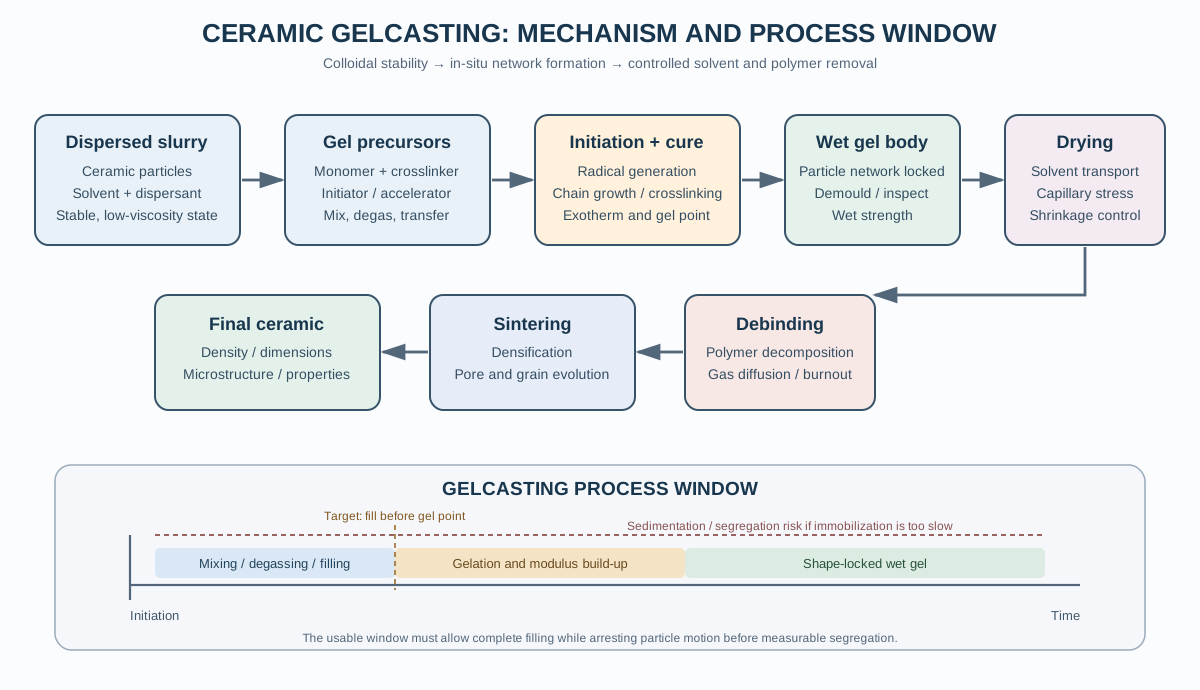
Ceramic gelcasting is a colloidal forming route in which a concentrated ceramic suspension is consolidated by forming a continuous gel network inside the mould. Unlike slip casting, consolidation does not primarily depend on liquid extraction through a porous mould. Unlike ceramic injection moulding, the feedstock is generally a low-viscosity, solvent-based slurry that is converted into a self-supporting body by an in-situ gelation reaction.
The defining scientific problem is the coupling of two evolving structures:
- A concentrated particulate suspension whose dispersion state determines packing and flow.
- A polymeric or physically associated network whose formation immobilizes the particles and gives the wet body mechanical integrity.
A successful process must preserve the suspension’s homogeneity until the network becomes strong enough to arrest particle motion. It must then remove solvent and organic matter without generating stresses that exceed the strength of the evolving porous body.
2. Suspension design: the first controlling problem
2.1 Why high solids loading is not sufficient
The slurry must combine high ceramic volume fraction with sufficiently low viscosity for mixing, degassing, transfer and mould filling. Raising solids loading reduces the amount of solvent to be removed and can improve green packing, but it also increases hydrodynamic interactions and the probability of particle contacts.
A useful first-order description of the relative viscosity of a concentrated suspension is the Krieger–Dougherty relation:
[ _r = = (1-)^{-[]_m} ]
where (_r) is relative viscosity, (_0) is the continuous-phase viscosity, () is particle volume fraction, (_m) is the maximum packing fraction and ([]) is the intrinsic viscosity. For ideal rigid spheres, ([]) is often taken as 2.5, but real ceramic powders deviate because of angularity, polydispersity, agglomeration, surface forces and non-spherical morphology.
The model is useful for understanding why viscosity rises sharply as () approaches (_m). It is not a substitute for rheological measurements on the actual slurry.
2.2 Maximum packing and particle-size distribution
A broad or deliberately multimodal size distribution can increase packing efficiency if smaller particles occupy voids between larger particles. However, the gain is not automatic. Fine particles increase specific surface area and may increase dispersant demand, while differences in sedimentation velocity can promote segregation.
The practical maximum packing fraction must therefore be determined experimentally. Useful measurements include:
- Particle-size distribution by laser diffraction, with dispersion conditions reported.
- SEM analysis of particle shape and agglomeration.
- BET specific surface area.
- Slurry viscosity as a function of solids loading.
- Sedimentation or stability measurements over the actual processing time.
- Green density and pore-size distribution after consolidation.
A high measured solids loading is only useful if the slurry remains stable and can be processed before gelation begins.
2.3 Colloidal interactions and stability
The suspension’s stability reflects the balance of attractive and repulsive interactions. In aqueous systems, electrostatic repulsion can be adjusted through pH and ionic composition, while steric or electrosteric stabilization can be provided by adsorbed polymers.
The classical DLVO framework expresses the interaction energy schematically as:
[ U_{}(h)=U_{}(h)+U_{}(h) ]
where (h) is the surface separation, (U_{}) is the van der Waals attraction and (U_{}) is the electrical-double-layer interaction. Polymer adsorption adds steric contributions that are not represented by the simplest DLVO expression.
The zeta potential is useful as a comparative indicator, but it is not a universal stability criterion. A large absolute zeta potential can indicate electrostatic stabilization in a suitable electrolyte environment; it does not prove that the slurry will remain stable at high solids loading or after adding monomer, crosslinker, initiator and other additives.
2.4 Dispersant adsorption and dosage optimization
Dispersant dosage should be related to powder surface area and adsorption behaviour rather than selected only as a percentage of powder mass. Under-dosing can leave attractive surface regions and promote agglomeration. Over-dosing can increase dissolved polymer concentration, alter ionic strength, change viscosity or interfere with gel chemistry.
A robust optimization sequence is:
- Establish the powder’s aqueous surface chemistry over the relevant pH range.
- Measure the slurry response without dispersant.
- Screen dispersant concentration while monitoring pH, conductivity and viscosity.
- Identify the concentration range where viscosity reaches a stable minimum without loss of suspension stability.
- Re-check rheology after adding the complete gel precursor solution.
- Verify that the selected dispersant does not inhibit or excessively accelerate polymerization.
The optimum dispersant concentration in water alone may not remain optimum after monomer and crosslinker addition.
3. Rheology before gelation
The slurry must flow during transfer and filling but remain stable against sedimentation and particle migration. A shear-thinning response is often useful because viscosity decreases under the shear rates encountered during mixing and filling.
A generalized Herschel–Bulkley relation can be used when a yield-like response is observed:
[ = _y + K^{n} ]
where () is shear stress, (_y) is the apparent yield stress, (K) is the consistency index and (n) is the flow index. This model is empirical. A fitted yield stress can depend on the measurement protocol, rest time, preshear and wall-slip control.
For process qualification, report the complete flow curve and measurement history rather than a single viscosity value. Include temperature, geometry, gap, shear-rate range, preshear, rest period and evidence that the measurement is not dominated by wall slip or sedimentation.
3.1 Time-dependent stability
A slurry can have acceptable initial rheology but become unstable during the time required for mixing, degassing and mould filling. Time-dependent viscosity, sedimentation and flocculation should be monitored over a realistic process window.
Useful tests include:
- Repeated flow curves after defined rest intervals.
- Oscillatory amplitude sweeps to identify the linear viscoelastic region.
- Frequency sweeps to compare storage modulus (G’) and loss modulus (G’’).
- Sedimentation or optical stability measurements.
- Rheology before and after the complete additive package is introduced.
The key acceptance criterion is not simply low viscosity. It is reproducible, stable and fillable rheology throughout the available processing time.
4. In-situ polymerization gelcasting
4.1 Network formation
In conventional free-radical gelcasting, a water-soluble monomer and a multifunctional crosslinker are dissolved in the liquid phase. An initiator generates radicals, and polymerization produces chains that become interconnected through crosslinking. The growing network spans the liquid phase and immobilizes the suspended ceramic particles.
A simplified sequence is:
[ ]
[ ]
[ ]
Crosslinking introduces network junctions, transforming the liquid precursor into a three-dimensional gel. These expressions illustrate the radical process but do not capture the full kinetics of a concentrated ceramic suspension.
The gel point is not necessarily the point of complete monomer conversion. It is the onset of a sample-spanning network with measurable long-time mechanical response.
4.2 Monomer, crosslinker and initiator roles
| Component | Function | Main optimization risk |
|---|---|---|
| Monomer | Forms the polymer chains | Residual monomer, toxicity and polymerization heat |
| Crosslinker | Connects chains into a three-dimensional network | Excessive crosslink density can increase brittleness and drying stress |
| Initiator | Generates reactive radicals or triggers the selected reaction | Too fast: short filling window; too slow: sedimentation and incomplete setting |
| Accelerator / catalyst | Modifies initiation rate where the chemistry uses one | Local concentration gradients and premature gelation |
| Dispersant | Stabilizes the ceramic particles before setting | Interaction with initiator, pH or polymer network |
| Solvent | Enables slurry preparation and transport | Drying shrinkage, capillary stress and environmental burden |
The monomer system should be selected based on toxicity, polymerization kinetics, solvent compatibility, green strength and the thermal decomposition behaviour of the resulting polymer. The historical acrylamide-based route established the method, but acrylamide has significant neurotoxicity concerns. Low-toxicity alternatives, including other vinyl monomers and naturally derived polymer systems, have therefore been widely investigated. The alternatives are not automatically equivalent in cure kinetics or final green-body behaviour.
4.3 Oxygen inhibition and atmosphere control
Molecular oxygen can react with propagating carbon-centred radicals to form less reactive peroxy radicals. This can retard free-radical polymerization, particularly near exposed surfaces or in thin sections with a high surface-to-volume ratio.
Potential consequences include: - A weak or tacky surface layer. - Delayed surface cure relative to the interior. - Spatial variation in conversion and modulus. - Local differences in shrinkage and green strength.
The severity depends on monomer chemistry, initiator concentration, oxygen transport, temperature and the geometry of the mould. Degassing the slurry does not necessarily eliminate oxygen entering from the mould interface or headspace. Surface cure and bulk cure should be assessed separately where this risk is important.
4.4 Polymerization heat and cure gradients
Free-radical polymerization is exothermic. In a large casting, heat generation and heat dissipation can become spatially non-uniform. A local temperature rise accelerates reaction kinetics, which can further increase the local reaction rate.
The thermal balance can be represented schematically as:
[ C_p = k^2T + (-H_p)R_p ]
where () is density, (C_p) is heat capacity, (k) is thermal conductivity, (H_p) is the polymerization enthalpy and (R_p) is the polymerization rate per unit volume. The equation highlights the competition between heat generation and conduction; a real model may also need convection, mould contact resistance and temperature-dependent properties.
A temperature gradient can create a cure gradient. Since the gel network’s modulus and shrinkage response depend on conversion and crosslink density, asynchronous gelation can generate residual stress before drying even begins.
For thick or large components, monitor temperature at more than one location during cure. A small laboratory specimen may not reproduce the thermal behaviour of a production-size part.
5. Gelation kinetics and process-window design
The processing window is the interval between introducing the reactive components and the point at which the slurry can no longer fill the mould reliably. It must be long enough for mixing, degassing, transfer and filling, but short enough to prevent sedimentation or particle redistribution before immobilization.
A simplified kinetic expression for conversion is:
[ =k(T)f() ]
with an Arrhenius temperature dependence:
[ k(T)=A(-) ]
where () is conversion, (A) is the pre-exponential factor, (E_a) is apparent activation energy and (f()) represents the reaction mechanism. For radical polymerization, the true rate law can be more complex because radical concentration, termination, oxygen inhibition and diffusion-controlled effects may change during cure.
Gel time should be defined operationally. Possible definitions include: - A specified increase in complex viscosity. - A crossover of (G’) and (G’’), when that criterion is appropriate to the material. - A defined storage-modulus threshold. - Loss of the ability to flow under a specified test condition.
These definitions are not interchangeable. Report the method and measurement frequency or test condition.
5.1 Cure kinetics measurements
Differential scanning calorimetry (DSC) can measure polymerization exotherms and compare reaction onset and heat release. Isothermal DSC is useful for evaluating cure behaviour at selected temperatures, while non-isothermal DSC can help identify thermal sensitivity.
Rheological cure monitoring provides complementary information on the evolution of viscoelasticity. The time at which (G’) begins to rise sharply, the (G’/G’’) crossover and the subsequent modulus development can be compared with DSC conversion data.
A robust study combines: - DSC heat-flow data. - Rheological time sweeps. - Temperature monitoring within representative castings. - Green-body mechanical measurements. - Spatial inspection for cure gradients.
A single gel-time value cannot describe the entire cure state or prove uniform polymerization.
6. Gel mechanics and the evolving ceramic skeleton
6.1 From liquid suspension to particle-filled gel
Before gelation, the particles are mobile and the slurry response is governed mainly by suspension rheology. As the polymer network develops, it progressively constrains particle motion. After gelation, the body behaves as a particle-filled viscoelastic solid.
The resulting mechanical response depends on: - Polymer conversion and crosslink density. - Polymer concentration relative to ceramic volume. - Particle–polymer interfacial interactions. - Ceramic particle packing and agglomeration. - Residual solvent content. - Temperature and time after gelation.
The polymer network must be strong enough to support demoulding and handling, but excessive network stiffness or brittleness can increase stress during solvent removal.
6.2 Oscillatory rheology
For small-amplitude oscillatory shear, the complex modulus is:
[ G^*()=G’()+iG’’() ]
where (G’) is the storage modulus, (G’’) is the loss modulus and () is angular frequency.
A rise in (G’) indicates development of elastic structure. A (G’=G’’) crossover is often used as an operational gel point, but the interpretation depends on frequency and the material’s relaxation spectrum. A more rigorous critical-gel analysis examines the frequency dependence of both moduli and the loss tangent.
The gel point should not be assigned from a single frequency without qualification. In systems with broad relaxation times or strong filler-network contributions, the crossover may shift with frequency.
6.3 Green strength and demoulding
The wet gel must withstand gravity, mould release and handling. Demoulding is governed by the balance between body strength, adhesion to the mould, geometric interlocking and capillary or suction effects at the interface.
Mould design should consider: - Surface finish and release behaviour. - Draft angles and undercuts. - Dimensional change during cure. - Thermal expansion mismatch. - Permeability and compatibility with the solvent. - Chemical compatibility with monomers, initiators and dispersants.
A chemically inert, non-porous mould is often attractive because it avoids uncontrolled liquid extraction. However, the actual mould material must be tested for swelling, inhibition, contamination and release performance.
7. Drying physics: why gelcast parts crack
Drying is frequently the most difficult stage for large or complex gelcast components. Solvent leaves the pore network, menisci form, and capillary pressure acts on the particle skeleton.
For an ideal cylindrical pore, the Laplace pressure can be approximated by:
[ P = ]
where () is liquid–vapour surface tension, () is the contact angle and (r) is the effective meniscus radius. Smaller pores can therefore generate larger capillary pressures, although real ceramic pore networks have complex geometry and evolving saturation.
Drying stress arises when capillary pressure, shrinkage and moisture gradients are constrained by spatially varying stiffness. The surface may become mechanically rigid while the interior remains solvent-rich. Differential shrinkage then produces tensile stresses, warpage or cracking.
7.1 Drying stages and transport
A simplified drying sequence includes: 1. Surface evaporation with a relatively wet interior. 2. Development of moisture gradients and a falling drying rate. 3. Internal transport becoming increasingly rate-limiting. 4. Continued removal of bound or confined solvent. 5. Final dimensional stabilization.
The actual stages depend on solvent, pore structure, sample geometry, temperature, humidity and airflow. The classic constant-rate/falling-rate framework is useful but may not fully describe a polymer-containing ceramic gel.
7.2 Diffusion-controlled moisture removal
A first approximation for moisture transport is Fick’s second law:
[ =D_{}^2C ]
where (C) is local solvent concentration and (D_{}) is an effective diffusivity. In a drying gel, (D_{}) can vary with moisture content, temperature, pore connectivity and polymer structure. A constant-diffusivity fit should therefore be treated as an effective engineering approximation over the tested range.
For a characteristic diffusion length (L), the drying timescale scales approximately as:
[ t_d ]
This quadratic dependence explains why increasing component thickness can dramatically increase drying time and amplify internal moisture gradients.
7.3 Stress, shrinkage and fracture
A simple constrained-shrinkage estimate is:
[ E_{}_{} ]
where (E_{}) is the effective modulus and (_{}) is the constrained shrinkage strain. This is only a scaling relation: real gels are viscoelastic, porous, moisture-dependent and may relax stress during drying.
Cracking occurs when local tensile stress exceeds the evolving fracture resistance. The fracture resistance is not constant during drying because the polymer network, solvent content and particle contacts change continuously.
A useful drying study therefore measures mass loss, dimensional change and mechanical response together. Recording only total drying time cannot identify the origin of a crack.
7.4 Drying strategies
Potential strategies include: - Controlled temperature and relative-humidity ramps. - Reduced airflow during the early, high-gradient stage. - Symmetric exposure of surfaces where geometry permits. - Solvent exchange to modify surface tension or transport. - Humidity-controlled equilibration before final drying. - Support fixtures that reduce distortion without constraining shrinkage excessively. - Physically and chemically crosslinked gel networks designed to improve strain tolerance.
No single drying schedule is universal. It must be validated against the part’s maximum thickness, pore structure, gel chemistry and target dimensional tolerance.
8. Debinding: polymer decomposition is a kinetic and transport problem
In free-radical gelcasting, the polymer network is generally not a simple low-molecular-weight wax that can be removed by capillary wicking. Thermal decomposition is commonly used, and the decomposition products must diffuse through the evolving pore network.
The mass-loss conversion can be expressed as:
[ = ]
where (m_0) is the initial mass, (m_t) is the mass at time (t) and (m_) is the final mass after the selected thermal programme.
For a non-isothermal experiment:
[ =A(-)f() ]
The apparent activation energy may vary with conversion if multiple reactions overlap or the controlling mechanism changes. A single Kissinger estimate can therefore be insufficient for a complex polymer network.
8.1 Thermal analysis and kinetic model selection
A useful debinding programme includes: - TGA at multiple heating rates. - DTG analysis to identify overlapping mass-loss events. - DSC where thermal events require separation. - Evolved-gas analysis, FTIR or Py-GC/MS where decomposition products need identification. - Isoconversional methods such as Friedman, Flynn–Wall–Ozawa or Kissinger–Akahira–Sunose. - Validation using representative bulk components rather than only finely ground samples.
Model-free kinetic methods estimate conversion-dependent apparent activation energy without requiring a single reaction model. They do not, by themselves, identify a unique chemical mechanism. Model-fitting should be supported by evolved-gas evidence and physical interpretation.
8.2 Coupled heat and mass transfer
A large component can experience temperature and gas-concentration gradients during debinding. A schematic species balance is:
[ =(D_{}c_g)+R_g ]
where (c_g) is the concentration of volatile decomposition products, (D_{}) is their effective diffusivity and (R_g) is the local generation rate. If generation is faster than transport, internal gas pressure can increase and produce cracks, blisters or delamination.
The heating schedule must therefore be selected from the overlap of: - Polymer decomposition kinetics. - Gas permeability and evolving pore connectivity. - Part thickness and surface-to-volume ratio. - Atmosphere and gas-flow conditions. - Mechanical strength of the partially debound body.
9. Alternative gelcasting chemistries
9.1 Low-toxicity and non-toxic aqueous systems
The historical acrylamide route is scientifically important, but acrylamide’s neurotoxicity makes exposure control and alternative chemistry important considerations. Alternatives include other vinyl monomers, polysaccharides, proteins, cellulose derivatives and other naturally derived polymers.
These systems differ in gelation mechanism: - Free-radical polymerization. - Physical association and thermoreversible gelation. - Ionic crosslinking. - Hydrogen-bond-mediated network formation. - Polymer complexation or other specific interactions.
A substitute should be compared on more than toxicity. Important criteria include slurry compatibility, gel time, green strength, drying strain, residual carbon, decomposition products and the effect of polymer residues on the final ceramic.
9.2 Thermoreversible gelcasting
Thermoreversible systems use physical association to create a network when temperature changes. The gel may soften or liquefy when heated and reform upon cooling, providing a potentially reversible processing window.
This can be advantageous when the casting contains initial defects that need correction before final setting. However, the process requires control of temperature uniformity and the thermal history of the entire mould. It is not equivalent to irreversible covalent crosslinking.
9.3 Gelcasting for porous and architected ceramics
Gelcasting can also be combined with foaming, sacrificial templates or other pore-forming routes. In such cases, the suspension’s rheology and gelation kinetics must stabilize both the ceramic particles and the introduced pore architecture.
The challenge changes from maximizing density to controlling pore size, connectivity, anisotropy and wall integrity. Foam stability, bubble coalescence, drainage and gelation time become coupled variables.
10. Defect diagnosis by process signature
| Observed defect | Likely mechanism | Discriminating measurements |
|---|---|---|
| Sedimentation or density gradient | Insufficient suspension stability or excessive delay before gelation | Time-dependent rheology, sedimentation, top-to-bottom density |
| Agglomerate-derived pores | Incomplete deagglomeration or poor dispersant coverage | SEM, particle-size analysis, green-body tomography |
| Weak surface / tacky region | Oxygen inhibition or surface-specific cure imbalance | Surface vs core conversion, local mechanical testing |
| Cure-gradient cracking | Non-uniform initiation, temperature or polymerization rate | Multi-point temperature, DSC, spatial modulus |
| Demoulding fracture | Insufficient wet strength, adhesion or geometric locking | Wet-gel strength, mould-release test, surface inspection |
| Drying cracks | Capillary stress and moisture-gradient-driven shrinkage | Mass-loss curve, dimensional mapping, humidity history |
| Warpage | Asymmetric drying, non-uniform stiffness or support constraint | Directional shrinkage, moisture profile, shape metrology |
| Debinding cracks / blisters | Volatile generation faster than gas transport | Multi-rate TGA, evolved-gas analysis, permeability |
| Residual carbon | Incomplete decomposition or unsuitable atmosphere | TGA residue, carbon analysis, atmosphere verification |
| Non-uniform sintering shrinkage | Initial packing or green-density gradient | Green density mapping, dilatometry, final dimensional map |
The diagnosis should follow the process history. A crack observed after sintering may have originated during gelation, drying or debinding and only become visible after densification.
11. Advanced experimental workflow
A research-grade development programme should isolate the coupled variables rather than change multiple formulation parameters simultaneously.
A. Powder and suspension - Characterize particle-size distribution, morphology and surface area. - Establish pH, conductivity and dispersant adsorption response. - Determine viscosity versus solids loading. - Quantify stability over the complete processing time.
B. Cure chemistry - Screen monomer and crosslinker chemistry. - Measure gel time using a defined rheological criterion. - Compare DSC cure exotherms with rheological evolution. - Assess oxygen sensitivity and temperature gradients. - Measure wet-gel modulus and demoulding strength.
C. Drying - Measure mass-loss and dimensional-change curves. - Map temperature and humidity history. - Compare drying routes or solvent-exchange strategies. - Determine effective diffusivity only within a stated model and geometry. - Quantify warpage and crack statistics.
D. Debinding - Collect TGA/DTG data at multiple heating rates. - Use isoconversional analysis before selecting a reaction model. - Identify volatile products when necessary. - Validate schedules using representative component thicknesses. - Inspect residual carbon and internal defects.
E. Final ceramic - Measure green and sintered density. - Quantify shrinkage in multiple directions. - Characterize pore structure and grain size. - Evaluate application-specific mechanical, electrical, thermal or optical properties. - Report repeatability and sample-to-sample variation.
12. Minimum reporting standard for a publishable study
A technically reproducible gelcasting paper should include:
- Powder composition, particle-size distribution, morphology, specific surface area and surface condition.
- Solvent, monomer, crosslinker, initiator, accelerator and dispersant identities and concentrations.
- pH, conductivity, temperature and mixing sequence.
- Ceramic solids loading in vol%, with the density basis stated.
- Rheology protocol, flow curves and time-dependent stability.
- Degassing procedure and time between initiation and mould filling.
- Mould material, geometry, surface condition and thermal boundary conditions.
- Gel-time definition, cure temperature and spatial temperature history where relevant.
- Wet-gel strength or viscoelastic data and demoulding procedure.
- Drying temperature, humidity, airflow, mass-loss and dimensional-change data.
- TGA/DTG conditions, heating rates, atmosphere and debinding mass balance.
- Sintering schedule, final density, shrinkage, porosity and microstructure.
- Replicate count, uncertainty and defect statistics.
13. Key conclusions
Gelcasting is not merely a slurry that solidifies after adding a gelling agent. It is a coupled colloidal, chemical, rheological and transport process. Suspension stability determines the spatial distribution of ceramic particles; polymerization kinetics determine when and how that distribution becomes immobilized; gel mechanics determine whether the wet body can be demoulded; drying determines the evolution of capillary and shrinkage stresses; and debinding kinetics determine whether decomposition products can escape without damaging the ceramic skeleton.
For advanced process development, the central design target is uniformity across length scales and throughout time: uniform particle dispersion before cure, uniform conversion during gelation, controlled moisture gradients during drying and controlled volatile transport during debinding.
References
- A. C. Young, O. O. Omatete, M. A. Janney and P. A. Menchhofer, “Gelcasting of Alumina,” Journal of the American Ceramic Society 74 (1991), 612–618. https://doi.org/10.1111/j.1151-2916.1991.tb04068.x.
- J. Yang, J. Yu and Y. Huang, “Recent developments in gelcasting of ceramics,” Journal of the European Ceramic Society 31 (2011), 2569–2591. https://doi.org/10.1016/j.jeurceramsoc.2010.12.035.
- “A review on aqueous gelcasting: A versatile and low-toxic technique to shape ceramics,” Ceramics International 45 (2019), 9653–9673. https://doi.org/10.1016/j.ceramint.2018.12.079.
- “Evaluation of the in Situ Polymerization Kinetics for the Gelcasting of Ceramic Foams,” Chemistry of Materials 13 (2001), 3882–3887. https://doi.org/10.1021/cm0102180.
- “Thermoreversible Gelcasting: A Novel Ceramic Processing Technique,” Journal of the American Ceramic Society (2002). https://doi.org/10.1111/j.1151-2916.2002.tb00239.x.
- “Modeling of liquid desiccant drying method for gelcast ceramic parts,” Ceramics International 29 (2003), 199–207. https://doi.org/10.1016/S0272-8842(02)00106-2.
- “Viscoelastic behaviors and drying kinetics of different aqueous gelcasting systems for large Nd:YAG laser ceramics rods,” Journal of the American Ceramic Society 103 (2020), 3513–3527. https://doi.org/10.1111/jace.17052.
- J. Li, J. Huang and R. Yin, “Multistage kinetic analysis of DMAA/MBAM polymer removal from gelcast ceramic parts using a multi-stage parallel reaction model and model-free method,” RSC Advances 9 (2019), 27305–27317. https://doi.org/10.1039/C9RA04489B.
- “Gelcasting: From laboratory development toward industrial production,” Journal of the European Ceramic Society 17 (1997), 407–413. https://doi.org/10.1016/S0955-2219(96)00147-1.
- “Gelcasting, a near net shape technique,” Materials & Design 21 (2000), 251–257. https://doi.org/10.1016/S0261-3069(99)00075-8.