Sol-Gel Drying and Thermal Conversion: Xerogels, Aerogels and Oxide Formation
Sol-Gel Drying and Thermal Conversion: Xerogels, Aerogels and Oxide Formation
A wet gel is a liquid-filled network. Converting it into a dry powder, monolith, coating or porous body requires removal of liquid and, in many systems, subsequent removal of organic groups and development of the intended inorganic structure.
These operations are not a single step. Drying removes pore liquid; thermal decomposition or burnout removes volatile organic components; crystallization and phase development occur during later heat treatment when required. Combining these stages without understanding their different mechanisms can cause cracking, pore collapse, residual carbon or unwanted phase formation.
1. What is inside a wet gel?
A wet gel may contain:
- An inorganic or metal–oxygen network.
- Surface hydroxyl and residual alkoxy groups.
- Solvent and water held within pores.
- Catalyst, counterions or unreacted precursor species.
- Organic modifiers, chelating agents or polymeric components.
The composition depends on the synthesis route. A gel produced from a simple alkoxide sol is not chemically equivalent to a polymer-complex resin or a particle-based colloidal gel. The drying and heating programme must therefore be designed around the actual gel chemistry.
2. Xerogel and aerogel: the drying route matters
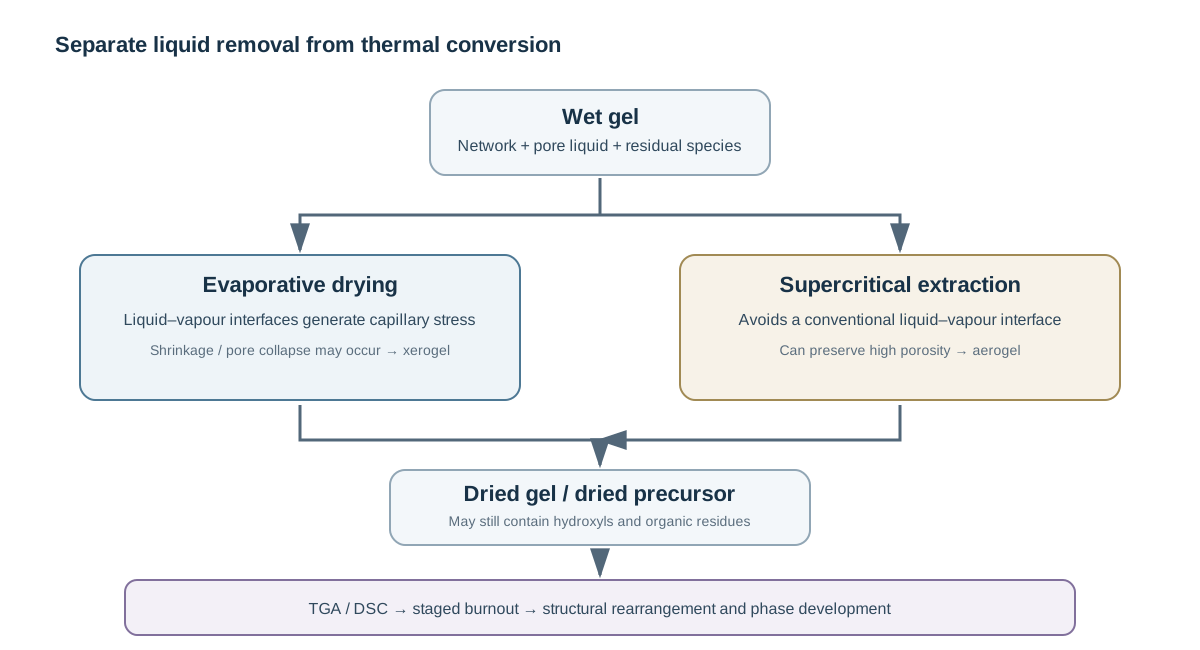
A xerogel is generally produced by evaporative drying of a gel. As liquid leaves the pores, curved liquid–vapour interfaces generate capillary pressure. The network may shrink, densify or crack.
An aerogel is produced using a drying route designed to avoid or greatly reduce the liquid–vapour interface within the pore network, commonly by supercritical extraction. The resulting material can retain a highly porous structure and low bulk density.
The terms describe different processing outcomes; neither is simply a synonym for a wet gel or a dry powder. Ambient-pressure drying can also be engineered to preserve porosity, but often requires surface modification and careful solvent exchange.
3. Capillary pressure and drying stress
For an ideal cylindrical pore with a liquid–vapour meniscus, the Laplace pressure magnitude can be represented as:
[ P = ]
where:
- () is the liquid surface tension,
- () is the contact angle,
- (r) is the effective meniscus or pore radius.
This relation is an idealized description. Real gels have interconnected, irregular pores, distributions of pore sizes and evolving contact angles. Nevertheless, it shows why small pores and high-surface-tension liquids can generate substantial capillary stresses.
If the network cannot withstand the stress, it may contract, develop cracks or lose pore volume. Drying stress is influenced by pore size, solvent properties, network stiffness, sample dimensions and the rate at which solvent is removed.
4. Choosing a drying strategy
| Route | Main principle | Potential advantage | Main limitation |
|---|---|---|---|
| Evaporative drying | Solvent evaporates from the gel | Simple equipment and direct processing | Capillary stress, shrinkage and cracking |
| Controlled-humidity drying | Evaporation rate is moderated | Can reduce surface-to-core drying gradients | Requires controlled environment and may be slow |
| Solvent exchange followed by drying | Pore liquid is replaced by a more suitable solvent | Can reduce drying stress or prepare for another route | Adds handling steps and risks network disturbance |
| Ambient-pressure surface-modified drying | Surface chemistry is adjusted to reduce capillary effects | Avoids high-pressure equipment | Chemistry-sensitive and not universal |
| Supercritical drying | Extraction avoids a conventional liquid–vapour interface | Can preserve highly porous networks | Specialized equipment, process safety and solvent handling |
A drying route should be selected according to the target form and the properties that must be retained. If the objective is a dense oxide powder, retaining an aerogel-like pore network may not be necessary. If the objective is a porous monolith, uncontrolled evaporative drying may be unacceptable.
5. Drying-rate control
Fast surface evaporation can create a moisture and concentration gradient between the surface and the interior. The outer region may stiffen or contract while the centre remains solvent-rich. This mismatch can produce tensile stress, warping and cracks.
Useful process controls include:
- Keep sample dimensions and exposed surface area consistent.
- Avoid abrupt changes in temperature, airflow or relative humidity.
- Use staged drying when the gel is mechanically weak.
- Record sample mass as a function of time to follow solvent removal.
- Compare dimensional shrinkage with mass loss.
- Avoid assuming that a constant mass means all chemically bound organics have been removed.
A mass-loss curve can be reported as:
[ (t)=% ]
where (m_0) is the defined initial mass and (m_t) is the mass at time (t). State whether the initial mass refers to the wet gel, solvent-exchanged gel or partially dried gel.
6. Thermal conversion: from dried network to inorganic material
After drying, many gels still contain hydroxyl groups, residual organic ligands, chelating agents, polymeric species or counterions. Heating may involve several overlapping processes:
- Desorption of physically adsorbed water and solvent.
- Dehydration and dehydroxylation.
- Decomposition or oxidation of organic groups.
- Removal of volatile reaction products.
- Structural rearrangement and densification.
- Nucleation and growth of crystalline phases.
The temperature ranges and sequence are composition- and atmosphere-dependent. A single generic calcination temperature cannot be assigned to all sol-gel-derived materials.
7. Use thermal analysis to design the heating programme
Thermogravimetric analysis (TGA) measures mass change during a programmed temperature profile. Differential scanning calorimetry (DSC) measures heat-flow differences associated with thermal events. Simultaneous thermal analysis can combine mass and heat-flow information.
Interpretation should consider:
- Sample mass and pan configuration.
- Heating rate.
- Gas identity, flow rate and oxygen availability.
- Whether the sample is a wet gel, dried gel or precursor powder.
- Overlap between solvent loss, organic decomposition and crystallization.
- Possible reaction with the pan or gas environment.
A TGA mass-loss step does not identify the evolved gas by itself. Coupling TGA to mass spectrometry or FTIR can help identify volatile products, but the interpretation still requires appropriate calibration and spectral analysis.
A practical thermal-programme design
- Dry the gel to a reproducible starting state.
- Collect TGA/DSC under the intended or a justified representative atmosphere.
- Identify mass-loss intervals and thermal events.
- Select intermediate hold temperatures around major decomposition stages when needed.
- Use a conservative heating rate through intervals where rapid gas evolution is observed.
- Verify the intermediate product before increasing the maximum temperature.
- Confirm the final phase and residual carbon/organic content using suitable characterization.
This is a design workflow, not a universal temperature schedule. The actual ramp rates and hold temperatures must be selected from measured data and the intended chemistry.
8. Why rapid heating can fail
If organic decomposition and gas release occur faster than gases can escape from the body, internal pressure can build. This may cause foaming, bloating, cracking or fragmentation. Thick monoliths and polymer-rich gels are particularly sensitive to transport limitations.
A slow ramp is not automatically optimal: excessively long treatment can promote grain growth, unwanted reactions or contamination. The goal is to coordinate decomposition rate, gas transport and structural evolution.
9. Characterization at each stage
| Stage | Useful methods | Main question |
|---|---|---|
| Wet gel | Rheology, visual inspection, mass and dimensions | Has a reproducible network formed? |
| Dried gel | TGA/DSC, FTIR, BET, SEM | What remains in the dried network? |
| Thermally treated intermediate | XRD, FTIR/Raman, TGA if needed | Have organics been removed and has crystallization begun? |
| Final product | XRD/Rietveld, SEM, BET, elemental analysis as appropriate | Are phase, morphology, composition and porosity acceptable? |
BET surface area and pore-size analysis require appropriate degassing conditions. Degassing itself can change a fragile or hydroxylated material, so the pretreatment temperature and duration must be reported.
10. Common problems and diagnosis
| Observation | Possible cause | Useful diagnostic |
|---|---|---|
| Cracks during drying | Capillary stress or drying gradients | Compare mass-loss and dimensional-change profiles |
| Strong shrinkage | Network collapse or syneresis followed by drying | Separate wet-ageing and drying measurements |
| Foaming during heating | Rapid gas evolution from organics or trapped solvent | TGA/DSC and evolved-gas analysis |
| Dark residue after heat treatment | Incomplete oxidation or carbonaceous residue | TGA in suitable atmosphere, elemental carbon analysis |
| Unexpected crystalline phases | Composition segregation or thermal reaction | XRD with phase analysis and composition checks |
| Low surface area | Pore collapse, densification or excessive thermal exposure | BET and comparison of intermediate stages |
| Powder agglomeration | Neck formation or partial sintering | SEM and comparison of heat-treatment conditions |
11. Integrated drying and thermal-conversion workflow
References
- C. J. Brinker and G. W. Scherer, Sol-Gel Science: The Physics and Chemistry of Sol-Gel Processing, Academic Press, 1990. Publisher record.
- A. C. Pierre and G. M. Pajonk, “Chemistry of Aerogels and Their Applications,” Chemical Reviews 102 (2002), 4243–4266. https://doi.org/10.1021/cr0101306.
- A. E. Danks, S. R. Hall and Z. Schnepp, “The evolution of ‘sol–gel’ chemistry as a technique for materials synthesis,” Materials Horizons 3 (2016), 91–112. https://doi.org/10.1039/C5MH00260E.
Scope note: Drying and thermal-conversion conditions depend on gel composition, geometry, atmosphere and target properties. Use thermal analysis and staged characterization to establish a defensible process rather than transferring a generic heat-treatment schedule.