Sol-Gel Chemistry: Hydrolysis, Condensation and Network Formation
Sol-Gel Chemistry: Hydrolysis, Condensation and Network Formation
The sol-gel method is a solution-based route in which molecular or colloidal precursors are converted into an interconnected inorganic network. The process commonly involves hydrolysis and condensation reactions, followed by gelation, aging, drying and thermal treatment.
Unlike conventional solid-state synthesis, sol-gel chemistry can distribute different cations through a liquid precursor mixture before the inorganic network forms. This can improve compositional homogeneity, but it does not guarantee atomic-scale mixing or phase-pure products. Precursor reactivity, solution stability, pH, water content and drying behaviour all influence the final material.
1. What do “sol” and “gel” mean?
A sol is a colloidal suspension or dispersion of solid-like particles or polymeric species in a liquid. A gel is a system in which a continuous three-dimensional network spans the sample and immobilizes the liquid within its pores.
The sol-to-gel transition occurs when the growing inorganic species connect sufficiently to form a sample-spanning network. The detailed structure depends on the chemistry and processing conditions.
2. Common precursor families
Sol-gel synthesis can use several precursor families:
- Metal alkoxides: compounds containing metal–OR groups, often highly reactive toward water.
- Metal salts: nitrates, chlorides, acetates and other salts that can undergo hydrolysis, complexation or precipitation.
- Organometallic compounds: selected metal-organic precursors with controlled reactivity.
- Preformed colloids or oxide sols: used when the route relies on particle assembly rather than molecular alkoxide polymerization.
Metal alkoxides are widely used in classical sol-gel chemistry, but they are not mandatory for every sol-gel route. The precursor must be selected according to the target cations, solvent compatibility, hydrolysis behaviour and required processing scale.
3. Hydrolysis of metal alkoxides
A simplified hydrolysis reaction for a metal alkoxide is:
[ ]
where M is a metal centre, OR is an alkoxy group and ROH is the corresponding alcohol.
Hydrolysis replaces some or all alkoxy groups with hydroxyl groups. The equation is a general representation; actual coordination numbers, oligomeric species and reaction pathways depend on the metal, ligand, solvent and water content.
For a silicon alkoxide such as tetraethyl orthosilicate (TEOS), a simplified complete hydrolysis equation is:
[ ]
The resulting silanol species can then condense to form Si–O–Si linkages. Transition-metal alkoxides often exhibit different and sometimes much faster hydrolysis behaviour, so the TEOS example should not be transferred directly to titanium, zirconium or niobium alkoxides.
4. Condensation reactions
Condensation connects hydrolysed or partially hydrolysed species through metal–oxygen–metal bonds. Two commonly represented pathways are:
Water-producing condensation
[ ]
Alcohol-producing condensation
[ ]
Repeated condensation builds oligomers, clusters and eventually an extended inorganic network. In multicomponent systems, different metal centres may have substantially different hydrolysis and condensation rates. This mismatch is a major challenge when synthesizing homogeneous complex oxides.
5. Variables controlling hydrolysis and condensation
5.1 Water-to-precursor ratio
The molar ratio of water to metal alkoxide is commonly written as:
[ r= ]
This ratio influences the extent and rate of hydrolysis, but its effect cannot be interpreted independently of precursor functionality, solvent, pH and reaction time. A value that works for silica may be unsuitable for a highly reactive transition-metal alkoxide.
5.2 pH and catalysts
Acidic and basic conditions can change hydrolysis and condensation rates and can produce different network structures. The response is metal-specific: a pH adjustment may accelerate condensation in one system while causing uncontrolled precipitation in another.
The pH value measured in a mixed alcohol-water solvent may not be directly comparable to an aqueous pH reading. Record the measurement method, solvent composition and calibration approach.
5.3 Solvent
The solvent controls precursor solubility, water miscibility, reaction dilution and heat/mass transfer. Alcohols are common for alkoxide systems, but solvent choice must account for ligand exchange, water content, safety and downstream removal.
5.4 Temperature and addition rate
Temperature and the rate of water addition can affect local supersaturation and the rate of hydrolysis. Rapid addition can create local regions with high water concentration, potentially causing precipitation or non-uniform gelation.
For highly reactive alkoxides, controlled addition, dilution or chemical modification may be necessary.
6. Why multication sol-gel synthesis is challenging
For a complex oxide containing several cations, the objective is to distribute all metal species before segregation or precipitation occurs. A common difficulty is that different precursors hydrolyse at different rates.
For example, one metal alkoxide may hydrolyse rapidly upon contact with water, while another precursor remains soluble or reacts much more slowly. The result can be a mixture of hydroxide-rich precipitates and unreacted soluble species rather than a homogeneous molecular-scale network.
Strategies used to manage reactivity differences include: - Selecting precursors with compatible hydrolysis rates. - Controlling water addition and concentration. - Using chelating or complexing agents. - Adjusting solvent and pH. - Preparing stable precursor solutions separately before combining them. - Monitoring the solution for precipitation or turbidity.
These strategies are system-dependent and should be justified chemically rather than applied as a universal recipe.
7. Gelation and aging
Gelation is the formation of a continuous network that immobilizes the liquid. The gel point depends on precursor concentration, functionality, reaction rate, temperature and solution chemistry.
Aging is the period after gelation during which the network can continue to condense, reorganize and strengthen. Syneresis, in which the gel contracts and expels liquid, may occur. Solvent exchange or controlled aging may be used to modify pore-liquid composition and drying behaviour.
Gelation time is therefore not simply a measure of reaction completion. The network can continue evolving after the sample appears solid.
8. Drying and conversion to oxide powders
Drying removes liquid from the gel, but capillary forces can generate stresses and shrinkage. Depending on the route, the dried product may be described as a xerogel or aerogel; these terms refer to different drying histories and pore structures.
For powder synthesis, the dried gel is often thermally treated to remove residual organics, decompose salts or ligands, and crystallize the desired oxide phase. The required schedule depends on the precursor chemistry and should be investigated using thermal analysis and phase characterization.
9. Sol-gel workflow
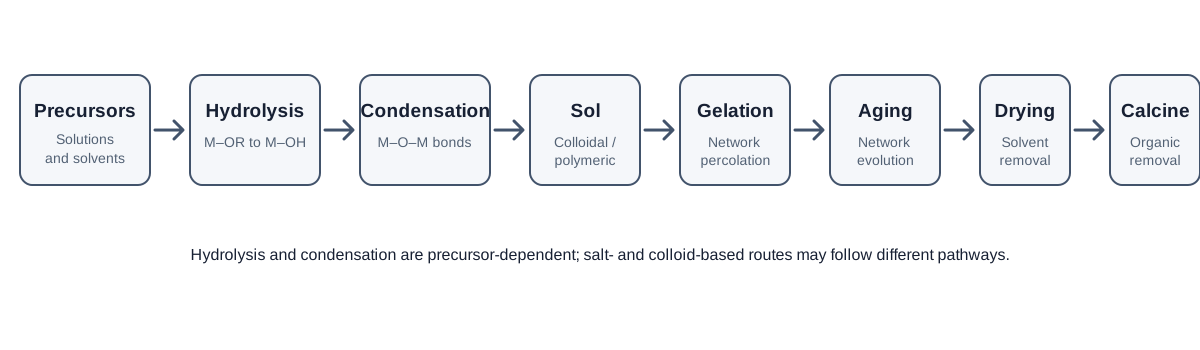
A practical development sequence is:
- Define the target composition and calculate the required cation amounts.
- Select precursors and verify their purity, hydration state and solvent compatibility.
- Prepare stable precursor solutions, separately if their reactivities are incompatible.
- Control water content, addition rate, pH and temperature.
- Observe hydrolysis, condensation and any precipitation.
- Allow gelation and define a reproducible aging period.
- Dry using a method compatible with the desired powder structure.
- Use TGA/DSC and XRD to develop the organic-removal and crystallization schedule.
- Check phase composition, morphology and elemental homogeneity.
10. Common problems and diagnostics
| Observation | Possible causes | Useful checks |
|---|---|---|
| Immediate precipitation after water addition | Hydrolysis too rapid, local water excess or poor precursor compatibility | Addition rate, dilution, solvent and precursor chemistry |
| No gelation | Low concentration, insufficient condensation or unsuitable pH | Concentration, reaction time and pH history |
| Different cations segregate | Mismatched precursor reactivity or selective precipitation | Solution stability, elemental mapping and phase analysis |
| Cracking during drying | Capillary stress, rapid solvent removal or gel shrinkage | Drying rate, sample geometry and solvent exchange |
| Large mass loss during calcination | Residual solvent, organics or decomposable anions | TGA/DSC and evolved-gas analysis |
| Secondary phases after calcination | Cation segregation, incorrect stoichiometry or incomplete reaction | XRD, bulk chemistry and thermal schedule |
11. Advantages and limitations
Advantages - Potential for intimate mixing of multiple cations in solution. - Lower synthesis temperatures may be possible for some systems. - Flexible control over composition and precursor chemistry. - Routes to powders, coatings, monoliths and porous materials. - Useful for compositions that are difficult to homogenize by dry mixing.
Limitations - Moisture-sensitive precursors may require controlled handling. - Hydrolysis rates can differ substantially between cations. - Gelation and drying can introduce shrinkage, cracking and agglomeration. - Residual carbon or other impurities may remain after incomplete thermal treatment. - Solvent use, recovery and waste treatment can complicate scale-up. - A clear gel does not prove chemical homogeneity or phase purity.
References
- J. Danks, S. Hall and Z. Schnepp, “The evolution of ‘sol–gel’ chemistry as a technique for materials synthesis,” Materials Horizons 3 (2016), 91–112. https://doi.org/10.1039/C5MH00260E
- C. J. Brinker and G. W. Scherer, Sol-Gel Science: The Physics and Chemistry of Sol-Gel Processing, Academic Press (1990).
Scope note: This article introduces general sol-gel chemistry. Precursor-specific recipes, especially for highly reactive transition-metal alkoxides and multication oxides, require separate treatment and should not be inferred from the simplified equations alone.