Sol Ageing, Gelation Kinetics and Structural Evolution
Sol Ageing, Gelation Kinetics and Structural Evolution
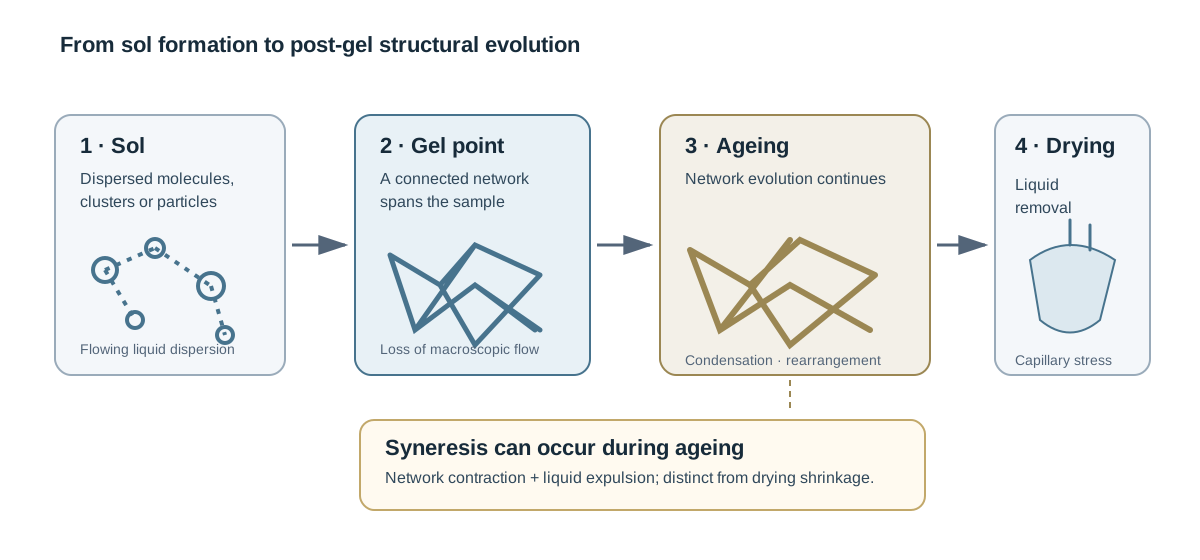
Gelation is not the end of sol-gel chemistry. After a continuous network first spans the liquid volume, condensation, dissolution–reprecipitation, particle rearrangement and solvent redistribution may continue. These post-gel changes determine whether a wet gel can be handled, dried without severe cracking and converted into a reproducible solid.
Three terms must be distinguished:
- Gelation: formation of a sample-spanning, mechanically connected network.
- Ageing: physical and chemical evolution of the gel after the gel point.
- Syneresis: contraction of the network accompanied by expulsion of liquid from the gel.
They are related, but they are not interchangeable. Their rates and relative importance depend on precursor chemistry, catalyst, solvent, concentration, temperature and the geometry of the sample.
1. From a flowing sol to a connected network
A sol contains molecular or colloidal species dispersed in a liquid. Hydrolysis and condensation can progressively increase the size and connectivity of these species. Gelation occurs when a connected structure spans the sample.
A simplified network-forming condensation step is:
[ ]
An alkoxide-bearing species may also react with a hydrolysed species:
[ ]
These equations represent common reaction motifs; actual sol-gel systems can involve oligomers, clusters, colloidal particles and multiple parallel pathways.
The gel point is a connectivity transition, not necessarily the moment at which every precursor molecule has reacted. A gel can contain residual alkoxy groups, hydroxyl groups, solvent and unreacted or weakly connected species.
2. What determines the gel time?
Gel time is an operational measurement: the time between a defined starting event and a defined gel-point criterion. The starting event might be water addition, catalyst addition or completion of mixing. The endpoint might be loss of flow, a rheological criterion or a specified vial-inversion test.
Consequently, reported gel times should not be compared unless the preparation history, sample geometry, temperature and endpoint definition are sufficiently similar.
Important variables include:
| Variable | Typical influence | Why it matters |
|---|---|---|
| Precursor concentration | Often shorter gel time at higher concentration | Increases the frequency of encounters between reactive species |
| Water content | Can accelerate hydrolysis, but the response is chemistry-dependent | Changes the population of hydrolysed species |
| Catalyst and pH | Can strongly alter hydrolysis and condensation pathways | Changes reaction rates and cluster-growth behaviour |
| Temperature | Usually accelerates reaction kinetics | Changes both reaction rate and solvent properties |
| Solvent composition | Can alter solubility, coordination and water activity | Affects precursor speciation and aggregation |
| Mixing and addition sequence | Can change local concentration gradients | Local premature gelation can create inhomogeneity |
| Chelating or modifying ligands | Can alter coordination and reactivity | May delay, redirect or otherwise modify network formation |
There is no universal direction or numerical relationship for every variable. For example, increasing water content does not guarantee a proportionally shorter gel time: the outcome depends on hydrolysis, condensation, phase separation and the stability of intermediate species.
3. Defining and measuring the gel point
No single test is ideal for every sol. A useful study combines a practical handling test with a measurement that follows the evolving material response.
3.1 Vial-inversion or flow test
A vial-inversion test records the time at which the sample no longer flows under a specified orientation and observation period. It is inexpensive and useful for screening, but it is subjective and sensitive to vial dimensions, sample volume and the chosen observation interval.
Use it as a consistently defined operational endpoint, not as a universal physical definition of gelation.
3.2 Rheology
Oscillatory rheology can follow the evolution of storage modulus, (G’), and loss modulus, (G’’). The storage modulus describes the elastic contribution, while the loss modulus describes the viscous contribution under the measurement conditions.
A simple frequency sweep at a single time is not sufficient to establish a universal gel point. A stronger approach is to collect time-dependent oscillatory data at multiple frequencies and examine the frequency dependence of the viscoelastic response. The Winter–Chambon criterion identifies critical gel behaviour through a frequency-independent loss tangent under the assumptions of the model.
In practice, instrument geometry, wall slip, evaporation, sample loading and the applied strain must be controlled. First establish the linear viscoelastic region so that the measurement does not disrupt the developing network.
3.3 Complementary measurements
- FTIR or Raman spectroscopy: can follow changes in functional groups, while band overlap and sample preparation may limit quantitative interpretation.
- NMR spectroscopy: can provide information on precursor conversion and local chemical environments when the system is suitable for the technique.
- DLS: can monitor hydrodynamic size in a stable, dilute dispersion; it becomes difficult to interpret as the sample approaches a space-spanning gel.
- SAXS or SANS: can probe characteristic length scales and structural correlations, subject to contrast and model limitations.
- Viscosity: useful for process monitoring, but a viscosity increase alone does not prove that a sample has reached a critical gel point.
4. Ageing: the network continues to evolve
After gelation, the solid-like network remains in contact with liquid in its pores. Chemical and physical processes can continue:
- Further condensation: additional M–O–M linkages may form between nearby species.
- Neck growth and strengthening: contacts between particles or clusters may become more strongly connected.
- Dissolution and reprecipitation: soluble species may dissolve from one region and deposit elsewhere.
- Structural rearrangement: the network can reorganize to reduce its free energy.
- Pore-liquid redistribution: liquid moves as the network contracts or its pore structure changes.
The balance between these processes is chemistry-dependent. Ageing may increase mechanical strength, change pore dimensions, reduce the concentration of residual reactive groups or cause macroscopic shrinkage.
An ageing time should therefore be reported as a controlled process parameter, not simply as a waiting period.
5. Syneresis and shrinkage
Syneresis is the contraction of a gel network with expulsion of liquid. It can occur as the network continues to condense or rearrange. The sample may become smaller while liquid accumulates around it or is released from the gel.
Do not confuse syneresis with drying shrinkage:
- Syneresis occurs in a liquid-containing gel and is associated with network contraction and liquid expulsion.
- Drying shrinkage occurs as liquid is removed and capillary stresses act within the pore network.
Both can contribute to dimensional change, but they have different driving forces and should be measured separately where possible.
A simple linear shrinkage metric is:
[ S_L = % ]
where (L_0) is the reference dimension at a clearly stated initial time and (L_t) is the dimension at the later measurement time. The measurement must specify whether it refers to wet-gel ageing, drying or a later heat-treatment stage.
6. Designing an ageing experiment
A useful ageing study separates the effects of gelation from those of post-gel treatment.
Recommended experimental logic
- Prepare a single, well-mixed sol using a documented addition sequence.
- Define time zero explicitly.
- Determine the operational gel time using a stated method.
- Prepare replicate samples with identical dimensions and fill volumes.
- Age samples at controlled temperature in sealed containers when solvent loss is not intended.
- Select several ageing intervals that span the process-relevant period.
- Record wet-gel dimensions, visible liquid separation and handling strength.
- Apply the same drying protocol to each sample.
- Compare dried mass, dimensions, cracking and subsequent phase/structure data.
For a meaningful comparison, maintain the same vessel geometry, headspace, sealing method and sample mass. If the aim is to study ageing temperature, vary temperature while holding the other variables constant.
Suggested response variables
| Response | What it can reveal | Important limitation |
|---|---|---|
| Gel time | Operational gelation kinetics | Depends on endpoint definition |
| Wet-gel shrinkage | Network contraction during ageing | Does not identify the molecular mechanism |
| Liquid expelled | Syneresis behaviour | May be affected by evaporation or leakage |
| Rheological modulus | Evolution of mechanical connectivity | Sensitive to geometry and test conditions |
| FTIR/Raman | Chemical-group evolution | Overlapping bands can complicate quantification |
| SAXS/SANS | Nanoscale structural evolution | Requires suitable contrast and a defensible model |
| Dried-gel porosity | Consequences of ageing plus drying | Cannot isolate ageing unless drying is controlled |
7. Common experimental problems
| Observation | Possible causes | Diagnostic approach |
|---|---|---|
| Gelation occurs during precursor addition | Local excess water, poor mixing or highly reactive precursor species | Review addition rate, mixing and solution compatibility |
| Large variation in gel time between batches | Uncontrolled temperature, moisture, concentration or reagent age | Standardize preparation and define time zero |
| Gel is weak immediately after formation | Low network connectivity or insufficient post-gel evolution | Compare ageing intervals and rheological response |
| Liquid appears around the gel | Syneresis, phase separation or solvent loss | Use sealed controls and record mass and dimensions |
| Gel cracks during handling | Nonuniform network, rapid contraction or mechanical disturbance | Compare sample geometry and ageing history |
| Different regions show different texture | Local concentration gradients or incomplete mixing | Review mixing regime and scale-up geometry |
8. Process-control checklist
Before transferring a sol-gel process to a larger batch, record:
- Exact precursor identity, assay and solution age.
- Solvent composition and water source.
- Catalyst identity and concentration.
- Addition order, addition duration and mixing conditions.
- Temperature during preparation and gelation.
- Definition and measured value of gel time.
- Ageing temperature, duration and container sealing.
- Wet-gel mass and dimensions before and after ageing.
- Drying conditions used after ageing.
Scale-up is not simply a proportional increase in reagent quantities. Mixing time, heat transfer, local addition gradients and the time required to fill a vessel can become comparable to the gelation time. A process that is reproducible in a small vial may therefore become spatially nonuniform at larger volume.
9. Gelation and ageing workflow
References
- C. J. Brinker and G. W. Scherer, Sol-Gel Science: The Physics and Chemistry of Sol-Gel Processing, Academic Press, 1990. Publisher record.
- H. H. Winter and F. Chambon, “Analysis of Linear Viscoelasticity of a Crosslinking Polymer at the Gel Point,” Journal of Rheology 30 (1986), 367–382. https://doi.org/10.1122/1.549853.
- A. E. Danks, S. R. Hall and Z. Schnepp, “The evolution of ‘sol–gel’ chemistry as a technique for materials synthesis,” Materials Horizons 3 (2016), 91–112. https://doi.org/10.1039/C5MH00260E.
Scope note: Gel time and ageing conditions are system-specific. Report the operational measurement method and experimental history; do not transfer a gel-time value or ageing schedule between chemically different sols without validation.