Multication Oxide Synthesis by Sol-Gel Routes
Multication Oxide Synthesis by Sol-Gel Routes
The main attraction of solution-based synthesis for a complex oxide is the opportunity to distribute different cations before the final crystalline phase forms. This can reduce the length scale of chemical segregation compared with a poorly mixed powder route. It does not, however, guarantee a homogeneous gel or a single-phase product.
A successful multication process must solve two separate problems:
- Composition control: supply each cation in the correct amount.
- Solution-chemistry control: keep the cations sufficiently compatible and prevent selective precipitation or segregation before the gel or precursor network is formed.
These problems are related, but they are not the same.
1. Start from the target formula
For a general perovskite-type oxide:
[ ]
the nominal formula contains one A-site cation, one B-site cation and three oxygen atoms per formula unit. A substituted composition can be written, for example, as:
[ ]
The required cation amounts must be obtained directly from the formula. For one mole of nominal formula units, the example requires 1 mol A, ((1-x)) mol B and (x) mol B’.
This is the starting point for precursor calculations. Do not select reagent masses by copying a recipe for a chemically similar compound.
2. Build a cation-source table
Before preparing any solution, create a table showing which reagent supplies each element.
| Target cation | Candidate precursor family | Questions to resolve |
|---|---|---|
| A-site alkaline-earth metal | Carbonate, nitrate, acetate or compatible complex | Solubility, hydration, counter-ion removal and pH compatibility |
| Ti | Titanium alkoxide or soluble Ti complex | Hydrolysis rate, moisture sensitivity and ligand modification |
| Zr | Zirconium alkoxide or zirconium salt/complex | Aggregation, hydrolysis and solution stability |
| Nb | Niobium alkoxide or a compatible niobium complex/salt | Moisture sensitivity, solubility and complex stability |
| Rare-earth dopant | Nitrate, acetate or other soluble salt | Hydration state, counter-ion removal and precipitation risk |
The table is a screening framework. Not every precursor family is compatible with every solvent or with every other cation in the same vessel.
3. Calculate cation amounts before solution preparation
For a target formula with (n_i) moles of cation i per formula unit and a batch size of (N) moles of product:
[ n_i()=Nn_i ]
If one mole of a precursor formula supplies (_i) moles of cation i:
[ n()= ]
For a solid reagent with purity expressed as a mass fraction:
[ m= ]
For a solution precursor, use a verified concentration or metal assay and account for the actual solvent and formulation. Do not infer concentration from a product label that only gives a nominal chemical name.
Worked cation-balance example: ()
For 0.010 mol of nominal formula units, the cation targets are:
| Element | Stoichiometric coefficient | Required amount |
|---|---|---|
| Ba | 1.00 | 0.0100 mol |
| Ti | 0.96 | 0.0096 mol |
| Nb | 0.04 | 0.0004 mol |
A Ti alkoxide can supply the Ti amount and a niobium precursor can supply the Nb amount, but a separate Ba precursor must provide the full Ba amount. If BaTiO3 is used as the Ti source instead, it contributes both Ba and Ti: 0.0096 mol BaTiO3 supplies 0.0096 mol Ba and 0.0096 mol Ti. The remaining 0.0004 mol Ba must still be supplied by another Ba-containing precursor.
This bookkeeping distinction is essential. It is incorrect to treat BaTiO3 as if it were a Ti-only reagent.
The example establishes cation amounts only. It does not define the oxygen balance, charge-compensation mechanism, precursor compatibility or a validated synthesis recipe. The nominal formula and defect chemistry must be assessed for the actual material.
4. The central challenge: mismatched hydrolysis and complexation
Different metal precursors do not necessarily react at the same rate when water is introduced. Some alkoxides hydrolyse rapidly; others may remain soluble longer. Metal salts can also undergo hydrolysis, ligand exchange or precipitation depending on pH and counter-ion.
If one cation precipitates before the others are incorporated, the gel may contain compositionally distinct regions. Subsequent calcination may not fully remove this segregation, leading to secondary phases or incomplete dopant incorporation.
The problem is not solved merely by adding all reagents to the same beaker. What matters is the chemical state and spatial distribution of each cation during mixing and gel formation.
5. Strategies for improving precursor compatibility
5.1 Select compatible precursor families
Where possible, choose precursors with compatible solvent requirements and manageable hydrolysis behaviour. A single precursor family is not mandatory, but mixed families require deliberate control of water, pH, counter-ions and complexation.
5.2 Prepare separate precursor solutions
Preparing stable solutions separately can prevent premature reaction between incompatible components. Each solution should be checked for clarity, precipitation and stability over the intended mixing period. A clear appearance is a useful observation, not proof of molecular-level homogeneity.
5.3 Use chelating agents
Chelating ligands can coordinate metal ions and modify their effective solution chemistry. Citrate, EDTA and β-diketones are examples used in different sol-gel or solution-processing routes.
The ligand must be selected for the relevant metal ions, pH and solvent. A chelator that strongly binds one cation may bind another differently. It can also alter gelation, organic content and the thermal decomposition pathway.
5.4 Control water addition
For alkoxide-based systems, water addition influences hydrolysis and condensation. The relevant water balance includes not only deliberately added water but also water introduced by hydrated salts, solvent impurities and atmospheric exposure.
A nominal water-to-alkoxide ratio can therefore be misleading if the other sources of water are ignored.
5.5 Control pH and counter-ions
pH can change metal-ion speciation, complex stability and precipitation tendency. Nitrates, chlorides, acetates and other counter-ions can affect ionic strength, acidity and thermal decomposition. The solution should be designed as a complete chemical system, not as a list of independent metal sources.
6. Three routes that should not be confused
The term “sol-gel” is used broadly in materials synthesis. The following routes share the goal of converting solution-state precursors into solids, but their chemistry is distinct.
| Route | Main chemical event | Typical precursor types |
|---|---|---|
| Alkoxide hydrolysis–condensation | Hydrolysis followed by M–O–M condensation | Metal alkoxides and water |
| Chelate-complex route | Complexation controls metal-ion speciation and subsequent gel/oxide formation | Metal salts plus chelating ligands |
| Pechini polymerizable complex method | Metal-citrate complex formation followed by polyesterification with a polyol | Metal salts, citric acid and ethylene glycol or another suitable polyol |
These methods should not be described as interchangeable recipes. In particular, the Pechini route relies on polymerizable complex chemistry; it is not simply alkoxide hydrolysis under a different solvent condition.
7. From solution to gel: monitor the process
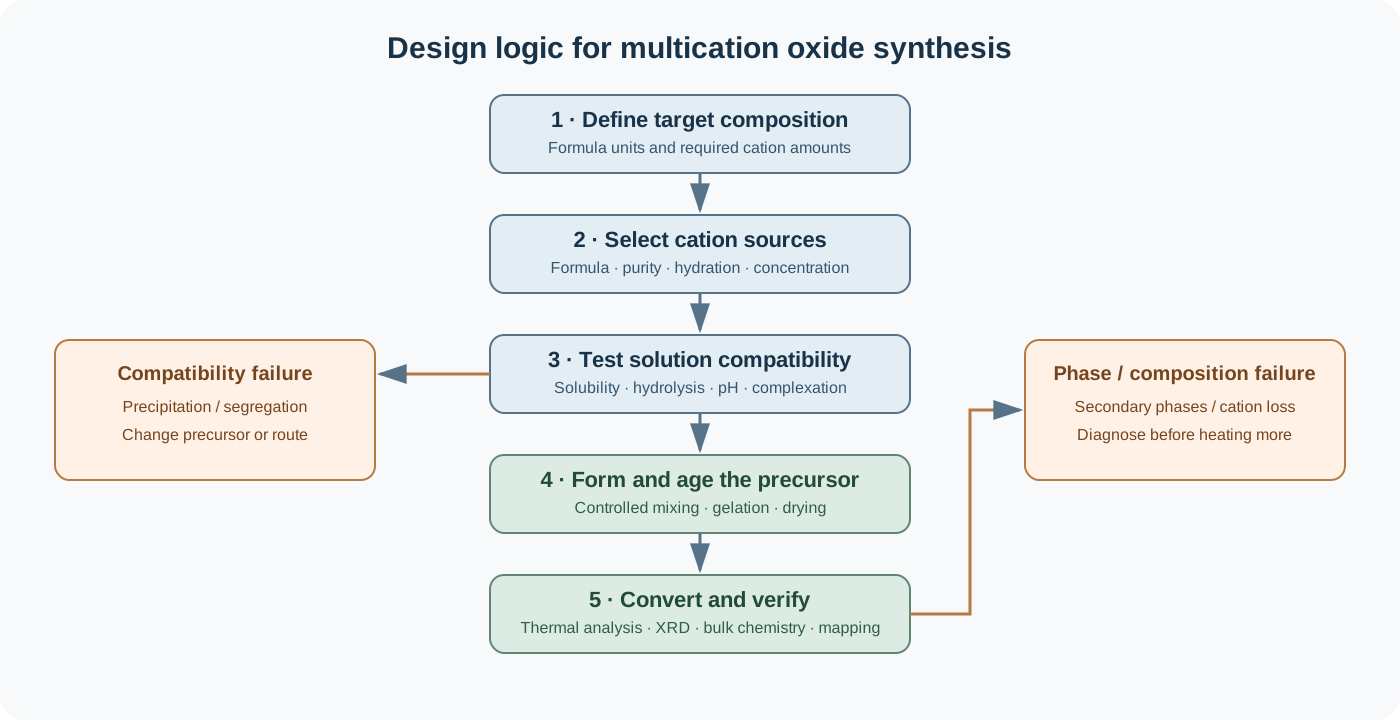
A useful development sequence is:
- Define the target formula and batch size.
- Build a cation-source table and calculate each precursor amount.
- Check precursor formula, purity, hydration state and concentration.
- Assess solvent compatibility and individual solution stability.
- Identify likely hydrolysis, complexation and precipitation risks.
- Select an appropriate route: alkoxide, chelate-complex or polymerizable-complex chemistry.
- Define a reproducible order of addition and mixing history.
- Monitor pH, appearance, viscosity and gelation time where relevant.
- Dry the gel under controlled and documented conditions.
- Use TGA/DSC to investigate decomposition and select thermal-analysis points.
- Use interrupted heat treatments and XRD to follow phase evolution.
- Verify bulk composition and local elemental distribution where required.
8. Thermal conversion does not automatically erase segregation
The dried gel or polymeric precursor is not necessarily the final oxide. Thermal treatment may involve solvent removal, ligand decomposition, oxidation of organics, formation of amorphous mixed oxides, crystallization and grain growth.
If the cations were segregated during solution processing, calcination may produce separate oxide phases rather than the intended complex oxide. Increasing the calcination temperature is not a guaranteed correction: it can also promote volatilization, grain growth or formation of thermodynamically stable secondary phases.
Use TGA/DSC, XRD at selected temperatures and bulk elemental analysis to distinguish incomplete decomposition from phase-segregation or stoichiometry problems.
9. How to verify a successful multication synthesis
No single characterization method proves all aspects of product quality.
- XRD: identifies crystalline phases and can support phase-fraction analysis when the data and structural models are suitable.
- Rietveld refinement: evaluates crystalline phase assemblage and lattice parameters; it does not independently prove correct cation distribution or oxidation state.
- SEM-EDS mapping: assesses elemental distribution at the spatial resolution and interaction volume of the measurement.
- TEM-EDS or STEM-EDS: can examine finer-scale segregation where sample preparation and instrument capability permit.
- ICP-OES or ICP-MS: can assess bulk elemental composition after suitable digestion and calibration.
- XPS or X-ray absorption methods: may help investigate oxidation states and local chemical environments, with method-specific limitations.
- TGA/DSC: helps assess residual decomposition and thermal events, but does not identify all crystalline phases.
A single-phase laboratory XRD pattern does not prove atomic-scale homogeneity. Likewise, a uniform EDS map at one magnification does not prove that every cation occupies its intended crystallographic site.
10. Common failure modes
| Observation | Likely issue to investigate | Useful next step |
|---|---|---|
| Immediate precipitate after combining solutions | Incompatible pH, solvent or precursor speciation | Test individual solutions and controlled mixing sequence |
| Gel forms before all cations are incorporated | Different hydrolysis/condensation rates | Reassess precursor choice and separate-solution strategy |
| Clear solution but secondary phases after heating | Molecular compatibility was not sufficient or composition drift occurred | Interrupted XRD and bulk chemical analysis |
| Residual carbon after calcination | Incomplete organic decomposition or restricted gas exchange | TGA/DSC and atmosphere/geometry review |
| Dopant-rich regions in EDS | Local segregation or inadequate precursor distribution | Higher-resolution mapping and solution-route redesign |
| Correct XRD phase but wrong bulk composition | Volatilization, weighing error or incomplete recovery | ICP-OES/XRF and batch mass balance |
11. Choosing a route for an ABO3 oxide
A practical route-selection decision should consider:
- Whether each required cation has a soluble and stable precursor.
- Whether the cations tolerate a common solvent and pH.
- Whether water can be introduced without uncontrolled precipitation.
- Whether a chelator can stabilize the relevant metal ions.
- Whether the organic content can be removed cleanly.
- Whether the target phase is stable under the planned calcination atmosphere.
- Whether the expected gain in homogeneity justifies solvent, safety and scale-up complexity.
If one cation has no suitable stable precursor under the chosen conditions, a hybrid route may be more defensible than forcing all reagents into a nominally uniform sol-gel process.
References
- A. E. Danks, S. R. Hall and Z. Schnepp, “The evolution of ‘sol–gel’ chemistry as a technique for materials synthesis,” Materials Horizons 3 (2016), 91–112. https://doi.org/10.1039/C5MH00260E
- M. Kakihana and M. Yoshimura, “Synthesis and characteristics of complex multicomponent oxides prepared by polymer complex method,” Bulletin of the Chemical Society of Japan 72 (1999), 1427–1443. https://doi.org/10.1246/bcsj.72.1427
- M. Kakihana, “Synthesis of high-performance ceramics based on polymerizable complex method,” Journal of the Ceramic Society of Japan 117 (2009), 857–862. https://doi.org/10.2109/jcersj2.117.857
- “Molecular mechanisms of the metal oxide sol-gel process and their application in approaches to thermodynamically challenging complex oxide materials,” Journal of Sol-Gel Science and Technology (2023). https://doi.org/10.1007/s10971-023-06120-y
- “Traditional Sol-Gel Chemistry as a Powerful Tool for the Preparation of Supported Metal and Metal Oxide Catalysts,” Catalysts (2019). https://pmc.ncbi.nlm.nih.gov/articles/PMC6416638/
Scope note: This article provides a route-design framework, not a validated synthesis recipe for a specific ABO3 composition. Exact precursor ratios, pH, solvent, water addition and heat treatment must be supported by the chemistry and literature for the selected system.