Metal Alkoxide Precursors for Sol-Gel Synthesis
Metal Alkoxide Precursors for Sol-Gel Synthesis
Metal alkoxides are important molecular precursors for oxide synthesis. Their metal–oxygen–carbon framework can be transformed into metal–oxygen–metal linkages by hydrolysis and condensation. The same reactivity that makes them useful also creates a challenge: many metal alkoxides are sensitive to water and can hydrolyse before the intended reaction step.
A reliable process therefore begins with identifying the exact precursor and understanding its solution chemistry.
1. General chemical formula
A metal alkoxide is commonly represented as:
[ ]
M is the metal, R is an organic group and OR is an alkoxide ligand. This formula is a useful representation, but it does not prove that the compound exists as an isolated monomer. Depending on the metal and ligand, alkoxides can be oligomeric, polymeric, solvated or associated through bridging ligands.
Examples include titanium(IV) isopropoxide, zirconium alkoxides, niobium(V) ethoxide, tantalum(V) ethoxide and aluminium isopropoxide. Confirm the exact formula, molecular weight, assay, solvent and concentration from the supplier’s product specification and certificate of analysis.
2. Why the alkoxy group matters
The R group influences steric environment, solubility, volatility and access of water to the metal centre. Replacing ethoxide with isopropoxide is therefore a chemical change, not merely a naming variation.
A more sterically demanding ligand can hinder access to the metal centre, but hydrolysis rate also depends on metal identity, coordination number, aggregation, solvent and other ligands. It is not reliable to rank two precursors by alkoxy-group size alone.
Titanium and zirconium alkoxides often show rapid hydrolysis. Niobium and tantalum alkoxides are also moisture-sensitive, and their behaviour depends on their molecular form and solvent environment. The response of one precursor should not be assumed for another.
3. Hydrolysis and condensation
A simplified hydrolysis step is:
[ ]
Hydrolysed species can condense:
[ ]
or:
[ ]
Repeated reactions can produce oxo/alkoxo clusters, colloidal particles or extended networks. The species formed depend on water content, concentration, solvent, temperature, ligand environment and addition history. These equations show general reaction motifs rather than a complete mechanism for every metal.
4. Moisture sensitivity and solution ageing
Exposure to atmospheric moisture can initiate hydrolysis before the planned synthesis step. Possible consequences include precipitation, changes in viscosity, formation of oxo/hydroxo particles and poor batch-to-batch reproducibility.
A clear solution does not prove that the precursor is chemically unchanged. Record the storage history, solution age and any changes in appearance. Follow the product-specific safety data sheet and institutional handling requirements.
5. Precursor selection
| Precursor family | Potential use | Main issue to evaluate |
|---|---|---|
| Titanium alkoxides | Ti source for oxide powders and coatings | Rapid hydrolysis and precipitation |
| Zirconium alkoxides | Zr-containing oxides | Aggregation and moisture sensitivity |
| Niobium alkoxides | Molecular Nb source | Moisture sensitivity and exact formulation |
| Tantalum alkoxides | Ta-containing oxides and films | Moisture sensitivity and product availability |
| Aluminium alkoxides | Al-containing oxides | Hydrolysis and solution stability |
This is a screening guide, not a universal ranking. Commercial grades may differ in formula, solvent and concentration.
6. Chemical modification and chelation
Ligands such as β-diketones, β-ketoesters, carboxylic acids and aminoalcohols have been studied for modifying metal alkoxides. Coordination changes the metal’s ligand environment and can alter hydrolysis rate, solubility and aggregation.
Acetylacetone is a widely studied modifier for titanium alkoxides. Its effect is not simply to slow hydrolysis: ligand exchange, adduct formation and changes in aggregation may also occur. A modification condition established for titanium should not be transferred automatically to niobium or zirconium.
7. Solvent compatibility
The solvent must dissolve or disperse the precursor and remain compatible with the planned water addition and other cation sources. Consider precursor solubility, solvent coordination, water miscibility, possible ligand exchange, volatility and the safety profile.
Some solvents used in thin-film precursor chemistry have significant health hazards. Consult the current SDS and institutional chemical-safety requirements before selecting a solvent; do not treat a solvent used in one published process as a default choice for another system.
8. Stoichiometric calculations
For a precursor formula that supplies (_M) moles of metal per mole of precursor formula units:
[ n()= ]
For a solid reagent with mass fraction purity (p):
[ m_{}= ]
Use the molar mass of the exact chemical formula. For solution precursors, use the verified metal concentration or assay and the supplier’s formulation data.
Cation bookkeeping example: ()
Per mole of nominal formula units, the target requires 1.00 mol Ba, 0.96 mol Ti and 0.04 mol Nb. Titanium and niobium alkoxides may supply the Ti and Nb, but a separate Ba precursor must still provide the full 1.00 mol Ba.
If 0.96 mol BaTiO3 is used as the Ti source, it supplies 0.96 mol Ti and also 0.96 mol Ba. A further 0.04 mol Ba source is required to reach the target A-site amount. BaTiO3 is therefore not a Ti-only reagent.
This is cation bookkeeping, not a validated experimental recipe. It does not specify oxygen balance, defect compensation, solvent, hydrolysis sequence or heat treatment.
9. Precursor qualification workflow
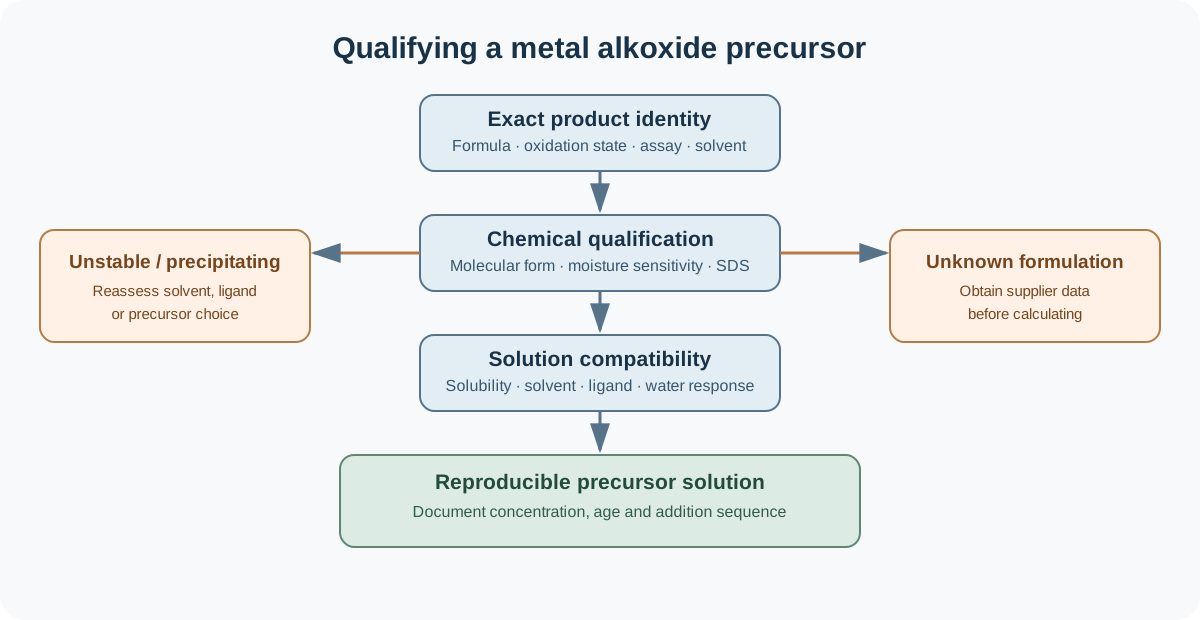
Before use:
- Confirm the chemical name, formula, molecular weight and metal oxidation state.
- Check whether the product is neat, solvated or supplied as a solution.
- Verify assay, density and concentration from supplier documentation.
- Review storage and safety requirements.
- Check solubility in the proposed solvent.
- Evaluate solution stability and precipitation risk.
- Decide whether ligand modification or separate precursor solutions are needed.
- Establish a reproducible addition and mixing sequence.
- Characterize the dried and calcined product rather than assuming that precursor-level mixing guarantees phase purity.
10. Common problems
| Observation | Possible explanation | Useful check |
|---|---|---|
| Immediate precipitation | Rapid hydrolysis or incompatible solution chemistry | Water addition, solvent and precursor identity |
| Solution changes during storage | Moisture ingress or aggregation | Container integrity and solution age |
| Gel forms before all cations are combined | Mismatched precursor reactivity | Addition order and separate-solution stability |
| Secondary phases after calcination | Cation segregation or composition error | XRD and bulk elemental analysis |
| Batch-to-batch variation | Uncontrolled moisture or precursor concentration | Reagent records and solution preparation |
References
- A. E. Danks, S. R. Hall and Z. Schnepp, “The evolution of ‘sol–gel’ chemistry as a technique for materials synthesis,” Materials Horizons 3 (2016), 91–112. https://doi.org/10.1039/C5MH00260E
- U. Schubert, “Chemical modification of titanium alkoxides for sol–gel processing,” Journal of Materials Chemistry 15 (2005), 3701–3715. https://doi.org/10.1039/B504269K
- U. Schubert, “Organically Modified Transition Metal Alkoxides: Chemical Problems and Structural Issues on the Way to Materials Syntheses,” Accounts of Chemical Research 40 (2007), 730–737. https://doi.org/10.1021/ar600036x
- “Molecular mechanisms of the metal oxide sol-gel process and their application in approaches to thermodynamically challenging complex oxide materials,” Journal of Sol-Gel Science and Technology (2023). https://doi.org/10.1007/s10971-023-06120-y
- “Sol-gel synthesis with niobium and tantalum alkoxides,” RSC Advances (2020). https://doi.org/10.1039/D0RA02558E
Scope note: This is a precursor-selection guide, not a universal hydrolysis recipe. Exact conditions must be established for the specific precursor and target composition.