Hydrolysis Control and Water-to-Alkoxide Ratio in Sol-Gel Processing
Hydrolysis Control and Water-to-Alkoxide Ratio in Sol-Gel Processing
Water is a reactant in alkoxide-based sol-gel processing, but its role is more complex than supplying the stoichiometric amount required to replace alkoxy groups. Water concentration and availability influence hydrolysis, condensation, nucleation, aggregation and ultimately the structure of the inorganic network.
The water-to-alkoxide ratio is therefore a process variable—not a universal recipe parameter. Its meaning must be defined carefully, and its effect must be interpreted together with precursor functionality, solvent composition, catalyst, concentration, temperature and addition history.
1. The chemical basis of alkoxide hydrolysis
A metal alkoxide contains metal–alkoxy bonds that can react with water. A simplified hydrolysis step is:
[ ]
For an idealized precursor with four alkoxy groups, the formal complete-hydrolysis equation can be written:
[ ]
This equation is a stoichiometric representation, not a claim that a discrete tetrahydroxide molecule is necessarily the dominant solution species. Real systems can contain partially hydrolysed species, oligomers, coordinated solvent molecules and oxo-bridged clusters.
Hydrolysis creates M–OH groups. These can participate in condensation reactions that form metal–oxygen–metal bonds:
[ ]
An alcohol-producing condensation pathway is also possible:
[ ]
Hydrolysis and condensation can proceed concurrently. Consequently, the measured water content does not directly reveal the fraction of alkoxy groups hydrolysed or the final network structure.
2. Defining the water-to-alkoxide ratio
A common definition is:
[ r= ]
The denominator must be stated explicitly. For a mononuclear precursor (), one mole of precursor formula units contains one mole of metal centres. For an oligomeric or multinuclear precursor, the number of metal centres per formula unit must be considered if the intended comparison is water per mole of metal.
For a mixture of different alkoxide precursors, report whether the ratio is calculated against: - Total moles of alkoxide precursor formula units. - Total moles of metal centres. - Total moles of hydrolysable alkoxy groups.
These definitions are not interchangeable. When comparing literature procedures, reproduce the authors’ definition rather than assuming that all reported ratios use the same basis.
3. The formal stoichiometric reference
For the idealized formula (), complete replacement of all n alkoxy groups by hydroxyl groups would formally require n moles of water per mole of precursor:
[ ]
This is a useful stoichiometric reference. It is not automatically the optimum process ratio.
Why not?
- Hydrolysis may be intentionally partial before condensation begins.
- Condensation can regenerate water through oxolation pathways.
- Alcohol-producing condensation consumes no additional water in the equation shown above.
- Water can be coordinated, adsorbed or distributed among different solution species.
- Solvent and precursor formulations may already contain water.
- Some systems undergo precipitation or aggregation before complete hydrolysis is achieved.
Thus, a ratio below the formal hydrolysis requirement does not necessarily mean that no network can form. A ratio above it does not guarantee a homogeneous gel.
4. A transparent calculation
Consider a purely hypothetical mononuclear precursor represented as (). Suppose the chosen experimental design defines:
[ r==2.5 ]
If the amount of precursor is 0.010 mol:
[ n(H_2O)=rn() ]
[ n(H_2O)=2.5=0.025; ]
Using a water molar mass of 18.015 g mol⁻¹:
[ m(H_2O)=0.025=0.450; ]
This calculation only converts a defined molar ratio into a water mass. It does not establish that this ratio is chemically appropriate for any particular precursor. The example is deliberately generic and should not be interpreted as a synthesis instruction.
5. Account for every source of water
The water deliberately added with a pipette may not be the total water available to the reaction. Potential sources include:
- Water present in the solvent.
- Hydrated salts or precursor hydrates in a mixed-precursor formulation.
- Water associated with hygroscopic reagents.
- Moisture absorbed during transfer or storage.
- Water introduced through glassware or other process-contact surfaces.
For reproducibility, distinguish added water from total estimated water. If the solvent or another reagent has a specified water content, include it in the material balance when that contribution is significant.
Karl Fischer titration can be used to determine water content in suitable solvents and liquid samples. The method and sample compatibility should be checked before relying on the result.
6. Why addition strategy matters
The final amount of water is only one descriptor of the process. The local water concentration experienced by the precursor can depend strongly on how water is introduced.
6.1 Direct addition
Adding water directly to a concentrated precursor solution can create a short-lived region with a high local water concentration. This may cause rapid hydrolysis, nucleation or precipitation before mixing becomes uniform.
6.2 Diluted or controlled addition
Diluting the water or introducing it gradually can reduce local concentration gradients in some systems. It may provide better control over hydrolysis, but it can also extend processing time and alter the balance between hydrolysis and condensation.
6.3 Premixing water with solvent
Premixing can improve distribution of water in a compatible solvent. However, the solvent may coordinate to the metal, change precursor aggregation or influence the effective activity of water. Miscibility alone does not prove chemical compatibility.
No addition strategy is universally superior. The correct choice depends on precursor reactivity, mixing efficiency, solution concentration and the desired product structure.
7. Other variables that interact with the water ratio
| Variable | Mechanistic influence | What should be controlled or recorded |
|---|---|---|
| Precursor functionality | Sets the number of hydrolysable groups per precursor unit | Exact formula and molecular structure |
| Metal-centre reactivity | Influences hydrolysis and condensation rates | Precursor identity and modification |
| Solvent | Affects solubility, coordination and water distribution | Solvent identity, composition and water content |
| Catalyst and pH | Can alter hydrolysis and condensation pathways | Catalyst identity, amount and measurement method |
| Precursor concentration | Influences collision frequency, aggregation and gelation | Total concentration and dilution history |
| Temperature | Changes reaction rates and solution stability | Actual temperature and thermal history |
| Mixing | Controls local concentration gradients | Vessel geometry and reproducible mixing conditions |
| Addition rate | Influences local water exposure and nucleation | Addition duration and delivery method |
Changing several of these variables simultaneously makes it difficult to identify why a gelation time or final morphology has changed.
8. What happens when water availability is poorly controlled?
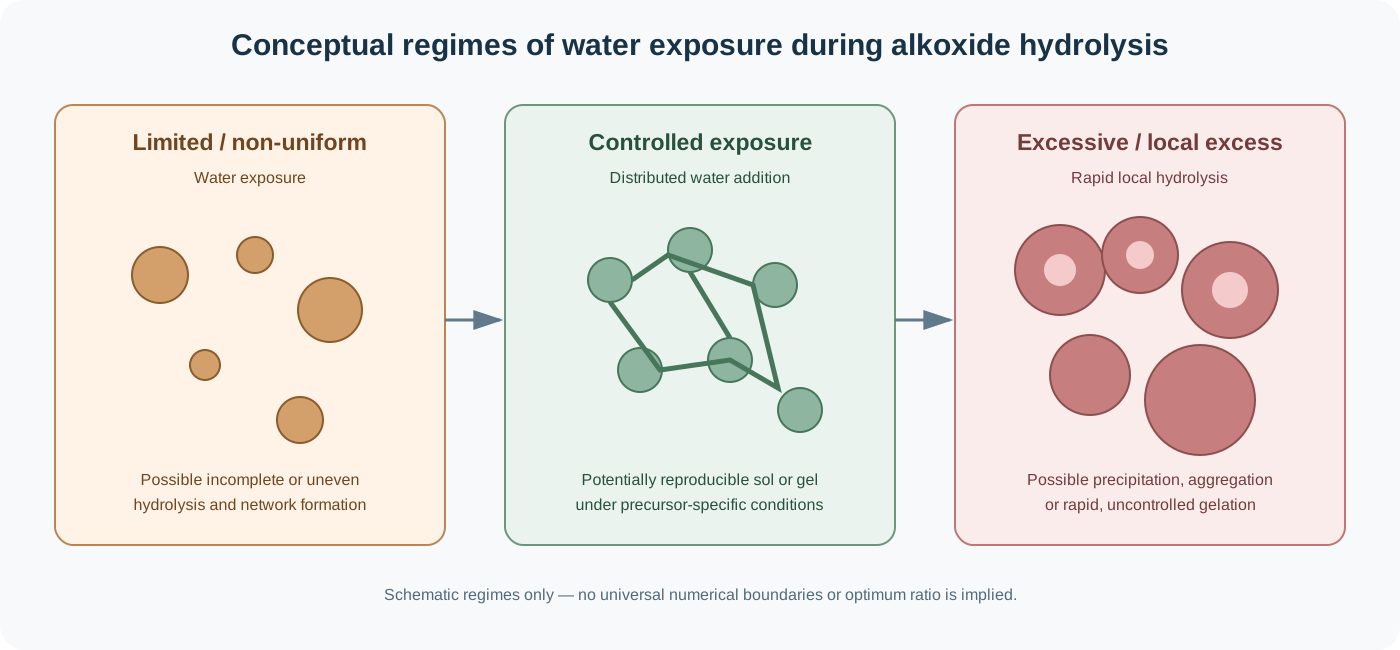
Insufficient or poorly distributed water
Possible outcomes include incomplete or spatially non-uniform hydrolysis, persistent alkoxy groups and delayed network development. These outcomes cannot be diagnosed from the nominal ratio alone; solvent water content and precursor chemistry must also be considered.
Controlled hydrolysis
A reproducible process may produce a stable sol and gradual network formation. The desired result could be a particulate sol, a polymeric sol or a gel, depending on the route. A transparent solution is not a universal target.
Excessive or locally concentrated water exposure
Rapid hydrolysis may cause uncontrolled nucleation, precipitation, aggregation or rapid gelation. A high nominal ratio can also change the relative importance of hydrolysis and condensation, but the outcome is precursor-specific.
9. A rational experimental strategy for optimizing the ratio
Instead of copying a water ratio from an unrelated paper, establish a small, controlled study.
- Confirm the exact precursor formula, assay and solvent formulation.
- Determine the denominator used for the ratio: precursor units, metal centres or alkoxy groups.
- Estimate water contributed by solvents and other reagents.
- Select a literature-supported screening interval for the same precursor chemistry, if available.
- Keep precursor concentration, solvent composition, catalyst, temperature and mixing procedure constant.
- Change the water ratio as the primary variable.
- Record solution clarity, turbidity, precipitation, viscosity and gelation time using consistent observation criteria.
- Characterize the dried product and thermally converted material.
- Repeat selected conditions to assess reproducibility.
If the objective is a powder, evaluate whether the resulting gel or precipitate can be dried and converted reproducibly. If the objective is a coating, evaluate solution stability, ageing and film formation separately. The best ratio for one product form may not be the best for another.
10. Characterization: what can and cannot be concluded
| Method | Useful information | Important limitation |
|---|---|---|
| Karl Fischer titration | Water content in suitable liquids | Does not identify how water is chemically bound |
| FTIR | Changes in selected O–H, C–O and metal–oxygen-related bands | Overlapping bands and sample preparation can complicate assignment |
| NMR, where applicable | Solution species and ligand environments | Requires suitable nuclei, solubility and validated assignments |
| Dynamic light scattering | Hydrodynamic size of suitable dispersed species | Sensitive to aggregates and optical assumptions |
| Rheology | Evolution of flow and gel-like behaviour | Does not uniquely identify molecular reaction mechanisms |
| TGA/DSC | Thermal mass-loss and heat-flow events in dried products | Does not alone prove complete hydrolysis or identify every evolved species |
| XRD | Crystalline phases after thermal conversion | Amorphous precursor structure is not fully described by conventional powder XRD |
A change in gelation time is evidence that the process has changed, not proof of a particular molecular mechanism. Mechanistic claims should be supported by complementary measurements.
11. Common interpretation errors
| Shortcut | Why it is unreliable | Better approach |
|---|---|---|
| “The formal stoichiometric ratio is always optimal” | Condensation, partial hydrolysis and solvent effects alter water demand | Treat stoichiometry as a reference and optimize experimentally |
| “The same ratio works for all alkoxides” | Metal identity and molecular structure change reactivity | Use precursor-specific literature and screening |
| “All added water is available for hydrolysis” | Water can be present in other reagents or associated with solvent | Estimate or measure total water |
| “A clear sol is homogeneous at molecular scale” | Small clusters and composition gradients may not be visible | Use suitable chemical and structural characterization |
| “Fast gelation means better synthesis” | Rapid gelation may trap heterogeneity or produce aggregation | Evaluate final composition, morphology and reproducibility |
| “More water always means more complete oxide formation” | Excess water may trigger precipitation or alter network structure | Relate water exposure to the intended product and route |
12. Key conclusions
The water-to-alkoxide ratio is meaningful only when its denominator and water balance are clearly defined. The formal stoichiometric requirement provides a reference, but the process outcome also depends on condensation, solvent, precursor structure, catalysts, concentration, temperature and addition history.
A defensible sol-gel procedure should report both the ratio and how it was implemented. Reproducibility requires documenting water sources, addition method, mixing, solution ageing and the criteria used to identify hydrolysis, precipitation and gelation.
References
- C. J. Brinker and G. W. Scherer, Sol-Gel Science: The Physics and Chemistry of Sol-Gel Processing, Academic Press (1990).
- A. E. Danks, S. R. Hall and Z. Schnepp, “The evolution of ‘sol–gel’ chemistry as a technique for materials synthesis,” Materials Horizons 3 (2016), 91–112. https://doi.org/10.1039/C5MH00260E
- U. Schubert, “Chemical modification of titanium alkoxides for sol–gel processing,” Journal of Materials Chemistry 15 (2005), 3701–3715. https://doi.org/10.1039/B504269K
Scope note: This article explains general process variables and a generic stoichiometric calculation. It intentionally does not prescribe a universal water ratio or use a material-specific synthesis example.