Crystallization, Nucleation and Phase Formation in Sol-Gel-Derived Materials
Crystallization, Nucleation and Phase Formation in Sol-Gel-Derived Materials
A dried sol-gel precursor is not necessarily a crystalline oxide. It may be amorphous, poorly ordered or composed of nanoscale domains that are below the detection limit of routine diffraction measurements. Crystallization requires the formation of ordered nuclei and their subsequent development into domains with sufficient long-range order.
The final phase assemblage depends on more than the maximum heat-treatment temperature. Precursor chemistry, cation distribution, network structure, residual organics, atmosphere, heating rate, dwell time and cooling history can all influence phase selection and microstructure.
This article separates the main physical concepts and provides a practical framework for studying phase development without assuming a universal calcination schedule.
1. Amorphous precursor, nuclei and crystalline phase
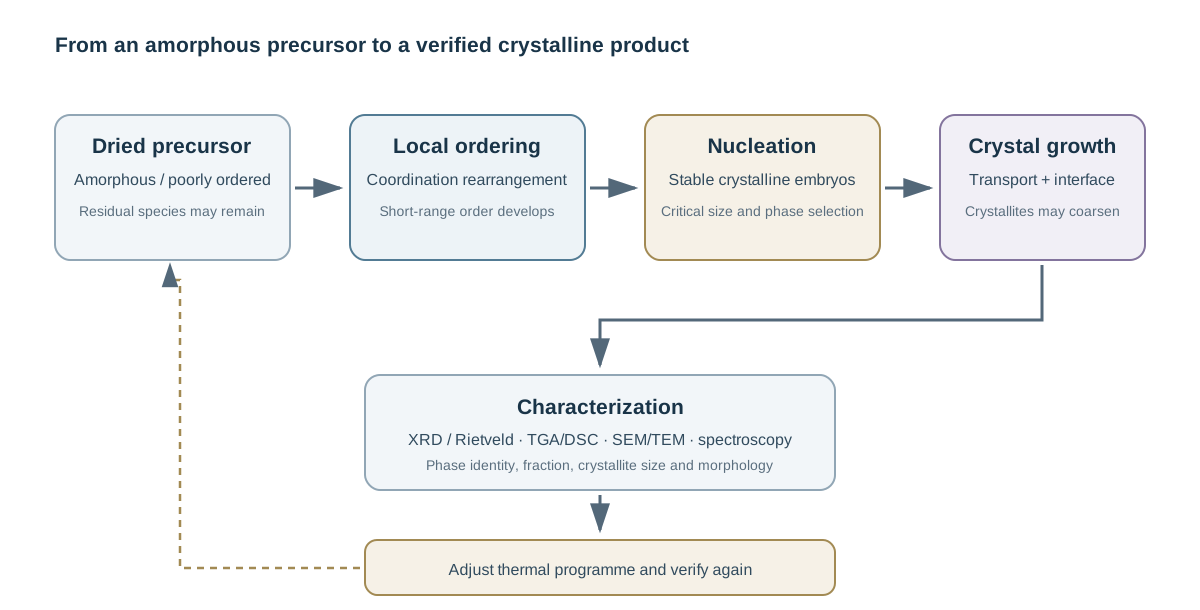
The transformation of a sol-gel-derived precursor can involve several overlapping stages:
- Removal of solvent, water and volatile reaction products.
- Decomposition of residual organic species and precursor ligands.
- Rearrangement of metal–oxygen coordination environments.
- Formation of short-range ordered regions.
- Nucleation of a crystalline phase.
- Growth of crystallites and possible transformation into other phases.
These stages are not necessarily sequential or cleanly separated. Crystallization may begin while decomposition is still occurring, and different regions of a sample may evolve at different rates.
A material can also remain amorphous after a heat treatment that removes most organic components. Chemical conversion and crystallographic ordering are different questions and should be measured independently.
2. Nucleation: formation of a stable crystalline embryo
A nucleus is a small region with structural order characteristic of a crystalline phase. Very small ordered clusters may form and disappear; only clusters that become sufficiently stable can develop into persistent nuclei.
In classical nucleation theory, the free-energy change for forming a spherical nucleus is represented as the competition between a positive surface contribution and a negative bulk contribution:
[ G(r)=4r^2+r^3G_v ]
where:
- (r) is the nucleus radius,
- () is the interfacial energy per unit area,
- (G_v) is the bulk free-energy change per unit volume, negative when formation of the new phase is thermodynamically favourable.
For this simplified model, the critical radius is:
[ r^*=- ]
Nuclei smaller than the critical size tend to dissolve or disappear; nuclei larger than the critical size can grow, provided the required mass transport and kinetics are available.
The model is useful for understanding the competition between surface and bulk free energy. Real sol-gel precursors are chemically and structurally complex, so a homogeneous spherical-nucleus model should not be treated as a complete mechanistic description. Heterogeneous nucleation, local composition fluctuations, interfaces and pre-existing ordered clusters can change the pathway.
3. Growth after nucleation
Once stable nuclei exist, growth requires transport of the relevant species and attachment to the growing crystalline interface. Depending on the precursor and thermal conditions, transport may involve:
- Local rearrangement within an amorphous metal–oxygen network.
- Short-range diffusion between neighbouring regions.
- Diffusion through a porous precursor.
- Interface-controlled incorporation of species.
- Longer-range solid-state diffusion as the material densifies.
At early stages, crystallites may be separated by an amorphous matrix. Continued heating can increase crystalline fraction and crystallite size. At higher thermal exposure, grain growth and densification may become significant.
Crystallite size obtained from diffraction peak broadening is not automatically equal to particle size observed by microscopy. A particle can contain several crystallites, and strain or instrumental broadening can also contribute to peak width.
4. Why sol-gel chemistry can affect phase formation
Solution processing can create short-range mixing of cations before the solid is formed. This can reduce some diffusion distances compared with a route that starts from separately prepared coarse powders. However, molecular-level mixing is not guaranteed merely because all precursor solutions initially appear clear.
Cation segregation can arise during hydrolysis, complexation, gelation, phase separation, drying or organic decomposition. Differences in precursor reactivity and solubility can create local compositional gradients.
A homogeneous-looking gel therefore does not prove atomic-scale compositional uniformity. Phase formation must be checked using appropriate structural and compositional measurements.
5. Thermodynamic stability and kinetic accessibility
The phase that forms is influenced by both thermodynamics and kinetics.
- Thermodynamic stability concerns which phase or phase assemblage has the lowest free energy under the specified temperature, pressure and composition.
- Kinetic accessibility concerns whether the system can reach that state within the available time through feasible nucleation and transport pathways.
A metastable phase may form first because its nucleation barrier is lower or because it is kinetically accessible at the processing temperature. A later heat treatment may transform it into a more stable phase, but this is not guaranteed: transformation may be limited by diffusion, interfaces or changes in composition.
For multicomponent systems, phase selection can also depend on oxygen chemical potential and defect chemistry. The furnace atmosphere is therefore part of the chemical boundary condition, not merely an equipment setting.
6. Thermal variables that control phase development
| Variable | Possible influence | What must be controlled or reported |
|---|---|---|
| Maximum temperature | Changes reaction rates, phase stability and diffusion | Actual sample temperature and calibration |
| Dwell time | Allows nucleation, growth and transformation to proceed | Time at the sample temperature |
| Heating rate | Changes decomposition overlap and time available for nucleation | Programmed rate and sample mass |
| Atmosphere | Influences oxidation state, oxygen vacancies and decomposition | Gas identity, purity and flow |
| Precursor homogeneity | Influences local composition and diffusion distance | Solution stability and mixing history |
| Residual carbon or organics | Can alter local atmosphere and reaction pathways | TGA/DSC and, where appropriate, carbon analysis |
| Sample geometry | Influences gas removal and temperature gradients | Powder-bed depth, coating thickness or monolith dimensions |
| Cooling rate | May preserve or alter high-temperature phases | Cooling programme and atmosphere |
No single variable should be interpreted in isolation. For example, increasing the dwell time may improve conversion in one system but promote grain coarsening or an unwanted secondary phase in another.
7. How to identify the crystallization interval
Thermal analysis and structural characterization answer complementary questions.
TGA/DSC can identify mass-loss intervals and thermal events. An exothermic signal may be consistent with crystallization, but it is not definitive proof: oxidation, decomposition and other reactions can also produce thermal signals.
A practical sequence is:
- Prepare a representative dried precursor.
- Record TGA/DSC using a documented atmosphere and heating rate.
- Select temperatures around relevant thermal events for interrupted heat-treatment experiments.
- Quench or cool each sample using a consistent, documented procedure.
- Collect XRD patterns from each intermediate.
- Compare the appearance and evolution of diffraction features.
- Use complementary spectroscopy or microscopy when XRD alone cannot resolve the transformation.
Interrupted heat treatments are particularly useful because they connect a thermal event to an actual structural change.
8. XRD: phase identification and crystallization
X-ray diffraction is a primary method for identifying crystalline phases. The appearance of distinct Bragg reflections from an initially diffuse background can indicate the development of long-range order.
However, several cautions are essential:
- A broad background or diffuse scattering may arise from amorphous material, but substrate, holder and fluorescence contributions must also be considered.
- Very small crystallites and low phase fractions may produce broad, weak reflections.
- Overlapping peaks can make phase identification ambiguous.
- Preferred orientation can change relative peak intensities.
- A phase not detected by laboratory XRD is not necessarily absent.
Rietveld refinement can estimate crystalline phase fractions when suitable structural models and data quality are available. Conventional refinement does not automatically quantify an amorphous fraction. An internal or external standard and an appropriate quantitative method may be required.
9. Crystallite size and microstructure
The Scherrer relation provides an approximate coherent-domain size:
[ D= ]
where:
- (D) is the apparent coherent-domain size,
- (K) is a shape factor,
- () is the X-ray wavelength,
- () is the peak breadth in radians after appropriate instrumental correction,
- () is the Bragg angle.
This estimate assumes that peak broadening is dominated by finite domain size. Microstrain, defects, compositional variation and instrumental broadening can also contribute. Use multiple reflections and an appropriate line-profile model when the data support it; do not report a single uncorrected peak width as a definitive particle size.
SEM and TEM provide complementary information about particle morphology, agglomeration and grain development. Selected-area electron diffraction or high-resolution TEM may help investigate local crystallinity, but the sampled region may not represent the bulk.
10. Distinguishing crystallization from grain growth
These processes are related but different:
- Crystallization is the development of long-range crystalline order from an amorphous or less ordered precursor.
- Crystallite growth is an increase in the size of coherent crystalline domains.
- Grain growth is the enlargement of grains, commonly through movement of grain boundaries.
- Sintering involves bonding and densification between particles, often accompanied by pore evolution.
A sample can show increased crystalline fraction without a large increase in crystallite size. Conversely, crystallites can coarsen while the phase fraction changes only slightly. Densification may also occur concurrently.
11. Practical experimental matrix
A useful study changes one thermal variable at a time while keeping precursor preparation and sample geometry fixed.
| Series | Variable | Primary question |
|---|---|---|
| A | Maximum temperature | At what interval does the target phase first become detectable? |
| B | Dwell time | Does conversion continue, reach a plateau or produce secondary phases? |
| C | Heating rate | Does the decomposition/crystallization sequence change? |
| D | Atmosphere | Does oxygen availability alter phase composition or defect state? |
| E | Precursor ageing or gel homogeneity | Does solution history affect phase development? |
For every specimen, record the mass, powder-bed geometry, crucible material, furnace position, atmosphere, ramp, dwell and cooling conditions. A thermal matrix is only interpretable if these variables are controlled.
12. Troubleshooting phase formation
| Observation | Possible explanation | Useful next check |
|---|---|---|
| Product remains X-ray amorphous | Insufficient structural ordering or crystallites below detection limit | Interrupted heat treatment and complementary microscopy |
| Several crystalline phases appear | Composition gradients, competing phase stability or incomplete reaction | Quantitative composition analysis and temperature series |
| Target phase appears then disappears | Transformation to another phase during further heating | Compare interrupted treatments and cooling histories |
| Peaks sharpen strongly with heating | Crystallite growth, reduced strain or both | Instrument-corrected line-profile analysis |
| XRD suggests one phase but microscopy shows segregation | Local heterogeneity or low-volume secondary regions | SEM-EDS/TEM-EDS mapping and bulk analysis |
| Results vary between batches | Differences in precursor age, drying, sample geometry or furnace history | Audit preparation and thermal records |
13. Phase-development workflow
References
- A. V. Vinogradov and V. V. Vinogradov, “Low-temperature sol–gel synthesis of crystalline materials,” RSC Advances 4 (2014), 45903–45919. https://doi.org/10.1039/C4RA04454A.
- V. G. Kessler and G. A. Seisenbaeva, “Molecular mechanisms of the metal oxide sol-gel process and their application in approaches to thermodynamically challenging complex oxide materials,” Journal of Sol-Gel Science and Technology 107 (2023), 190–200. https://doi.org/10.1007/s10971-023-06120-y.
- A. E. Danks, S. R. Hall and Z. Schnepp, “The evolution of ‘sol–gel’ chemistry as a technique for materials synthesis,” Materials Horizons 3 (2016), 91–112. https://doi.org/10.1039/C5MH00260E.
- K. Kajihara, K. Kanamori and A. Shimojima, “Current status of sol–gel processing of glasses, ceramics, and organic–inorganic hybrids: a brief review,” Journal of the Ceramic Society of Japan 130 (2022), 575–583. https://doi.org/10.2109/jcersj2.22078.
Scope note: Phase formation is specific to composition, precursor chemistry and thermal atmosphere. Treat temperatures and dwell times as experimentally determined variables, not transferable recipes.