Citrate Sol-Gel and the Pechini Polymerizable Complex Method
Citrate Sol-Gel and the Pechini Polymerizable Complex Method
Citrate-based synthesis routes are widely used to prepare multicomponent oxide powders. They are particularly attractive when several metal cations must be distributed through a common precursor before thermal conversion.
The term “citrate sol-gel” is sometimes used broadly, but it can describe chemically different processes. A simple metal-citrate gel is not necessarily equivalent to the Pechini or polymerizable complex method. The defining feature of the latter is the formation of a polymeric organic network that retains the metal complexes during precursor processing.
1. The basic chemistry
A common Pechini-type route involves two main chemical stages:
- Complexation of metal ions by citric acid or another suitable hydroxycarboxylic acid.
- Polyesterification between the citrate-containing species and a polyol such as ethylene glycol.
The resulting organic-inorganic resin contains the metal species distributed through a polymeric matrix. Subsequent thermal treatment decomposes the organic network and produces an oxide precursor, which may crystallize into the target phase during calcination.
2. Metal-citrate complex formation
Citric acid can coordinate many metal ions through carboxylate and hydroxyl-containing donor groups. The solution pH influences its protonation state and therefore its coordination behaviour.
A simplified representation is:
[ ]
This equation does not specify a unique coordination structure or stoichiometry. Depending on the metal and solution conditions, several complexes or oligomeric species may coexist.
The citrate-to-metal ratio must be selected for the actual metal-ion mixture. Different cations do not necessarily bind citrate with the same strength, and some ions may require additional complexing strategies or modified pH conditions.
3. Polyesterification with ethylene glycol
Ethylene glycol acts as a polyol. On heating, it can react with carboxyl-containing citrate species through esterification/transesterification chemistry, producing a polymeric network.
A highly simplified representation of ester formation is:
[ ]
In the Pechini-type precursor, repeated ester-forming reactions build a network in which metal-citrate complexes are distributed. The real resin chemistry is more complex than a single esterification equation and depends on temperature, water content, pH and reagent ratios.
The purpose of polymerization is not merely to increase viscosity. It creates a covalent organic framework intended to reduce segregation of the metal species during drying and precursor conversion.
4. Distinguishing citrate gelation from the polymerizable complex method
| Route | Main chemical feature | Important distinction |
|---|---|---|
| Metal-citrate complexation | Metal ions coordinated by citrate | Complex formation alone does not prove polymerization |
| Amorphous citrate route | Concentration/drying of metal-citrate solutions | May form a mixed amorphous precursor without an extended polyester network |
| Pechini / polymerizable complex | Metal-citrate complexes plus polyol-driven polyesterification | A polymeric network entraps the metal species |
| Alkoxide sol-gel | Hydrolysis and condensation of metal alkoxides | Builds M–O–M networks through inorganic condensation chemistry |
These routes may all be called “sol-gel” in some papers, but the chemical mechanisms are not interchangeable. Describe the actual precursor chemistry when reporting a synthesis.
5. Reagent selection
5.1 Metal salts
Nitrates are often used because many are water-soluble and decompose thermally, but they are oxidizing salts and their thermal behaviour must be considered. Acetates, chlorides and other salts may also be used when their solubility and decomposition chemistry are appropriate.
The counterion is not chemically irrelevant. It can influence solution pH, redox behaviour, gas release and residual impurities.
5.2 Citric acid
Citric acid is a common complexing ligand. Its amount should be selected based on total metal content, metal identities, solution pH and evidence of complexation. A nominal molar ratio reported for one oxide system should not be assumed to work for another.
5.3 Ethylene glycol
Ethylene glycol is commonly used as the polyol. The citric-acid-to-glycol ratio affects resin formation, viscosity and organic content. Too little polyol may not produce the intended network; excessive organic content can increase foaming, gas release and combustion intensity during thermal decomposition.
6. General experimental workflow
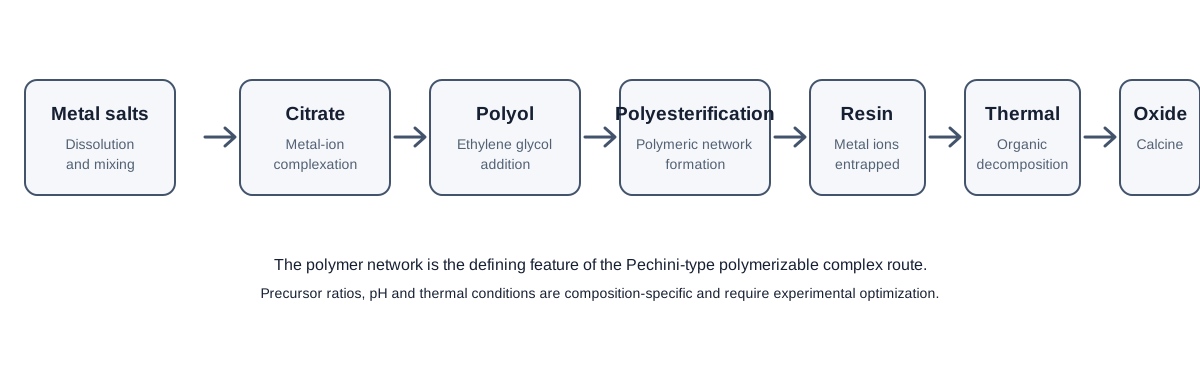
A typical development sequence is:
- Calculate the required amount of each metal precursor from the target oxide composition.
- Correct reagent masses for purity, hydration state and assay.
- Dissolve the metal salts in a compatible solvent, commonly water when all precursors are sufficiently soluble.
- Add citric acid under controlled mixing and establish a stable complexed solution.
- Check pH and solution stability; avoid uncontrolled precipitation.
- Add ethylene glycol and heat under controlled conditions to promote polyesterification.
- Concentrate the solution to form a viscous resin or polymeric precursor.
- Dry or decompose the resin using a controlled thermal programme.
- Use TGA/DSC to identify organic decomposition and gas-release events.
- Calcine the precursor and verify phase formation by XRD.
This is a workflow framework, not a universal laboratory recipe. The exact order of addition and thermal schedule depend on the selected salts and target composition.
7. Thermal decomposition and calcination
The resin contains a substantial organic fraction. Heating can involve dehydration, polymer decomposition, oxidation of organic species and formation of an amorphous inorganic intermediate.
Rapid heating of a large resin mass can cause vigorous gas release, foaming, local overheating or loss of powder. A staged thermal treatment may be useful, but the stages should be based on TGA/DSC and the safety characteristics of the actual precursor.
Do not assume that a visually black or fluffy ash is a pure oxide. Residual carbon, carbonate, amorphous material and secondary phases may remain. XRD, elemental analysis and thermal analysis provide complementary evidence.
8. Advantages and limitations
Advantages - Good potential for distributing multiple cations in a common precursor. - Solution chemistry allows flexible composition adjustment. - Often produces fine, reactive oxide precursor powders. - Useful for complex oxides and doped compositions. - Can reduce the diffusion distances required during later crystallization.
Limitations - Large organic content can cause foaming and substantial gas release. - Different cations may form complexes with different stability. - pH and solubility constraints can cause selective precipitation. - Organic decomposition can leave carbonaceous residues. - Batch scale and resin geometry affect heat and mass transfer. - A homogeneous resin does not guarantee a single-phase final oxide.
9. Common problems and troubleshooting
| Observation | Possible causes | Next check |
|---|---|---|
| Precipitation after citrate addition | pH shift, insoluble salt or incompatible complexation | pH, precursor solubility and order of addition |
| Solution remains watery | Low concentration or insufficient polyesterification | Solids content, temperature history and glycol chemistry |
| Resin foams violently | Rapid decomposition, large organic fraction or excessive heating rate | TGA/DSC, batch geometry and staged heating |
| Black residue after calcination | Incomplete oxidation or insufficient thermal treatment | TGA, carbon analysis and atmosphere |
| Secondary phases in final powder | Cation segregation, incorrect stoichiometry or incomplete reaction | XRD, bulk chemistry and precursor stability |
| Poor reproducibility | Variable evaporation, pH, reagent hydration or resin mass | Standardized batch records and precursor assay |
10. How to verify precursor homogeneity
The polymer-complex method is designed to improve cation distribution, but homogeneity should be demonstrated rather than assumed.
Possible approaches include: - ICP-OES or ICP-MS for bulk elemental ratios. - SEM-EDS mapping for microscale segregation. - TEM-EDS for selected nanoscale investigations. - FTIR or Raman spectroscopy to investigate ligand coordination and organic-network chemistry. - TGA/DSC to assess decomposition behaviour. - XRD and Rietveld analysis to evaluate crystalline phases after calcination.
No single method proves atomic-scale cation homogeneity. The appropriate combination depends on the material and the claim being made.
11. When to choose the Pechini route
The method is worth considering when: - Several cations must be mixed before oxide crystallization. - Suitable soluble metal salts are available. - The solution can be kept stable during complexation and concentration. - The organic fraction can be decomposed safely and completely. - A fine precursor powder is useful for the subsequent reaction or sintering step.
It may be less attractive when the metal precursors have incompatible solubilities, when organic removal is difficult, or when a simpler precipitation or solid-state route already provides adequate homogeneity and phase purity.
References
- M. Kakihana and M. Yoshimura, “Synthesis and characteristics of complex multicomponent oxides prepared by polymer complex method,” Bulletin of the Chemical Society of Japan 72 (1999), 1427–1443. https://doi.org/10.1246/bcsj.72.1427
- M. Kakihana, “Synthesis of high-performance ceramics based on polymerizable complex method,” Journal of the Ceramic Society of Japan 117 (2009), 857–862. https://doi.org/10.2109/jcersj2.117.857
- J. Danks, S. Hall and Z. Schnepp, “The evolution of ‘sol–gel’ chemistry as a technique for materials synthesis,” Materials Horizons 3 (2016), 91–112. https://doi.org/10.1039/C5MH00260E
Terminology note: The Pechini route is described here as a polymerizable complex or polymer complex method. Although it is often grouped with sol-gel processing, its defining chemistry is metal-ligand complexation followed by organic polyesterification, not simply alkoxide hydrolysis and inorganic condensation.