Solid-State Reaction Method for Ceramic Oxide Synthesis
Solid-State Reaction Method for Ceramic Oxide Synthesis
The conventional solid-state reaction method is one of the most widely used routes for preparing bulk ceramic powders and functional oxides. It combines selected solid precursors, usually by grinding or milling, followed by one or more heat treatments that promote reaction and formation of the target crystalline phase.
Its apparent simplicity can be misleading. A successful reaction depends on precursor chemistry, particle size, contact area, diffusion, intermediate phase formation, thermal history and atmosphere. Understanding these factors is essential for reproducible synthesis.
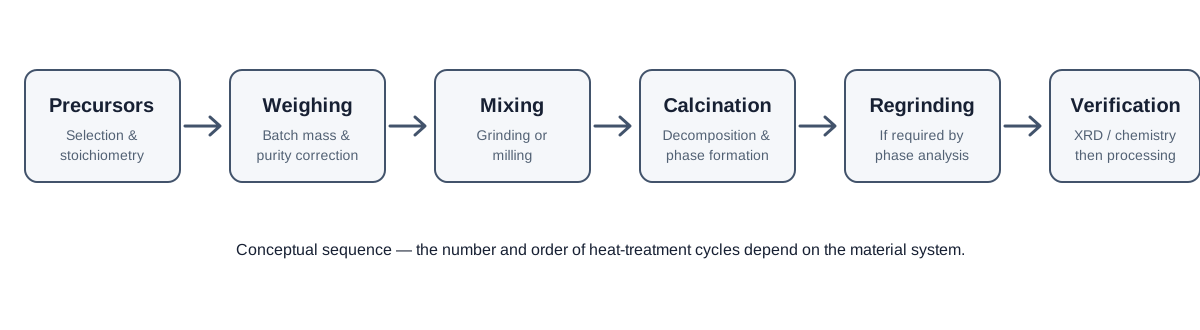
1. Principle of the method
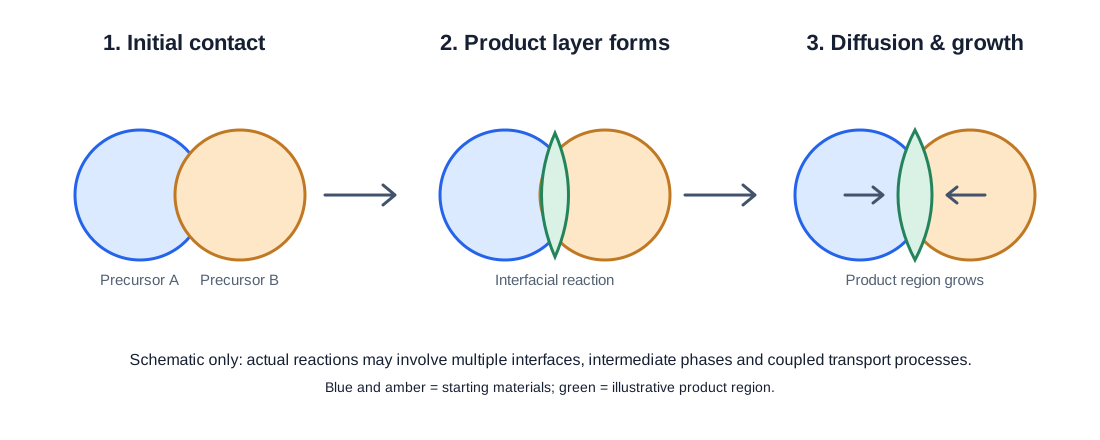
In a conventional solid-state reaction, two or more solid reactants are brought into intimate contact. At elevated temperature, atoms or ions move across interfaces and through product layers. New phases nucleate and grow until the reactants are consumed or the reaction becomes kinetically limited.
A simplified sequence is:
- Mixing and homogenization of precursor powders.
- Formation of contact points between different particles.
- Initial interfacial reaction and nucleation.
- Growth of product layers or intermediate phases.
- Diffusion through the reaction region.
- Consumption of the starting materials and development of the target phase.
The real mechanism may involve several sequential reactions rather than one direct conversion. This is why intermediate phases can appear during calcination and why a single high-temperature treatment does not guarantee a single-phase product.
2. Choosing precursors for ABO₃ perovskites
For a nominal perovskite ABO₃, the target formula defines the required A-site and B-site cation ratio. It does not prescribe a unique set of starting reagents.
Common precursor choices include:
- A-site oxides, carbonates or other thermally decomposable salts.
- B-site oxides or, in selected routes, other compounds that form the required oxide on heating.
- Dopant oxides or salts for substituted compositions.
The correct choice depends on the reaction pathway and the elemental balance.
2.1 Why precursor choice matters
Consider the nominal composition:
[ ]
The required cation ratio is:
[ =1:0.96:0.04 ]
If BaTiO₃ is selected as the titanium source, each mole of BaTiO₃ also supplies one mole of Ba. Therefore, using 0.96 mol BaTiO₃ supplies 0.96 mol Ba, while the target requires 1.00 mol Ba. The missing 0.04 mol Ba must be supplied by an additional barium precursor if this is the chosen precursor scheme.
A possible cation-balanced precursor equation using BaTiO₃, Nb₂O₅ and BaCO₃ is:
[ 0.96, +0.02, +0.04, +0.04, +0.01, ]
This is an idealized elemental balance for the nominal formula. It does not establish the actual oxygen content, charge-compensation mechanism or phase assemblage. Nb⁵⁺ substitution on a Ti⁴⁺ site is donor doping; electronic compensation, ionic defects and oxygen non-stoichiometry depend on oxygen chemical potential and processing conditions.
The practical lesson is broader than this example: never assume that a compound precursor supplies only the element named in the part of the formula you are targeting. Every cation contributed by every reagent must be included in the mass balance.
2.2 Oxide precursors versus carbonate precursors
Oxide precursors are often chemically stable and avoid gas release associated with carbonate decomposition. However, stable oxides may have low reactivity and require higher temperatures, finer particles or longer reaction times.
Carbonates can be useful sources of alkaline-earth cations. Their decomposition releases CO₂ and can create a more reactive intermediate oxide, but the decomposition and subsequent solid-state reaction must be considered together. The exact behaviour depends on the carbonate, particle size, atmosphere and heating schedule.
The best precursor combination is therefore determined by the complete reaction pathway, not by a universal rule that oxides or carbonates are always preferable.
3. Powder mixing and homogenization
The purpose of mixing is to distribute the reactants and increase the number of effective contact points. Better mixing can shorten diffusion distances and reduce local composition variations.
3.1 Manual grinding
An agate mortar and pestle can be suitable for small batches and relatively soft powders. It is simple but operator-dependent. Grinding time alone is not a reliable measure of homogenization.
3.2 Ball milling
Ball milling can improve mixing and reduce particle size. Important variables include:
- Milling media and jar composition.
- Ball-to-powder mass ratio.
- Rotation speed and milling duration.
- Dry or wet milling conditions.
- Solvent and dispersant, if used.
- Contamination from the milling media.
Milling does not automatically improve a synthesis. Excessive milling can introduce impurities, alter particle surfaces or cause agglomeration during drying. Select media compatible with the target composition and verify possible contamination when it matters.
3.3 Why particle size matters
For diffusion-controlled reactions, smaller particles can increase contact area and shorten characteristic diffusion distances. However, primary particle size, agglomerate size and the effective contact between unlike particles are not the same thing. A powder that looks fine may still contain hard agglomerates that limit reaction.
4. Calcination: promoting phase formation
Calcination is a thermal treatment used to decompose precursors and promote chemical reaction or crystallization. It is distinct from sintering, whose primary objective is densification of a formed powder compact, although phase formation and densification can overlap in some systems.
The appropriate calcination schedule depends on:
- Precursor decomposition temperatures.
- Target phase stability.
- Diffusion and reaction kinetics.
- Formation of intermediate phases.
- Volatile species and composition loss.
- Crucible and setter compatibility.
- Furnace atmosphere.
A single temperature cannot be recommended for all ABO₃ compounds. It must be selected from literature on the specific composition and supported by thermal and phase analysis.
5. Why intermediate grinding and repeated calcination are used
After an initial calcination, the powder may contain unreacted precursor cores, product layers, intermediate phases or agglomerates. Regrinding can expose fresh interfaces and redistribute residual reactants.
A repeated calcination cycle is useful when phase analysis shows that the reaction remains incomplete and when the target phase is stable under the additional heat treatment.
However, repeated heating is not automatically the correct solution. If a secondary phase is caused by an incorrect precursor ratio, volatilization, contamination or an incompatible atmosphere, simply increasing the number of calcination cycles may not solve the underlying problem.
6. Reaction mechanism: interfacial reaction and diffusion
The reaction often begins at the interface between contacting particles. As product forms, it can create a layer separating the remaining reactants. Further reaction then requires transport through or along this layer.
A simplified diffusion relation is:
[ x^2Dt ]
where x is a characteristic diffusion distance, D is the diffusion coefficient and t is time. This parabolic relation is an idealized description for diffusion-controlled growth under simplified conditions; real ceramic reactions can involve multiple phases, changing interfaces and more complex kinetics.
The temperature dependence of diffusion is commonly represented by:
[ D=D_0(-) ]
This explains why increasing temperature can accelerate reaction substantially. It also explains why a small temperature change may have a large effect when diffusion is the rate-limiting process.
7. Atmosphere and crucible selection
The furnace atmosphere can influence oxidation state, oxygen-vacancy concentration and phase stability. Air is not interchangeable with pure oxygen, inert gas or a reducing atmosphere.
Crucible and setter materials must also be considered. Possible problems include:
- Reaction between the powder and the crucible.
- Diffusion of crucible elements into the sample.
- Volatilization or loss of selected components.
- Local changes in oxygen chemical potential.
- Contamination during repeated high-temperature treatment.
A crucible material should be selected based on chemical compatibility at the intended temperature and atmosphere, not only on its maximum rated temperature.
8. How to evaluate reaction completion
X-ray diffraction
XRD is a primary tool for identifying crystalline starting materials, intermediate phases and the target phase. Compare the experimental pattern with appropriate reference patterns and consider peak overlap, detection limits and preferred orientation.
Rietveld refinement can support quantitative phase analysis when the structural models, data quality and refinement strategy are appropriate. A low residual alone does not prove that the phase model is chemically correct.
SEM and EDS
SEM can reveal particle morphology, agglomeration and microstructural features. EDS can provide local elemental information, but its spatial resolution, interaction volume and sensitivity must be considered. It does not replace bulk composition analysis when accurate stoichiometry is required.
Thermal analysis
TGA and DSC/DTA can help determine whether precursor decomposition or other thermal events remain. Interrupted calcination followed by XRD can be especially useful for identifying the sequence of phase formation.
9. Common problems and diagnostic approach
| Observation | Possible causes to investigate | Useful next check |
|---|---|---|
| Residual starting oxide | Insufficient contact, diffusion or thermal treatment | XRD, powder mixing review, interrupted calcination |
| Unexpected secondary phase | Incorrect cation balance, competing reaction or contamination | Recalculate reagent balance; XRD and composition analysis |
| Different results between batches | Weighing, mixing, atmosphere or furnace variation | Batch records, calibration and repeatability checks |
| Strong agglomeration | High-temperature necking, surface chemistry or drying | SEM, particle-size analysis and milling review |
| Poor sinterability | Coarse particles, hard agglomerates or low green density | Powder and green-body characterization |
| Composition drift | Volatile components, crucible interaction or weighing error | Bulk composition and mass-balance review |
These are diagnostic hypotheses, not one-to-one diagnoses. A secondary phase, for example, can have several possible causes and should not be assigned to a single cause without supporting evidence.
10. Advantages and limitations
Advantages
- Relatively simple equipment and workflow.
- Suitable for many bulk ceramic compositions.
- Straightforward scaling to larger powder batches.
- Broad compatibility with oxide and carbonate precursors.
- Direct integration with conventional ceramic forming and sintering.
Limitations
- Often requires elevated temperatures and long dwell times.
- Solid-state diffusion can be slow.
- Local inhomogeneity can persist after mixing.
- Intermediate and secondary phases may form.
- Fine-powder production can require additional milling.
- Volatile components and crucible interactions may complicate composition control.
11. Practical decision sequence
Before increasing calcination temperature or duration, ask:
- Is the starting composition balanced correctly?
- Does each precursor supply the intended cations?
- Are the powders adequately mixed and free from hard agglomerates?
- Have the precursors decomposed as expected?
- Is the target phase stable under the selected atmosphere?
- Does XRD show residual reactants, intermediate phases or a composition-related secondary phase?
- Is the crucible chemically compatible?
This sequence helps distinguish a kinetic problem from a composition or compatibility problem.
References
- A. Miura et al., “Observing and modeling the sequential pairwise reactions that drive solid-state ceramic synthesis,” Advanced Materials (2021). https://doi.org/10.1002/adma.202100312
- A. Vartanian, “Breaking down ceramic synthesis,” Nature Reviews Materials 6, 464 (2021). https://doi.org/10.1038/s41578-021-00335-7
- “Review of the opportunities and limitations for powder-based high-throughput solid-state processing of advanced functional ceramics,” Journal of the European Ceramic Society 44 (2024). https://doi.org/10.1016/j.jeurceramsoc.2024.116780
Editorial note: The BaTiO₃–Nb₂O₅–BaCO₃ equation is included to teach cation accounting for one nominal precursor scheme. It is not a validated experimental recipe for producing phase-pure BaTi₀.₉₆Nb₀.₀₄O₃. Actual defect chemistry, oxygen content and phase assemblage must be established experimentally.