Particle Size, Powder Mixing and Milling in Solid-State Synthesis
In solid-state ceramic synthesis, the nominal chemical composition is only one part of the problem. The spatial distribution of the starting elements is equally important. Two batches can have identical weighed compositions yet behave differently during calcination because their particle-size distributions, agglomeration states and mixing histories are different.
Powder preparation therefore has a direct influence on reaction kinetics, phase homogeneity, calcination requirements and the properties of the final ceramic.
1. Why particle size matters
A solid-state reaction requires transport of atoms or ions between contacting reactants. Reducing the characteristic particle size can:
Increase the specific surface area.
Increase the number of potential interparticle contacts.
Shorten characteristic diffusion distances.
Improve the statistical distribution of minor dopants.
Reduce the time required to reach a given degree of reaction in suitable systems.
These benefits are not unlimited. Very fine powders can agglomerate, absorb moisture or carbon dioxide, become difficult to handle, and introduce contamination during intensive milling. A nominally small primary particle size does not guarantee a fine, well-dispersed powder.
2. Primary particles, aggregates and agglomerates
These terms describe different structural levels.
Primary particles: individual crystallites or particles that form the basic powder units.
Aggregates: strongly bonded or fused assemblies of primary particles that may be difficult to separate without fracture.
Agglomerates: loosely bound clusters held together by weaker physical forces and often removable, at least partly, by dispersion or milling.
The distinction matters because a particle-size instrument may report an agglomerate-size distribution rather than the size of individual crystallites. XRD crystallite size, SEM particle dimensions and laser-diffraction particle size are therefore not interchangeable quantities.
3. Mixing quality and local stoichiometry
The goal of mixing is not merely to make the powder look uniform. It is to distribute each chemical component at a length scale that permits the required reaction to proceed without persistent composition gradients.
For a doped ABO₃ oxide, a low dopant fraction creates a particular challenge. If the dopant precursor remains in isolated coarse particles, local regions may become dopant-rich while other regions remain dopant-poor. The nominal bulk composition can be correct even when the local composition is not.
The practical implications are:
Use a reproducible weighing and transfer procedure.
Break soft agglomerates before or during mixing.
Select milling conditions that distribute the dopant without excessive contamination.
Avoid powder losses during transfer, drying and recovery.
Verify the final phase and, where necessary, the elemental distribution.
4. Manual grinding
An agate mortar and pestle is useful for small batches, preliminary homogenization and breaking weak agglomerates. Its limitations include operator dependence, limited energy input and possible contamination or wear.
For reproducibility, record more than grinding time. Record batch mass, mortar material, approximate loading, solvent use, drying procedure and the number of grinding intervals. Scraping and redistributing powder from the mortar walls can be important for small batches.
5. Ball milling
Ball milling uses moving grinding media to transfer mechanical energy to powder particles. Depending on the mill design and operating conditions, the dominant effects may include mixing, particle fracture, deagglomeration, cold welding in some material systems, and mechanical activation.
5.1 Important process variables
Variable
Why it matters
Milling media
Controls impact behaviour and potential contamination
Jar material
Can contribute wear debris or react with the powder
Ball-to-powder ratio
Influences collision frequency and energy transfer
Rotation or vibration conditions
Controls the milling-energy regime
Milling duration
Changes particle size, mixing and contamination exposure
Dry or wet milling
Changes agglomeration, heat transfer and surface chemistry
Solvent
Must be chemically compatible and removable
Filling fraction
Affects media motion and available collision space
There is no universal optimum ball-to-powder ratio, speed or milling time. The suitable operating window depends on the mill geometry, media size, powder properties, batch mass and whether the objective is gentle mixing or high-energy activation.
5.2 Wet milling
Wet milling can reduce dust, improve dispersion and limit some forms of dry-powder agglomeration. However, the liquid must not hydrolyse, dissolve, oxidize or otherwise alter the precursors in an uncontrolled way.
The drying stage is part of the synthesis route. Incomplete solvent removal, hard drying-induced agglomerates, residual organics and powder loss can all affect subsequent calcination. For water-sensitive precursors, water may be unsuitable even if it is convenient.
5.3 Contamination from milling
Contamination may originate from balls, jars, seals, liners, sieves or handling tools. Zirconia media, alumina media and agate are common choices, but none is universally inert.
Choose materials by considering: - The elements already present in the target composition. - The chemical stability of the media under the selected solvent and atmosphere. - The expected wear rate. - Whether trace contamination could alter electrical, magnetic, catalytic or optical properties.
For functional oxides, small impurity concentrations can matter. When contamination is suspected, use appropriate elemental analysis rather than assuming that the milling media are chemically inert.
6. A practical powder-preparation workflow
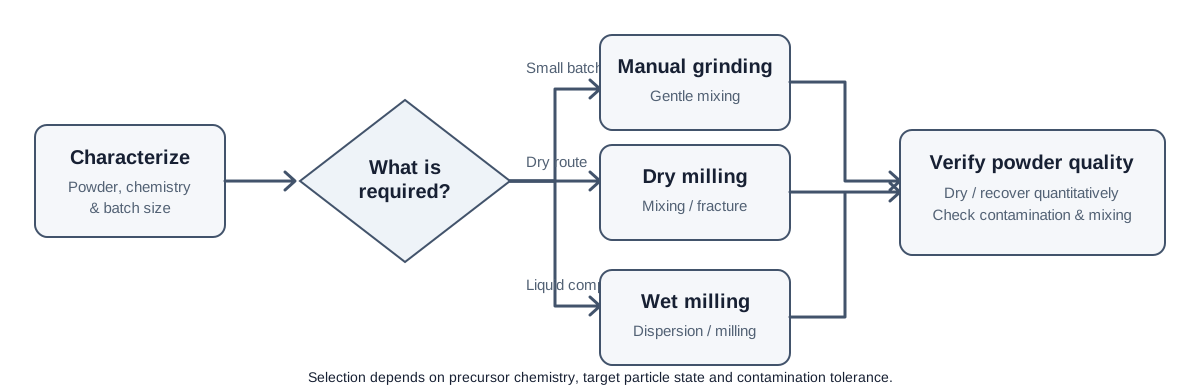
Powder preparation should be selected according to the required mixing scale and contamination tolerance, then checked before calcination.
A defensible workflow is:
Confirm the reagent identity, purity, hydration state and storage history.
Calculate the batch composition and account for every cation supplied by each precursor.
Weigh and transfer each reagent quantitatively.
Select manual grinding, dry milling or wet milling based on batch size and chemical compatibility.
Select jar and media materials according to contamination tolerance.
Dry the powder under conditions compatible with the precursors and solvent.
Recover the powder quantitatively and document any transfer losses.
Inspect the powder and evaluate particle-size or elemental homogeneity when necessary.
Calcine using a schedule justified by the specific material system.
7. How to assess whether milling helped
No single measurement describes all aspects of powder quality.
Laser diffraction: useful for dispersed particle or agglomerate size distributions; results depend strongly on dispersion conditions.
SEM: reveals particle morphology, agglomeration and local heterogeneity.
BET surface area: estimates accessible specific surface area, not particle size directly.
XRD line broadening: can estimate coherent crystallite size and microstrain when instrumental broadening and model assumptions are treated correctly.
EDS mapping: can reveal local elemental segregation, subject to interaction-volume and detection limitations.
Chemical analysis: is needed when accurate bulk composition or trace contamination must be established.
A smaller measured particle size does not automatically prove better chemical homogeneity. Likewise, a more homogeneous EDS map at one magnification does not establish atomic-scale mixing.
8. Common problems
Observation
Possible explanation
Useful diagnostic
Powder remains visibly non-uniform
Inadequate mixing or coarse particles
SEM, particle-size distribution
Milling produces unexpected secondary elements
Media or jar wear
ICP-OES, XRF or suitable elemental analysis
Powder forms hard lumps after drying
Solvent removal or drying-induced agglomeration
SEM and redispersion test
No improvement after longer milling
Milling regime is ineffective or agglomerates are strong
Inspect media motion, jar loading and powder morphology
Batch-to-batch variation
Inconsistent loading, transfer loss or milling conditions
Inadequate precursor distribution or reaction transport
SEM-EDS mapping and phase analysis
9. Key conclusions
Particle size and mixing determine how effectively reactants can contact and exchange species during solid-state synthesis. Milling is a process tool, not a guarantee of improved powder quality. It should be selected and optimized with explicit attention to contamination, agglomeration, solvent compatibility and the intended reaction mechanism.
The most useful question is not simply “How long should I mill?” but “What powder characteristic must change, how will I measure that change, and what new risks will the milling step introduce?”
References
K. G. Webber et al., “Review of the opportunities and limitations for powder-based high-throughput solid-state processing of advanced functional ceramics,” Journal of the European Ceramic Society44 (2024), 116780. https://doi.org/10.1016/j.jeurceramsoc.2024.116780
J. Cho et al., “Roles of local reactivity on the solid-state addition reaction kinetics,” Journal of the American Ceramic Society (2020). https://doi.org/10.1111/jace.17372
“Protocols for the Fabrication, Characterization, and Optimization of n-Type Thermoelectric Ceramic Oxides,” Chemistry of Materials (2017). https://doi.org/10.1021/acs.chemmater.6b03600
T. A. Ring, Fundamentals of Ceramic Powder Processing and Synthesis, Academic Press (1996).
Scope note: The discussion describes general powder-processing principles. Milling conditions must be established for the actual mill, precursor chemistry, batch size and target material; the values should not be copied from an unrelated composition or equipment configuration.