Calcination and Phase Evolution in Solid-State Ceramic Synthesis
Calcination and Phase Evolution in Solid-State Ceramic Synthesis
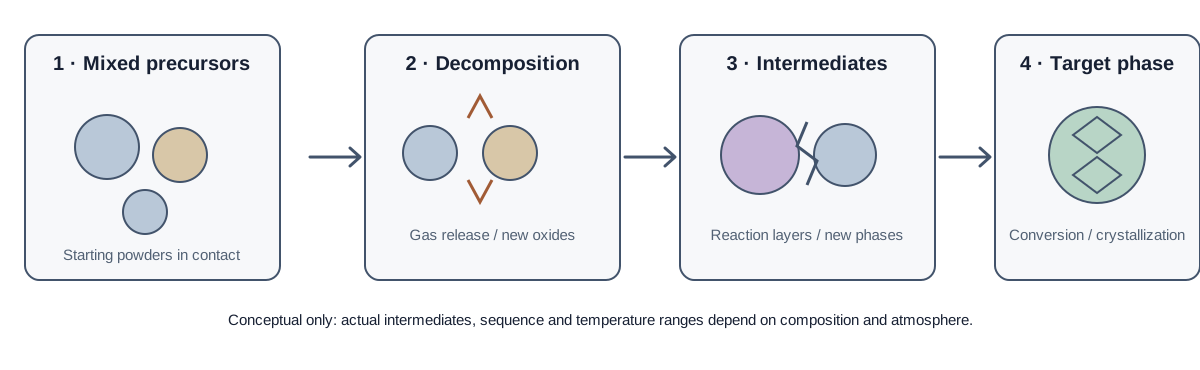
Calcination is often described as heating a mixed powder to form the target oxide. In practice, it may involve several overlapping processes: dehydration, decomposition, oxidation or reduction, gas evolution, interfacial reaction, nucleation, crystallization and growth of intermediate or final phases.
A successful calcination schedule must therefore be designed around the chemistry and reaction pathway of the actual precursor system.
1. What calcination is intended to achieve
Depending on the starting materials, calcination can be used to:
- Remove adsorbed water or volatile species.
- Decompose carbonates, nitrates, hydroxides, oxalates or organic precursors.
- Convert precursor compounds into reactive oxides.
- Promote interdiffusion and formation of the target crystalline phase.
- Adjust oxidation state or oxygen non-stoichiometry when the atmosphere is controlled.
- Produce a powder suitable for subsequent forming and sintering.
Calcination is not synonymous with sintering. Calcination primarily develops the required chemical and phase composition; sintering primarily develops density and microstructure. The two can overlap, but their objectives should be distinguished when designing a process.
2. Thermal events before and during phase formation
A mixed precursor powder may undergo several thermal events:
- Removal of physically adsorbed water or solvent.
- Dehydration or loss of coordinated water.
- Decomposition of precursor anions or organic groups.
- Formation of intermediate oxides or oxy-compounds.
- Reaction between newly formed and initially present solid phases.
- Crystallization and growth of the target phase.
- Grain growth, neck formation or local densification at higher temperatures.
These events do not necessarily occur as clean, separate steps. Their temperatures and sequence depend on heating rate, gas atmosphere, particle size, sample mass, crucible geometry and precursor chemistry.
3. Use thermal analysis to design the temperature programme
3.1 Thermogravimetric analysis
TGA records mass change as a function of temperature or time. It can identify temperature regions associated with water loss, decomposition and volatilization.
A mass-loss step does not by itself identify the evolved species or prove that a desired crystalline phase has formed. Couple TGA with evolved-gas analysis when gas identity is important, and use XRD or other phase-sensitive methods to identify solid products.
3.2 Differential scanning calorimetry and DTA
DSC measures heat flow associated with thermal events; DTA measures the temperature difference between a sample and a reference. Endothermic and exothermic features can help locate decomposition, crystallization or reaction events.
Peak temperatures are not universal material constants. They can shift with heating rate, sample mass, atmosphere and instrument configuration.
3.3 Interrupted calcination
A useful strategy is to heat separate aliquots to selected temperatures, cool them, and measure each by XRD. This builds a phase-evolution sequence rather than relying on a single final pattern.
For a complex oxide, this approach can reveal: - Which precursor disappears first. - Whether intermediate phases form. - The temperature interval where the target phase first appears. - Whether a secondary phase is transient or persistent. - Whether higher temperature improves conversion or instead causes decomposition or volatilization.
4. Selecting calcination temperature and dwell time
The calcination temperature should be high enough to promote the desired reaction at a practical rate, but not so high that it causes unacceptable grain growth, volatilization, crucible interaction or destabilization of the target phase.
Dwell time and temperature are coupled variables. A longer dwell at a lower temperature may produce a different phase pathway from a short dwell at a higher temperature. The best schedule should be determined from thermal analysis, phase evolution and relevant literature on the same or a chemically comparable composition.
Do not transfer a temperature from a related ABO₃ compound without checking differences in: - A-site and B-site chemistry. - Dopant concentration and valence. - Precursor identity and particle size. - Oxygen partial pressure. - Volatility and phase stability. - Heating and cooling rates.
5. Heating rate, sample mass and powder-bed geometry
The programmed furnace temperature is not always the instantaneous temperature experienced by every part of a powder batch. Larger sample masses, deep powder beds and poorly ventilated crucibles can create thermal and gas-transport gradients.
Heating rate affects the time available for decomposition products to escape and can influence transient phase formation. A rapid ramp may be unsuitable when substantial gas release occurs. A slow ramp is not automatically better: it increases process time and may permit unwanted reactions or grain growth.
Record the actual sample mass, powder-bed depth, crucible type, lid condition, heating rate, dwell and cooling conditions. These are part of the experimental protocol.
6. Atmosphere and oxygen chemical potential
For transition-metal and donor-doped oxides, oxygen partial pressure can affect oxidation state, defect concentrations and phase stability. Air, oxygen, argon and reducing mixtures are not interchangeable.
A change in atmosphere can alter: - Oxygen-vacancy concentration. - Cation valence state. - Electronic compensation. - Phase stability and decomposition behaviour. - Mass change during heating and cooling.
If oxygen non-stoichiometry is relevant, specify the gas composition, flow rate or pressure, and cooling atmosphere. Avoid attributing a change in electrical conductivity to a structural phase change without independent evidence.
7. Crucible, lid and sample placement
The crucible must remain chemically compatible with the powder at the selected temperature and atmosphere. The use of a lid can reduce contamination or volatile-component loss in some systems, but it also changes gas exchange and local atmosphere. It should not be treated as a universally beneficial modification.
Check for: - Reaction with the crucible or setter. - Contamination from the container. - Volatilization of one or more components. - Powder adhesion and recovery losses. - Temperature gradients within the furnace. - Local atmosphere changes caused by gas evolution.
When composition loss is suspected, compare mass balance and bulk elemental composition rather than relying only on XRD.
8. Phase evolution: a practical experimental design
A compact experimental matrix can vary one or two thermal parameters while holding all other variables constant. For example:
| Experiment | Maximum temperature | Dwell | Purpose |
|---|---|---|---|
| A | Lower screening temperature | Fixed | Identify early decomposition and reaction |
| B | Intermediate temperature | Fixed | Check target-phase formation |
| C | Higher temperature | Fixed | Test whether residual phases are consumed |
| D | Selected temperature | Longer dwell | Separate time effects from temperature effects |
The temperatures must be selected from the precursor chemistry and thermal analysis; this table intentionally does not prescribe universal numerical values.
After each treatment, use XRD to compare phase assemblage. If the reaction is incomplete, consider regrinding before simply increasing temperature. If a secondary phase grows with temperature, investigate phase stability, stoichiometry, volatility and crucible interaction.
9. XRD interpretation and phase-purity claims
A pattern dominated by the target phase is not automatically proof of absolute phase purity. Minor crystalline phases may fall below the detection limit, amorphous material may be poorly represented, and peak overlap can obscure impurities.
For rigorous phase analysis: - Collect data with adequate counting statistics and angular range. - Use reference structures appropriate to the composition and symmetry. - Inspect residual peaks rather than relying only on a refinement goodness-of-fit value. - Consider preferred orientation, microstrain and peak broadening. - Use an internal standard or complementary method when amorphous content matters. - Confirm elemental composition independently when stoichiometry is critical.
Rietveld refinement can estimate crystalline phase fractions when the structural models and data quality support it. It cannot by itself establish the oxidation state or complete defect chemistry.
10. Troubleshooting calcination outcomes
| Observation | Potential causes | Next investigation |
|---|---|---|
| Carbonate or precursor remains | Insufficient decomposition, poor contact or low reaction extent | TGA/DSC, interrupted XRD, mixing review |
| Intermediate phase persists | Kinetic limitation or stable competing phase | Temperature-series XRD, precursor balance |
| Target phase appears then decreases | Target instability, volatilization or atmosphere effect | Recheck atmosphere, mass balance and phase diagram |
| Secondary phase increases at higher temperature | Composition drift, competing reaction or crucible interaction | Bulk chemistry, crucible inspection, lower-temperature route |
| Strong agglomeration after calcination | Local sintering or high surface-energy-driven clustering | SEM, regrinding assessment |
| Batch mass changes unexpectedly | Gas evolution, volatilization, powder loss or moisture uptake | TGA comparison and quantitative recovery record |
11. A decision rule before changing the furnace programme
Before increasing temperature or dwell time, establish which of the following is actually limiting the process:
- Decomposition: precursor remains chemically undecomposed.
- Contact: reactants are not sufficiently mixed or in contact.
- Transport: diffusion through the product layer is too slow.
- Thermodynamics: the desired phase is not stable under the selected conditions.
- Composition: the batch is not correctly balanced or has lost a volatile component.
- Compatibility: the crucible, setter or atmosphere changes the chemistry.
The corrective action depends on the diagnosis. More heat cannot correct every synthesis problem.
References
- K. G. Webber et al., “Review of the opportunities and limitations for powder-based high-throughput solid-state processing of advanced functional ceramics,” Journal of the European Ceramic Society 44 (2024), 116780. https://doi.org/10.1016/j.jeurceramsoc.2024.116780
- A. Miura et al., “Observing and modeling the sequential pairwise reactions that drive solid-state ceramic synthesis,” Advanced Materials 33 (2021), 2100312. https://doi.org/10.1002/adma.202100312
- J. Cho et al., “Roles of local reactivity on the solid-state addition reaction kinetics,” Journal of the American Ceramic Society (2020). https://doi.org/10.1111/jace.17372
Scope note: This article describes a method for designing calcination experiments, not a universal thermal recipe. A defensible schedule requires composition-specific thermal and phase evidence.