Environmental Monitoring
Environmental Monitoring
A practical framework for planning environmental measurements, collecting representative data, validating results and interpreting changes in environmental quality and pollution-control performance.
<a href="monitoring-plan/index.html"><span>01 / PROGRAMME DESIGN</span><strong>Monitoring Plan Design</strong><p>Objectives, sampling locations, parameter selection, frequency and monitoring networks.</p><b>Open guide ↗</b></a>
<a href="drinking-water-monitoring/index.html"><span>02 / DRINKING WATER</span><strong>Drinking-Water Monitoring</strong><p>Source-to-consumer monitoring, operational indicators and microbiological considerations.</p><b>Open guide ↗</b></a>
<a href="wastewater-monitoring/index.html"><span>03 / WASTEWATER</span><strong>Wastewater Monitoring</strong><p>Influent, process and effluent monitoring for treatment performance and discharge assessment.</p><b>Open guide ↗</b></a>
<a href="field-measurements/index.html"><span>04 / FIELD INSTRUMENTS</span><strong>Field Measurements</strong><p>pH, temperature, EC, TDS, DO, turbidity, calibration and field records.</p><b>Open guide ↗</b></a>
<a href="air-noise-monitoring/index.html"><span>05 / AIR & NOISE</span><strong>Air and Noise Monitoring</strong><p>Ambient air, stack emissions, meteorology, noise locations and measurement context.</p><b>Open guide ↗</b></a>
<a href="monitoring-data-qaqc/index.html"><span>06 / DATA QUALITY</span><strong>QA/QC and Data Interpretation</strong><p>Quality controls, validation flags, uncertainty, trend analysis and reporting.</p><b>Open guide ↗</b></a>
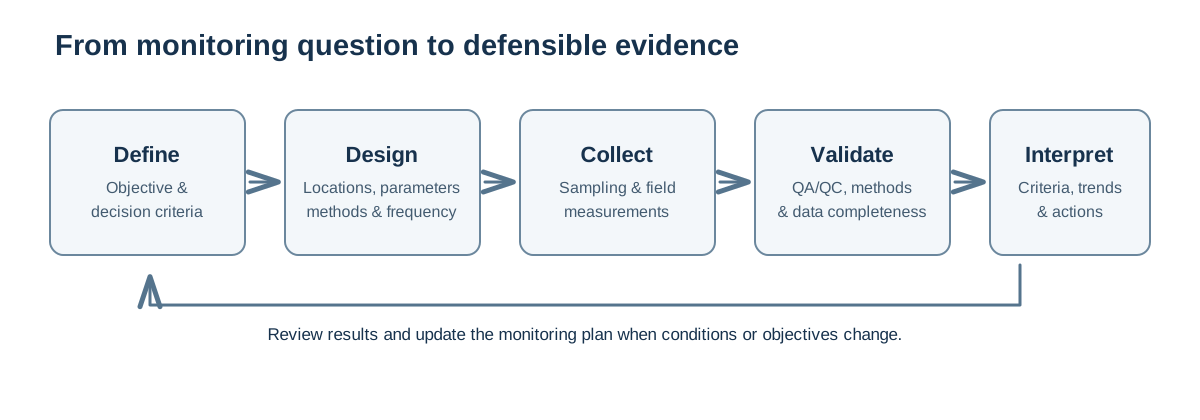
## Core monitoring principles - Start with a defined question: compliance, baseline characterization, operational control, impact assessment or trend detection. - Select representative locations and sampling times based on the objective and process variability. - Use methods, containers, preservation and holding times appropriate to each parameter. - Document instrument checks, calibration, blanks, duplicates, chain of custody and laboratory methods as applicable. - Compare results only with criteria that match the parameter, units, sampling basis and applicable legal or permit context. - Report non-detects, missing data, deviations and uncertainty transparently.
This is a general technical knowledge resource. Monitoring limits, frequencies, methods and reporting obligations depend on the current permit, applicable standards, competent authority and monitoring objective.