Industrial Facility Inspection
Industrial Facility Inspection
A practical framework for planning an industrial site inspection, tracing pollution pathways, evaluating control systems and documenting evidence. The method is adaptable to different industrial sectors; the applicable permit and local regulations always determine the compliance criteria.
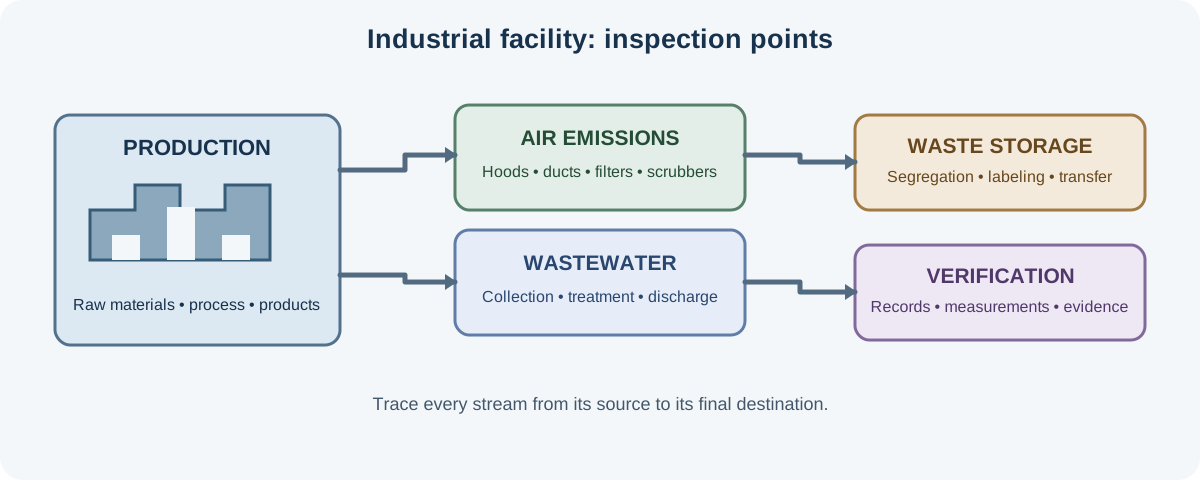
## 1. Inspection objectives and scope
An environmental inspection should establish how the facility operates and how its environmental aspects are controlled. It should not rely on a single observation or on the presence of equipment alone.
Typical objectives are to:
- Understand the production process, capacity, operating schedule and major inputs.
- Identify sources of air emissions, wastewater, solid waste, hazardous waste, noise and potential soil contamination.
- Trace each stream from its point of generation to treatment, storage, discharge or final destination.
- Check whether control equipment is operating and whether maintenance and monitoring records support that conclusion.
- Record objective evidence and identify items requiring sampling, document review or follow-up.
Define the scope before the visit. A focused inspection may cover one activity, such as a boiler house or wastewater treatment plant, while a comprehensive inspection may cover the entire facility.
## 2. Preparation before entering the facility
| Preparation item | Information to obtain | Why it matters |
|---|---|---|
| Facility profile | Sector, products, production capacity and operating hours | Establishes the operational context |
| Process information | Process-flow diagrams, raw materials, fuels and chemicals | Helps identify potential pollution sources |
| Environmental documents | Permits, approvals, previous inspection reports and monitoring results | Identifies applicable requirements and previous issues |
| Site layout | Production buildings, drains, stacks, storage and discharge points | Supports an efficient inspection route |
| Control systems | Treatment-unit descriptions, operating procedures and maintenance records | Identifies systems that need physical verification |
| Field arrangements | Site contact, access restrictions, PPE and photography rules | Supports safe and properly documented access |
Before sampling: define the purpose, locations, parameters, sampling method, preservation requirements, containers, quality-control samples and chain-of-custody procedure. Sampling should be performed only by trained personnel using an approved plan and suitable safety controls.
## 3. Systematic site walkthrough
Follow the process from incoming materials to products and residual streams. Do not inspect only the easiest-to-access areas.
| Inspection area | What to examine | Evidence to record |
|---|---|---|
| Raw-material receiving | Unloading, dust, spills, chemical transfer and drainage | Material identity, transfer method and observed condition |
| Storage areas | Compatibility, labels, secondary containment, damaged containers and rain exposure | Storage layout, container condition and inventory records |
| Production lines | Process stages, fugitive emissions, leaks, cleaning and material losses | Process step, operating state and visible evidence |
| Boilers and utilities | Fuel, combustion equipment, stacks, blowdown and maintenance | Equipment ID, fuel type, operating records and control devices |
| Air-pollution controls | Ducts, hoods, filters, scrubbers, fans, pressure indicators and bypasses | Equipment status, readings where available and maintenance logs |
| Wastewater system | Collection network, equalization, treatment stages, sludge handling and discharge | Flow route, operating condition, sampling points and records |
| Waste storage | Segregation, labeling, containment, accumulation and dispatch | Waste description, storage condition and transfer documentation |
| Site boundary | Visible emissions, odor, noise, stormwater outlets and nearby receptors | Location, time, weather and observation details |
## 4. Trace each pollution pathway
A useful inspection question is: where does each environmental stream begin, how is it controlled, and where does it end?
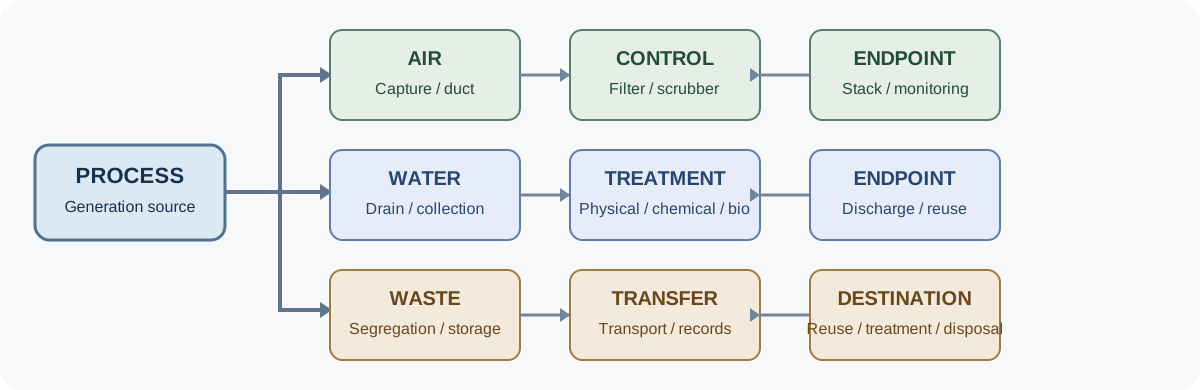
For each process or activity, document:
- Source: the operation, equipment or storage activity generating the stream.
- Stream: the emission, wastewater, waste, noise or spill risk.
- Collection: hood, duct, drain, sump, container or transfer system.
- Control: treatment or pollution-prevention equipment.
- Endpoint: stack, permitted discharge, reuse system, licensed receiver or other destination.
- Verification: monitoring data, operating parameters, maintenance records and physical observations.
If a drain, pipe or duct cannot be traced, record it as an unresolved pathway rather than assuming its destination.
## 5. Inspecting air-emission control systems
The presence of a pollution-control device does not by itself demonstrate effective control. Inspect the complete system, including capture, conveyance, treatment and discharge.
| Equipment | Main function | Inspection points |
|---|---|---|
| Local exhaust hood and duct | Capture and convey contaminants | Hood position, visible leakage, duct damage and fan condition |
| Cyclone separator | Remove larger particles by centrifugal action | Dust discharge, hopper condition, air leakage and abnormal vibration |
| Bag filter | Capture particulate matter on filter fabric | Differential pressure, cleaning cycle, bag damage indicators and dust handling |
| Electrostatic precipitator (ESP) | Electrically charge and collect particles | Power supply status, rapper operation, hopper discharge and alarms |
| Wet scrubber | Transfer pollutants into a liquid phase | Liquid flow, pressure drop, pH where relevant, nozzle condition and wastewater handling |
| Activated-carbon unit | Adsorb selected gaseous compounds | Bed condition, breakthrough monitoring where applicable, replacement records and spent-carbon handling |
Record instrument readings with the instrument identity, unit, time and operating condition. A visual observation is not a substitute for a valid stack-emission measurement.
## 6. Inspecting wastewater collection and treatment
Trace wastewater from each generation point to the final discharge or reuse point. Check whether stormwater and process wastewater are separated where required by the facility design and applicable permit.
Common treatment stages include:
- Screening and grit removal: removal of coarse solids and grit.
- Equalization: reduction of flow and concentration fluctuations.
- pH adjustment and chemical treatment: conditioning, coagulation or precipitation where applicable.
- Primary clarification: separation of settleable solids.
- Biological treatment: degradation of biodegradable organic matter.
- Secondary clarification: separation of biological solids.
- Tertiary treatment or disinfection: additional polishing when required.
- Sludge handling: thickening, dewatering, storage and transfer.
Parameters may include pH, temperature, electrical conductivity, TSS, turbidity, BOD, COD, oil and grease, nutrients or metals, depending on the process and permit. Do not assume that every parameter is required at every facility.
During the walkthrough, check for bypass lines, overflows, leaks, inactive units, poor sludge handling, chemical-storage risks and inconsistencies between the physical system and the process diagram.
## 7. Solid and hazardous waste inspection
Evaluate waste management from generation to final destination:
- Identify waste streams and the process that generates each one.
- Check segregation and compatibility; prevent mixing of incompatible materials.
- Examine container integrity, labeling, covers, secondary containment and access control.
- Review accumulation dates, quantities and internal movement records where maintained.
- Verify transporter and receiving-facility documentation against the applicable local requirements.
- Inspect wastewater-treatment sludge and other process residues as distinct waste streams.
A waste label or manifest should be checked against the actual material and the facility’s records; paperwork alone does not establish correct handling.
## 8. Field notes, evidence and sampling
Use a consistent record for every observation:
| Field | What to enter |
|---|---|
| Observation ID | Unique reference, e.g. AIR-01 or WW-02 |
| Date and time | When the condition was observed |
| Location | Building, line, equipment ID or mapped point |
| Operating condition | Running, stopped, start-up, maintenance or unknown |
| Direct observation | Factual description without assumptions |
| Supporting evidence | Photo reference, record title, reading or interview note |
| Requirement to verify | Permit clause, standard or procedure requiring review |
| Follow-up | Document request, measurement, sample or corrective-action check |
Distinguish clearly between: - Direct observation: something personally seen or measured during the visit. - Documented information: a value or statement contained in a reviewed record. - Interview statement: information reported by an employee or representative. - Assessment: an interpretation that must be supported by evidence and the applicable requirement.
For photographs, record the location, direction, date and a short caption. Preserve original files and avoid editing evidence in a way that changes its meaning. For samples, use unique sample IDs and maintain chain of custody.
## 9. Practical field checklist
Use this as a working prompt, not as a substitute for an official regulator’s checklist or the facility’s permit conditions.
### Facility and process - [ ] Facility identity, activity and operating status recorded. - [ ] Main production stages and material inputs understood. - [ ] Site layout and inspection route reviewed. - [ ] Relevant permits and previous reports requested.
### Air emissions - [ ] Emission sources and stacks identified. - [ ] Capture hoods, ducts and fans visually checked. - [ ] Control equipment operating status recorded. - [ ] Maintenance and monitoring records requested. - [ ] Abnormal emissions, bypasses or leaks documented.
### Wastewater - [ ] Wastewater generation points and drainage routes traced. - [ ] Treatment stages and operating status checked. - [ ] Final discharge or reuse point identified. - [ ] Sampling points and recent analytical results reviewed. - [ ] Bypasses, overflows and sludge handling checked.
### Waste and chemical storage - [ ] Waste streams identified and segregation checked. - [ ] Containers, labels and containment inspected. - [ ] Storage conditions and accumulation reviewed. - [ ] Transfer and receiving records requested. - [ ] Chemical compatibility and spill controls checked.
### Evidence and close-out - [ ] Each observation has a location and time. - [ ] Photographs and records have unique references. - [ ] Direct observations are separated from interview statements. - [ ] Missing information and required follow-up are listed. - [ ] Findings are checked against the applicable permit and jurisdiction.
## 10. Writing an inspection finding
A strong finding is specific, traceable and evidence-based. Avoid conclusions such as “the facility is polluting” unless the evidence and applicable requirement support that conclusion.
Illustrative example — not a real facility finding
| Element | Example |
|---|---|
| Observation | A chemical container was observed inside the raw-material store with visible liquid residue on the floor nearby. |
| Location and time | Raw-material store, north side, 10:35 on the inspection date. |
| Evidence | Photograph CHEM-01 and site observation note. |
| Information to verify | Chemical identity, spill history, drainage connection and relevant storage requirements. |
| Follow-up | Review the chemical inventory and spill procedure; inspect the nearby drain; verify the applicable permit or legal requirement. |
The example is an observation requiring verification. It should not automatically be classified as a confirmed legal violation.
## 11. Inspection report structure
- Executive summary and inspection purpose.
- Facility profile, process description and operating status.
- Scope, date, team and inspection route.
- Environmental aspects and control systems examined.
- Observations supported by photographs and document references.
- Samples and measurements, including methods and quality-control information.
- Assessment against the applicable permit and legal requirements.
- Corrective actions, responsible parties and target dates where established.
- Follow-up requirements and appendices.
## 12. Safety and professional limitations
- Follow the facility’s access rules, risk assessment and permit-to-work requirements.
- Use task-appropriate PPE and do not enter confined spaces, restricted process areas or elevated structures without authorization and required controls.
- Do not touch, open or sample unknown chemicals or waste.
- Treat gas readings, instrument measurements and laboratory results according to the method, calibration and quality-control requirements.
- Verify regulatory limits against the current permit and applicable jurisdiction; limits must not be generalized across countries or industrial sectors.