Air Emissions and Pollution-Control Inspection
Air Emissions & Pollution Control
A structured inspection of emission sources, capture and conveyance systems, pollution-control equipment, stacks and monitoring records. Measurement requirements depend on the pollutant, process, permit and applicable test method.
## 1. Build an emission-source inventory
Start with the process, not the stack list. Walk through production and utility areas and identify both point and fugitive sources.
| Source category | Examples | Inspection focus |
|---|---|---|
| Combustion | Boilers, furnaces, kilns and generators | Fuel, operating load, burner condition and stack |
| Process exhaust | Reactors, dryers, ovens and process vents | Process chemistry, temperature and exhaust routing |
| Material handling | Crushing, screening, conveying and loading | Dust generation, enclosure and local exhaust |
| Storage and transfer | Tanks, silos, chemical transfer and loading | Vapors, seals, vents and spill/evaporation controls |
| Solvent use | Coating, cleaning and printing | Solvent identity, ventilation and vapor control |
| Diffuse sources | Open yards, roads and exposed stockpiles | Dust suppression, housekeeping and boundary observations |
Record each source ID, process, operating schedule, likely pollutant, capture arrangement, control device and final release point. Do not assume a pollutant is present solely because a process type is listed; verify the materials and process conditions.
## 2. Trace the complete exhaust pathway
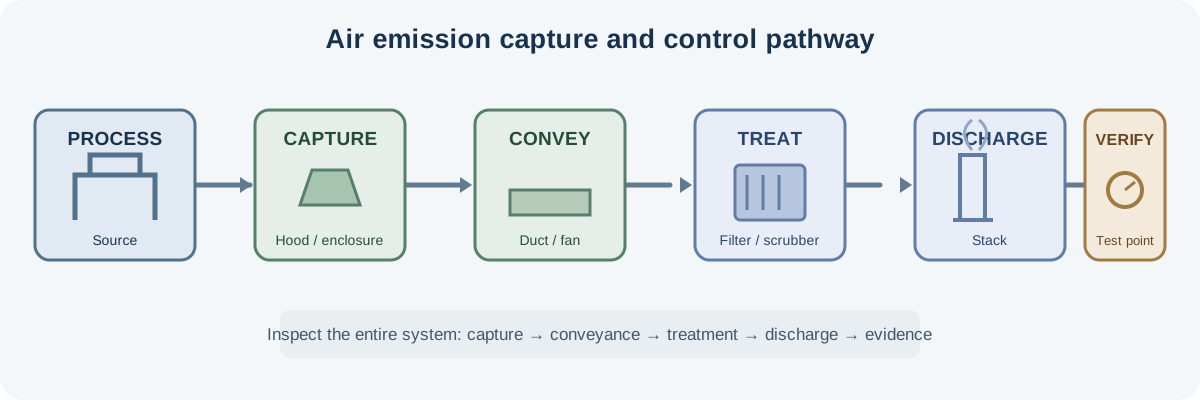
An effective system includes more than a filter or scrubber. Follow the gas stream through:
- Generation: process equipment or combustion source.
- Capture: hood, enclosure or local exhaust arrangement.
- Conveyance: ductwork, dampers and fan.
- Treatment: particulate or gas-control equipment.
- Discharge: stack or permitted outlet.
- Verification: operating indicators, monitoring ports, test reports and maintenance records.
Check for disconnected ducts, open access doors, damaged flexible connections, leaks, bypasses and evidence that the control device is not operating while the process is running.
## 3. Inspect common air-pollution controls
| Equipment | Main function | Field inspection points |
|---|---|---|
| Cyclone separator | Removes larger particles by centrifugal action | Inlet/outlet duct, dust hopper, discharge valve, air leakage and vibration |
| Bag filter | Captures particulate matter on filter fabric | Differential pressure, cleaning cycle, bag-leak indicators, hopper and dust removal |
| Electrostatic precipitator (ESP) | Electrically charges and collects particles | Power supply, operating indicators, rapper system, hopper discharge and alarms |
| Wet scrubber | Transfers selected pollutants from gas to liquid | Liquid circulation, pressure drop, nozzle condition, pH where relevant and blowdown handling |
| Activated-carbon adsorber | Adsorbs selected gaseous compounds | Bed condition, breakthrough monitoring, replacement interval and spent-carbon management |
| Thermal oxidizer | Destroys selected combustible gaseous pollutants | Temperature, residence-time design, operating interlocks and fuel/energy records |
Record actual indicators and units where available. A differential-pressure reading, scrubber pH or operating temperature should be interpreted against the equipment design and operating procedure, not against a generic universal range.
## 4. Stack, duct and sampling-port inspection
Check: - Stack identity and correspondence with the source inventory. - Structural condition, corrosion, visible leakage and access safety. - Sampling ports, platform and access provisions where required. - Whether sampling locations meet the relevant method’s requirements for flow disturbance and measurement traverse. - Whether the process and control device were operating under representative conditions during the reported test. - Whether bypasses, dampers or alternate exhaust routes could affect the measurement.
Do not improvise stack access. Work at height, hot surfaces, confined spaces and process gases require formal risk assessment and approved access controls.
## 5. Stack testing and measurement concepts
Stack testing is method-specific. Depending on the pollutant and source, a test program may include:
- Particulate sampling, with isokinetic sampling where required by the method.
- Gas concentration measurement using an appropriate analyzer or laboratory method.
- Gas velocity and volumetric flow measurement.
- Temperature, pressure and moisture determination.
- Oxygen or carbon-dioxide measurement where needed for the applicable correction or reporting basis.
A report should identify the test method, sampling location, test duration, process operating condition, calibration or quality-control information, units and reference conditions. Concentrations on a dry or wet basis, actual or normalized conditions, and oxygen-corrected values are not interchangeable.
Important: visible plume observations do not quantify concentration. A portable screening instrument is not automatically equivalent to a reference-method compliance test.
## 6. Continuous monitoring and operating records
Where continuous emission monitoring systems (CEMS) are installed or required, review the system’s scope and quality documentation. Relevant records may include:
- Analyzer identity, measured parameters and measurement range.
- Calibration, zero/span checks and maintenance.
- Data availability, invalid-data flags and downtime.
- Alarm history and corrective actions.
- Data validation and reporting procedures.
- Relationship between monitoring data and process operating status.
For non-continuous monitoring, review the approved test schedule, previous stack-test reports, contractor/laboratory competence and whether reported results represent the relevant operating conditions.
## 7. Review operating and maintenance evidence
Compare the physical condition with records such as:
- Fuel type and consumption, raw-material use and production rate.
- Operating hours and process start-up/shutdown records.
- Fan, duct, filter, scrubber and analyzer maintenance.
- Filter-bag replacement and dust-hopper removal.
- Scrubber-liquid consumption, blowdown and wastewater destination.
- Activated-carbon replacement and spent-media transfer.
- Stack-test reports, monitoring summaries and abnormal-operation logs.
Check consistency: for example, a maintenance log showing a control unit offline should be considered alongside production records for the same period.
## 8. Practical field checklist
### Source and process - [ ] Point and fugitive sources identified. - [ ] Source IDs linked to process equipment and operating schedule. - [ ] Fuel, raw materials and relevant process inputs reviewed. - [ ] Likely pollutants identified from verified process information.
### Capture and control - [ ] Hood/enclosure and duct route traced. - [ ] Fans, dampers and visible duct condition checked. - [ ] Control-device identity and operating status recorded. - [ ] Available pressure, temperature, flow or pH indicators documented with units. - [ ] Bypasses, leaks, alarms and abnormal conditions checked. - [ ] Dust, scrubber blowdown and spent adsorbent handling reviewed.
### Stack and monitoring - [ ] Stack identity and release point recorded. - [ ] Sampling ports and safe access reviewed where applicable. - [ ] Test reports include methods, operating conditions and reference basis. - [ ] CEMS calibration, downtime and data-validation records reviewed where installed. - [ ] Monitoring results compared with the correct permit requirement and units.
### Evidence and close-out - [ ] Photographs have location, date and source ID. - [ ] Direct observations separated from measured results. - [ ] Missing records and follow-up measurements listed. - [ ] Any suspected non-compliance is checked against the applicable legal/permit requirement.
## 9. Example of a documented observation
Illustrative example — not a real facility finding
During operation of a production line, dust was observed escaping from a transfer point upstream of the bag-filter duct connection. The observation was recorded with the process status, source ID and photograph reference.
Follow-up should establish whether the hood design, capture velocity, duct integrity or operating practice explains the release. The observation alone does not quantify ambient concentration or establish a stack-emission exceedance.
## 10. Reporting structure
- Source inventory and process description.
- Exhaust and control-system flow diagram.
- Equipment condition and operating indicators.
- Stack and monitoring arrangements.
- Test reports, methods, units and reference conditions.
- Maintenance records and abnormal-operation events.
- Evidence-based observations and applicable permit assessment.
- Corrective actions and verification requirements.
## Safety and regulatory note
Follow site-specific PPE, chemical exposure, hot-work, electrical and work-at-height controls. Never enter ducts or stacks without a formal confined-space assessment and authorization. Emission limits, test methods and monitoring frequencies must be checked against the current permit and jurisdiction.